Service Level Agreement (SLA)
Service Level Agreement (SLA) defines the level of service that can be expected from the service provider to the customer. Zoho BugTracker supports SLA and it is user-defined. You can create escalation procedures in terms of which bugs are subject to escalation, the escalation criteria to be applied, and the action to execute upon a specific escalation level. SLAs are applied automatically to tickets that match the defined parameters or criteria. You can also send alerts to selected resources when there is a potential SLA violation.
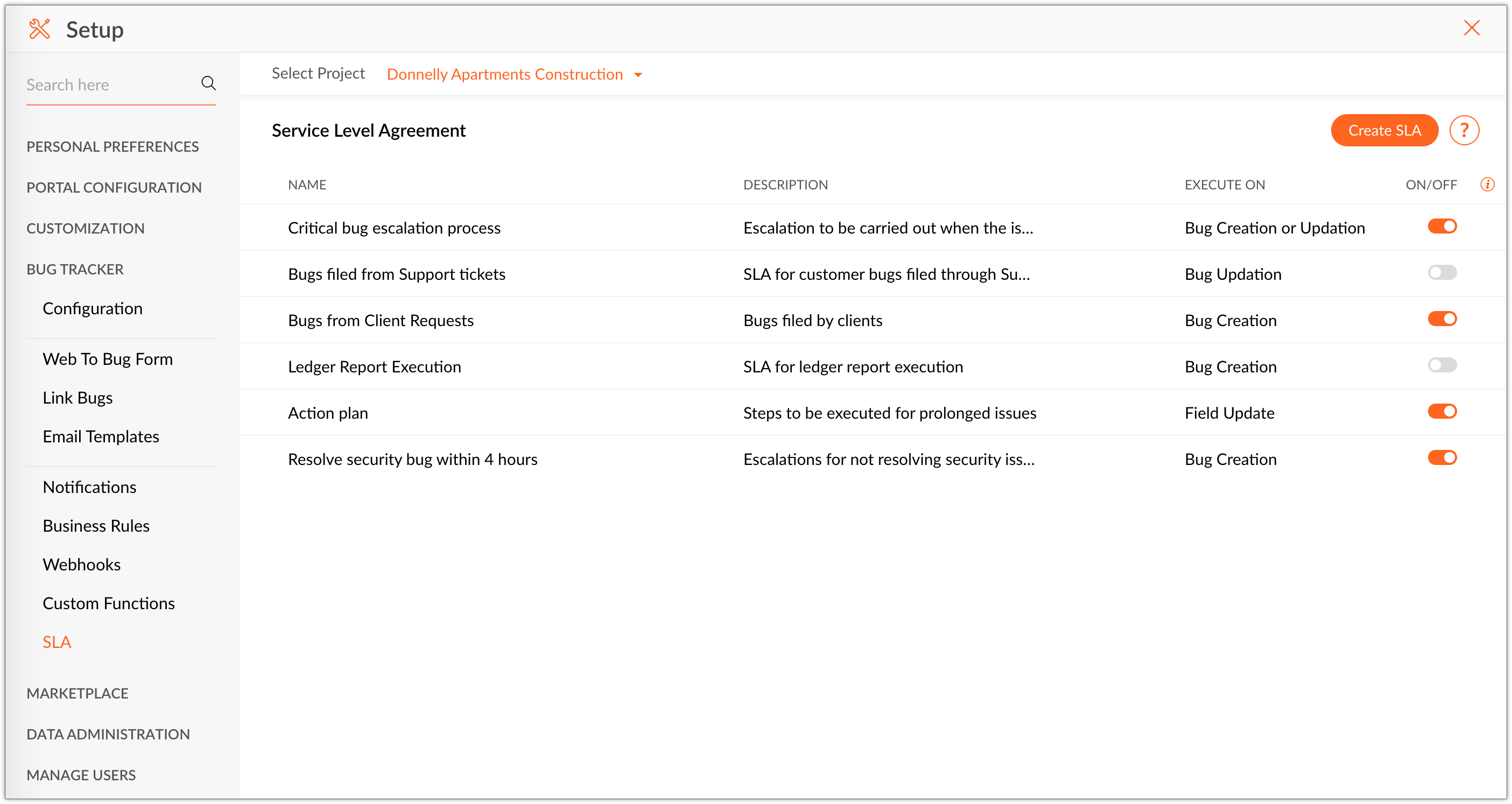
Create an SLA
You can create as many SLA rules as required.
- Navigate to
 > Bug Tracker > SLA and click Create SLA.
 - Enter a Name.
- Select the desired option for the rule to Execute On and then click Add targets for this SLA.
-
Select the criteria as to when the SLA must be executed for the bug.
You can choose your criterion from the various options that are displayed. You can set targets to view only bugs based on Modified Date, Last Closed Date, Phase, Severity, and so on. -
Select the due date or the target time for the SLA.
-
In Target Action, you can choose Close Before or Resolve Before and set their respective target field and target time based on the Calendar or Business hours.
-
If you choose Resolve Before, the custom date field is also displayed in the Target Field. This helps in escalating the bug if it is not resolved within the set target time.
-
If you choose Close Before, it helps in escalating the bug if it is not closed within the set target time.
-
Specify Escalate on as to when to escalate the bug. You can specify a maximum of four levels if the ticket exceeds the target time.
-
Specify Escalate to as to whom to escalate the bug. You can choose Assignee, Project Owner, or any of the project users from Users section, or any of the users from the User Pick-List section.
-
Select an existing Email Template from the drop-down or create a new Email template.
-
Configure the action to be taken for the escalation. You can specify a maximum of 10 actions.
-
Click Save.
The escalation levels are highlighted in color-codes next to each bug in the List view and bug details view.
SLA Notifications
Any update to a bug will be notified to all the concerned users.
- If there is a breach in SLA, the escalation will appear in Feeds.
- The updates can also be found in the Notifications tab.
Validations for escalation
An SLA is constructed to achieve the expected output or target within a defined time period. So, any SLA will have time and a target for the time, constructed with various criterion. An SLA assures that bugs will be closed within a defined time period.
- You can have more than one criteria for the same bug. However, a bug is tracked based on the first criteria that it matches in the existing SLA list.
- You can create your escalation workflow for bug transitions based on your business values, and set different escalation schedules for critical and non-critical bugs.
- Any combination of criteria is possible.
- You can configure notification emails to be escalated for any bugs after it's target time, to the required project member or the bug owner or the assignee.
Example:
If a bug is not closed within it's defined target time, the SLA that matches the bug will trigger the escalation actions.
Edit SLA
- Navigate to > Bug Tracker > SLA.
- Click
and select Edit to modify the SLA.
- Click Save.
Delete SLA
- Navigate to > Bug Tracker > SLA.
- Click
- Confirm your action.
Reorder SLAs
- Navigate to > Bug Tracker > SLA.
- Hover over the SLA you would like to reorder and click
.
- Drag and swap the SLAs. You can reorder them as many times as you want until you get the desired order.
- Click Save Order.
More about SLAs
- Decrease the customer waiting time for any bugs by defining appropriate SLAs.
- Construct well-defined SLAs for increased customer satisfaction. A good SLA must be based on a constant parameter that does nor vary during the bug's life cycle like the Title, Reporter, Module, Submitted Date, etc. Parameters like Status, Severity, Is it Reproducible, etc are subject to change.
- Automatically assign SLAs to tickets based on the various defined parameters.
- Manage SLA with multi-level escalations, if the ticket is not closed within the defined target time.
- Activate or Deactivate SLAs you have created.
- Send alert email to selected resources when there is a potential SLA violation.