Quota-Based Commissions
Quota-based commissions reward partners based on their progress toward a predefined target, or quota, within a specified period.
Unlike transaction-based commissions, which reward individual transactions, quota-based commissions evaluate a partner's cumulative performance over time. This approach encourages partners to focus on long-term growth and sustained revenue generation.
How quota-based commissions work
A quota represents the target value a partner is expected to achieve during a commission period.
As qualifying transactions accumulate, the partner's progress toward the quota is tracked. Once the commission period ends, commissions are calculated based on the partner's quota attainment and the commission structure configured in the plan.
Quota attainment
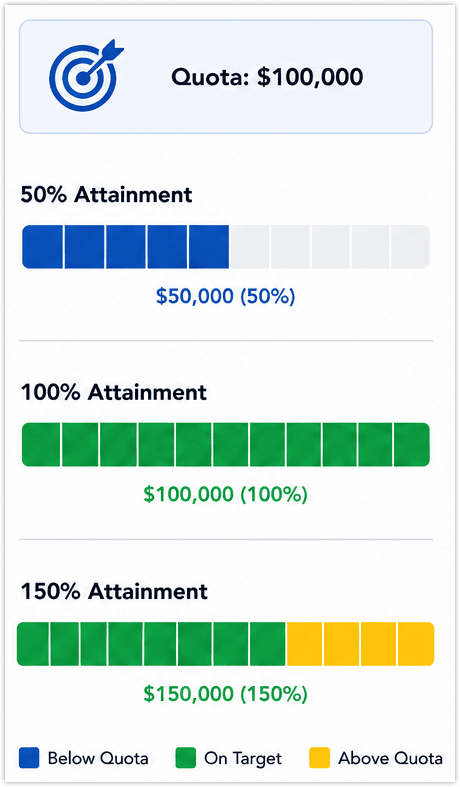
Quota attainment measures how much of the target a partner has achieved.
Quota attainment measures how much of the target a partner has achieved.
The attainment percentage is calculated using the following formula:
Quota Attainment (%) = (Achieved Value ÷ Quota Value) × 100
Here's an example:
Here's an example:
Quota | Achieved Value | Attainment |
$100,000 | $50,000 | 50% |
$100,000 | $100,000 | 100% |
$100,000 | $150,000 | 150% |
|
|
In this example, a partner who generates $150,000 against a quota of $100,000 achieves 150% attainment.
Why use quota-based commissions?
Quota-based commissions are useful when partner success is measured over a period rather than through individual transactions.
Organizations typically use quota-based commissions to:
- Encourage sustained partner performance
- Reward long-term revenue generation
- Align partner incentives with business growth objectives
- Motivate partners to exceed targets
Quota-based vs transaction-based commissions
Both commission types reward partner performance, but they differ in how earnings are calculated.
Transaction-Based | Quota-Based |
Evaluates individual transactions | Evaluates cumulative performance |
Commission is calculated per qualifying transaction | Commission is calculated based on quota attainment |
Suitable for short sales cycles | Suitable for long-term performance goals |
Focuses on individual outcomes | Focuses on overall contribution |
For example, partner closes ten transactions worth $10,000 each during a quarter.
Under a transaction-based commission plan, each transaction earns commission individually.
Under a quota-based commission plan, the total revenue generated during the quarter is evaluated against the partner's quota, and commission is calculated based on overall attainment.
Commission calculation models
Quota-based commissions can be configured using either line-item or total-amount calculations.
Line-item calculations
Line-item calculations evaluate individual products or services that contribute toward the quota. This method is useful when different products carry different commission values or when product-level performance needs to be tracked.
Let's say for example, a partner sells:
- Product A: $40,000
- Product B: $30,000
- Product C: $20,000
Each product contributes independently toward quota attainment.
Total-amount calculations
Total-amount calculations use the combined value of all qualifying transactions.
This method is useful when commission calculations are based on overall revenue rather than individual products.
Say, a partner generates three transactions:
- Transaction 1: $25,000
- Transaction 2: $35,000
- Transaction 3: $40,000
Total contribution toward quota: $100,000
The commission is calculated using the combined transaction value.
Choosing the right approach
Use quota-based commissions when:
- Partners are expected to achieve revenue targets over time
- Long-term performance is more important than individual transactions
- Partner success should be measured against predefined goals
- The program is designed to encourage continuous growth
Use transaction-based commissions when:
- Every qualifying transaction should be rewarded immediately
- Transaction values vary significantly
- Individual deals are more important than cumulative performance
Related concepts
Quota-based commissions work together with:
- Commission structures
- Line-item and total-amount calculations
- Commission approvals
- Discrepancy handling and clawbacks
These settings collectively determine how partner performance is evaluated and rewarded.