Structures in Partner Commissions
Commission structures define how partner earnings are calculated in a commission plan. They determine the rate, method, and logic used to compute commissions based on transactions or quota attainment.
Choosing the right structure helps align partner incentives with your business goals, whether you want predictable payouts or performance-driven rewards.
Types of commission structures
Partner Commissions support two primary structures:
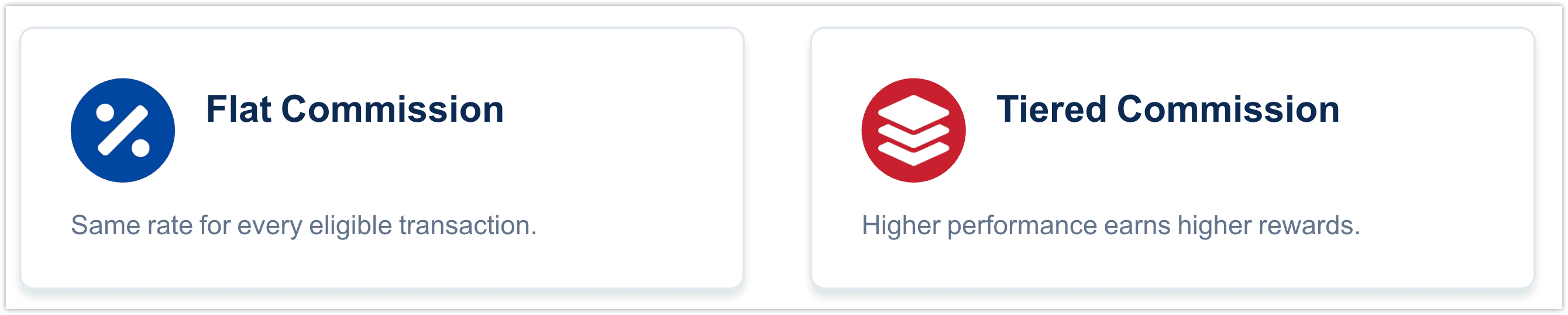
- Flat commission
- Tiered commission
Each structure offers a different way to calculate earnings.
Flat commission
A flat commission structure applies a fixed commission value to all eligible transactions or quota achievements.
Flat commissions are simple to configure and make earnings predictable for both administrators and partners.
How it works
A fixed commission percentage is applied whenever a transaction or quota qualifies for commission.
For example, if a partner earns a 10% commission and generates a transaction worth $10,000:
- Transaction value: $10,000
- Commission rate: 10%
- Commission earned: $1,000
The same percentage is applied consistently to all qualifying transactions.
When to use flat commissions
Flat commissions are ideal when:
- All qualifying transactions should be rewarded equally
- Commission calculations need to remain simple and predictable
- Partner performance is measured consistently across transactions
Benefits of choosing Flat:
- Easy to understand and manage
- Predictable commission calculations
- Suitable for straightforward partner programs
Tiered commission
A tiered commission structure rewards higher performance with higher commission values.
Instead of using a single commission rate, earnings are calculated using multiple tiers. As transaction values or quota attainment increase, higher commission rates or amounts can be applied.
This approach encourages partners to generate more revenue and exceed performance targets.
Here's an example:
Tier | Transaction Value | Commission Rate |
Tier 1 | Up to $10,000 | 5% |
Tier 2 | $10,001 - $25,000 | 8% |
Tier 3 | Above $25,000 | 12% |
A partner generating higher-value transactions can earn more commission than a partner operating within lower tiers.
Calculation methods for tiered commission
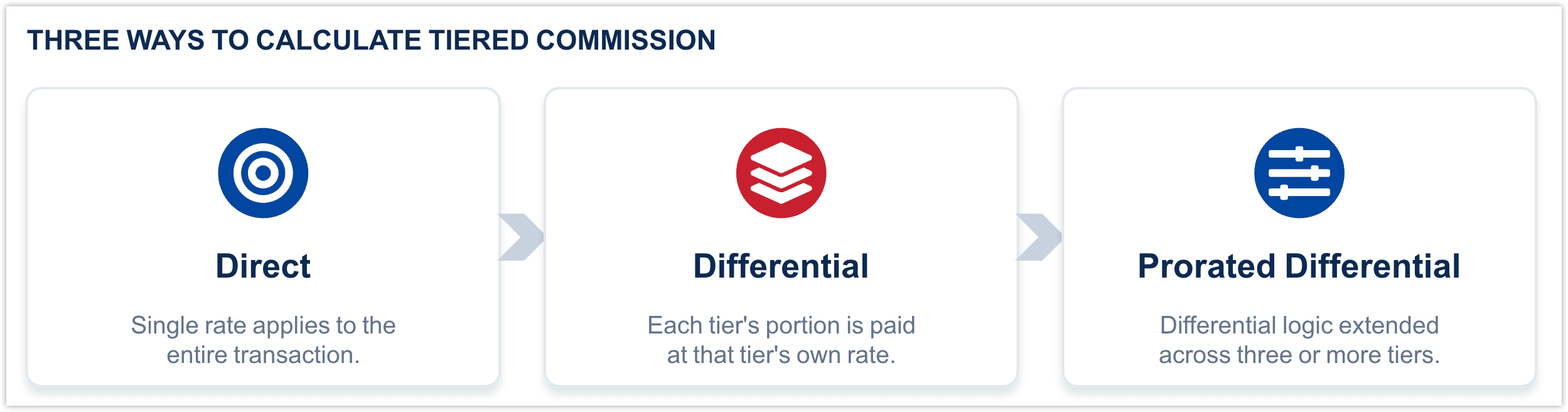
Tiered structures support different calculation methods that determine how earnings are applied across tiers.
1. Direct (Flat)
The entire transaction is evaluated against a single tier. Once the transaction falls into a tier, that tier's commission rate is applied to the full transaction value.
For example, using the tier structure above:
Transaction value: $20,000
Applicable tier: Tier 2
Commission rate: 8%
Commission earned = $20,000 × 8% = $1,600
This method is simple and easy to understand because only one tier is used for calculation.
2. Differential
The transaction value is split across tiers.
Each portion of the transaction is calculated separately using the commission rate assigned to that tier. The earnings from all tiers are then added together.
Each portion of the transaction is calculated separately using the commission rate assigned to that tier. The earnings from all tiers are then added together.
Let's take a look at an example:
Transaction value: $20,000
First $10,000 at 5% = $500
Remaining $10,000 at 8% = $800
Total commission = $1,300
Differential method rewards incremental growth because higher portions of the transaction earn higher commission rates. This results in a more competitive payout compared to direct calculation.
3. Prorated differential
Differential prorate follows the same principle as differential calculation but applies commissions only to the portion consumed within each tier.
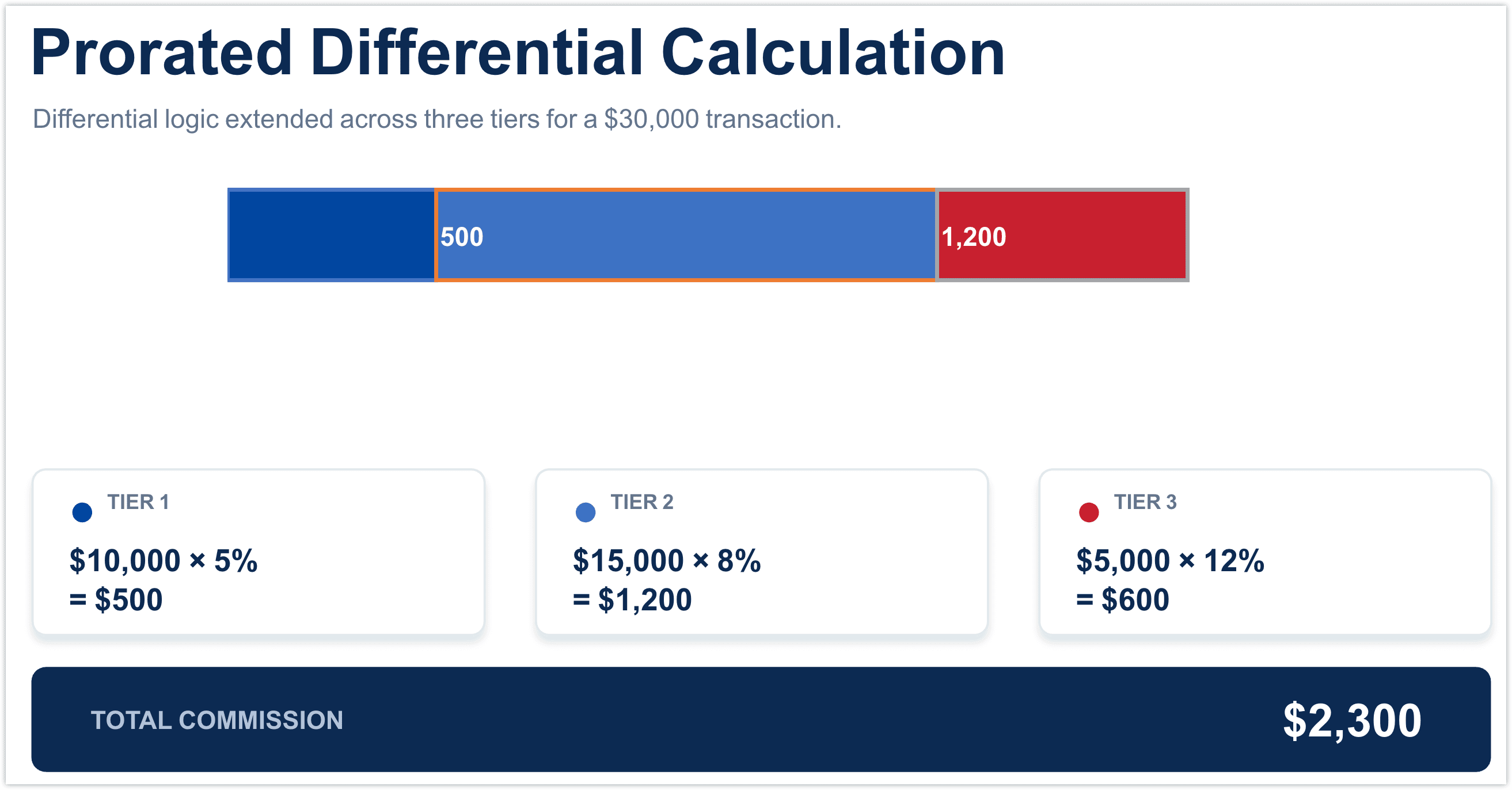
This method provides the most granular calculation and helps organizations maintain precise control over commission payouts.
This method ensures:
- More accurate payouts
- Better cost control for the business
When to use tiered commissions
Tiered commissions are useful when:
- Higher-performing partners should earn higher rewards
- Revenue growth is a key objective
- Partner programs are designed to encourage incremental performance improvements
- Different levels of contribution should be rewarded differently
Choosing the right structure
The choice of structure depends on your incentive strategy:
Use Flat Commission When | Use Tiered Commission When |
Simplicity is important | Performance should be rewarded progressively |
All transactions earn the same rate | Higher contributions should earn higher rewards |
Predictable payouts are preferred | Revenue growth is a primary goal |
Partner performance is relatively consistent | Partner performance varies significantly |
- Use flat commission for simplicity and predictability
- Use tiered commission to reward higher performance
- Use differential or prorated methods when you want more granular and competitive payouts
Related concepts
Commission structures work together with:
- Commission triggers and record selection
- Transaction-based commissions
- Quota-based commissions
- Discrepancy handling and clawbacks
- Commission approvals
Together, these settings determine how, when, and for whom commissions are calculated.