Dataset Finder powered by ChatGPT API
Zoho DataPrep helps you enrich your data by enabling you to find new datasets based on your requirement using ChatGPT API integration, a generative artificial intelligence developed by OpenAI. You can use these datasets for data enrichment purposes. To enable this feature in your DataPrep organization, click Find new dataset with ChatGPT during import, OpenAI configuration tab will open when you try to enable it for the first time or go to the OpenAI Integration tab in the Settings page. Click here to know more about enabling OpenAI integrated features in the settings page. With this connector, you can streamline your ETL workflows, enable smooth data movement, and simplify data integration.

Note: If Ask Zia is not integrated with ChatGPT, Zoho DataPrep utilizes its Inbuilt AI to create a dataset.
Here's a quick video on ChatGPT API integration with Zoho DataPrep.
Here's a quick demo on the features powered by OpenAI in Zoho DataPrep.
 Data Privacy Notice : Zoho DataPrep utilizes OpenAI's ChatGPT API, an external service based in the USA, subject to OpenAI's Terms of Use . Please be aware that the information sent to OpenAI depends on the access provided by you, the user. The data shared with ChatGPT is based on the features you enable. Details such as column names and/or selected cell data will be shared based on each feature. You can choose to enable or disable each feature based on the level of data you want to share. Therefore, exercise caution while using this service and ensure that the data you provide does not contain confidential or personal information.
 Go to OpenAI Integration in the Settings page to learn more about configuring this integration.

Notes :
- The generative response are coming in from ChatGPT's training data. Accuracy, consistency, and relevance of the response are subjective to the type of prompts and the data available in its training set.
- ChatGPT doesn't respond to prompts about personal information.
To configure and enable OpenAI's ChatGPT integration
1. During import, choose the Zoho Apps category > Find new dataset with ChatGPT and click Configure in the OpenAI configuration pop-up. This pop-up appears only when you configure it for the first time.
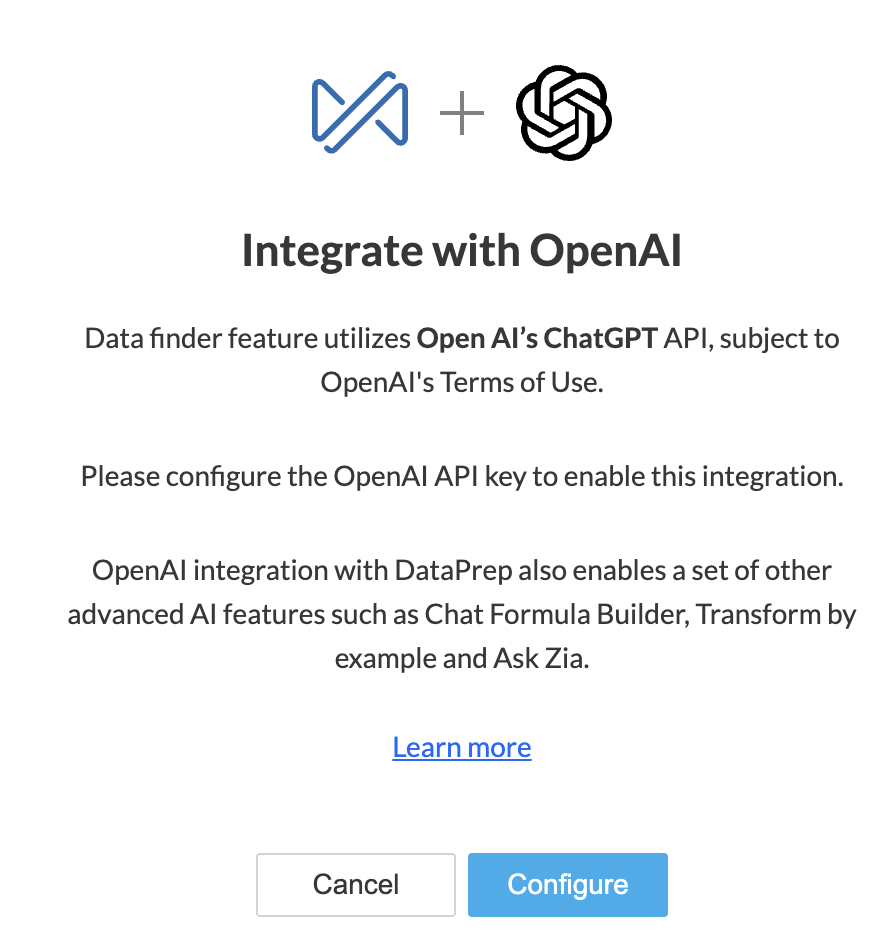
You can also go to the OpenAI Integration tab in the Settings page by clicking the settings icon at the top-right corner in the top bar. Click here to know more.

Note: The OpenAI configuration in DataPrep will be visible to only the Account admin.
The features can enabled for your DataPrep organization only by the Account admin.
2. Provide the API Key and Organization ID of your OpenAI organization to configure OpenAI integration in your DataPrep organization.
Note : The key will be encrypted and securely stored in Zoho DataPrep. Learn how to get the Organization ID and the API key from OpenAI3. Click the Save button. Consent popup will be shown. Please read the data privacy notice carefully before you proceed. By proceeding, you acknowledge and accept the risks, and OpenAI's terms of use policy.
4. Once saved, you can choose to enable the Dataset Finder feature.
5. After enabling the feature, you will be able to use them in your DataPrep organization.
Notes:
1. The ChatGPT powered features, when enabled can be used by the Account admin and the Organization admins in your DataPrep organization.
2. The API key entered is specific to the particular organization that it is configured in. If you are a part of multiple Zoho DataPrep organizations, the API key still won't be shared across organizations.
3. The API key entered is specific to Zoho DataPrep, and will not be shared with any other Zoho service.
Organization ID and API key in OpenAI
1. Go to your settings page in Open AI to get the Organization name and ID. Here's a snapshot for reference. Read more from OpenAI
2. Go to the API keys tab under the Organization section to get your API Key. Here's a snapshot for reference. Read more from OpenAI
Data Enrichment powered by OpenAI ChatGPT API
1. Create a pipeline or open an existing pipeline from the Home Page, Pipelines tab or Workspaces tab and click the Add data option. You can also click the Import data option under the Workspaces tab to import data.

Info: You can also click the Import data  icon at the top of the pipeline builder and bring data from multiple sources into the pipeline.
2. Choose the Zoho Apps category from the left pane and click Find new dataset with ChatGPT. You can also directly search the option in the search box.
3. Provide a hint about the type of data you are looking for in the Instruction prompt. For example, create a dataset for salesforce CRM instagram "Liked" list. You can also insert one of the prompts from the Insert hints section.
4. Click Fetch data and you will see a preview of the data generated by ChatGPT.
5. Click the Import button to import data.
6. Once you complete importing data, the Pipeline builder page opens and you can start applying transforms to the ETL pipeline. You can also right-click the stage and choose the Prepare data option to prepare your data using various transforms in the DataPrep Studio page. Click here to know more about the transforms.
7. Once you are done creating your data flow and applying necessary transforms in your stages, you can right-click a stage and add a destination to complete your data flow.
While configuring the Schedule, Backfill, Manual reload, Webhooks, or Zoho Flow, the import configuration needs to be mandatorily setup for all the sources. Without setting up the import configuration, the run cannot be saved. Click here to know more about how to set up import configuration.
8. After configuring a run, a pipeline job will be created at the run time. You can view the status of a job with the granular details in the Job summary. Click here to know more about the job summary.
Here are some sample prompts for you to try out
a. Create a dataset of sales tax rates by state in the US.
b. Create a dataset for places with the highest average temperature in the US.
c. Create a dataset of average electricity prices by state.
SEE ALSO