Pipeline
Pipelines are fundamental entities that allow users to create data flows in DataPrep, with multiple data stages and various flow-level transforms.
To view the list of pipelines, you can click the Pipeline tab from the top bar.
The Pipelines tab shows the list of all the pipelines across all the workspaces in your organization, along with their schedule information, last run time, next run time, and last modified time.

Create new: You can create pipelines from scratch, from the templates library, or a .zdpt file using this option. After creating a pipeline, you can proceed to import data from various sources into DataPrep. Learn more.
Duplicate pipeline: Click on the Duplicate icon  to create a copy of the pipeline.

Note: Connection sharing is not supported for Zoho applications such as Zoho Analytics, Zoho CRM, Zoho Bigin, and Zoho WorkDrive.
Because of this, only the account admin can duplicate pipelines that use these connections.
Share: You can share pipelines with other users in your organization using the share icon  . Learn more.
Rename: You can rename your pipeline using the rename option  in the pipeline overview, or you can simply click the pipeline name in the Pipeline Builder to rename it.
Delete: Use this delete icon  to move your pipeline to the trash.
Pipeline Overview: Click on the info icon  near the pipeline name to navigate to the pipeline overview. You can view the pipeline overview for details such as the pipeline name, created and last modified date and time, last modified user, number of stages in the pipeline, data sources, destinations, shared users, schedule details, along with the last run job time and the next job run time. Learn more about Jobs here. You can also rename, delete, and share your pipeline with support
  from the pipeline overview.
Filter
You can quickly sort and search for your pipelines using the respective icons located at the top of the table header. Use the checkboxes to the left of the pipeline names to multi-select and share or delete multiple pipelines at once. Click here to know more about how to share a pipeline.
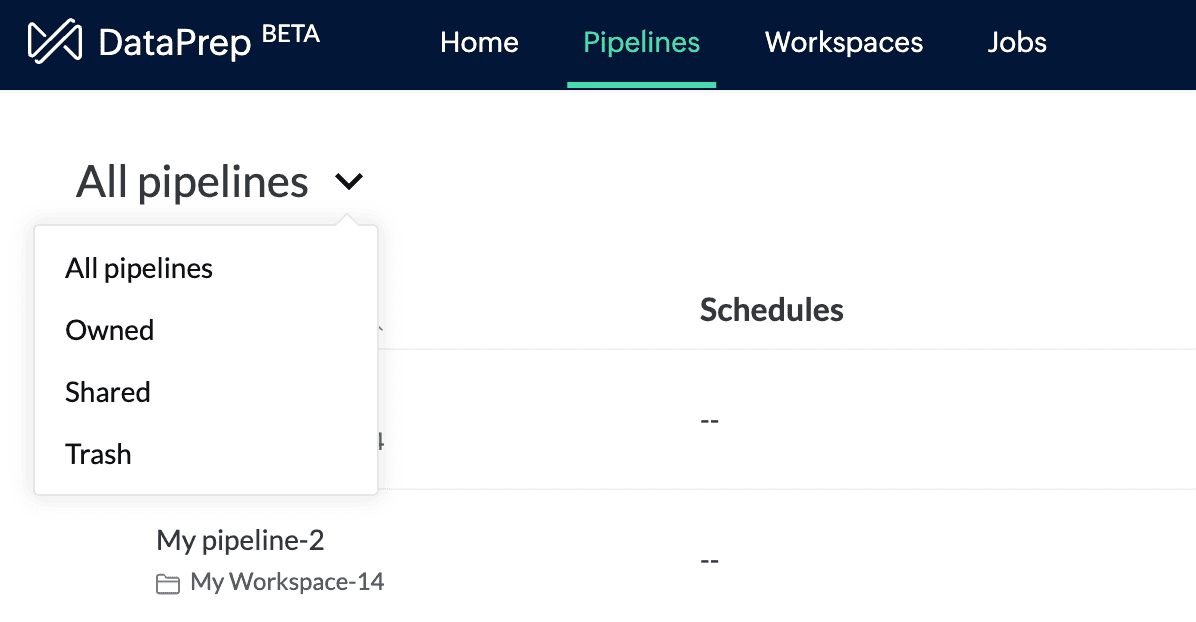
You can use the filter dropdown to list all the pipelines, pipelines owned by you, shared with you, and pipelines in the trash.
You can quickly sort and search for your pipelines using the respective icons located at the top of the table header. Use the checkboxes to the left of the pipeline names to multi-select and share or delete multiple pipelines at once. Click here to know more about how to share a pipeline.
You can use the filter dropdown to list all the pipelines, pipelines owned by you, shared with you, and pipelines in the trash.
You can filter and search the pipelines using attributes such as schedule status, pipeline status, workspace name, associated workspace, last modified, and last run time. Click here to understand pipeline status.
SEE ALSO