Creating Reports
Overview
With reports, you can sort and consolidate form data by applying filters on the received entries. This way, you can analyze the data collected better and get your team involved in managing them. You can share the reports publicly, or with specific users, and print and export the reports. You can also embed the report into any webpage.
You can access the Reports section of your form as given below:
- On the homepage (Forms listing page), click the Reports link below your form's name.
- A list of all the reports created for the selected form will be displayed if any. To create a new report, clickNew Report.
- Now, a Create Report popup will open where you can provide the details and configure the report.Alternatively, reports can also be created from the homepage (Forms listing page) > REPORTS section > My Reports tab. A list of all the created reports of all forms will appear here. To create a new report, click the New Report button in the top-right corner of the page.
Configuring a Report
Configure your report with these three steps: Basic Details, Report View, and Column Configuration.
1. Basic Details
This is the first stage of the configuration.
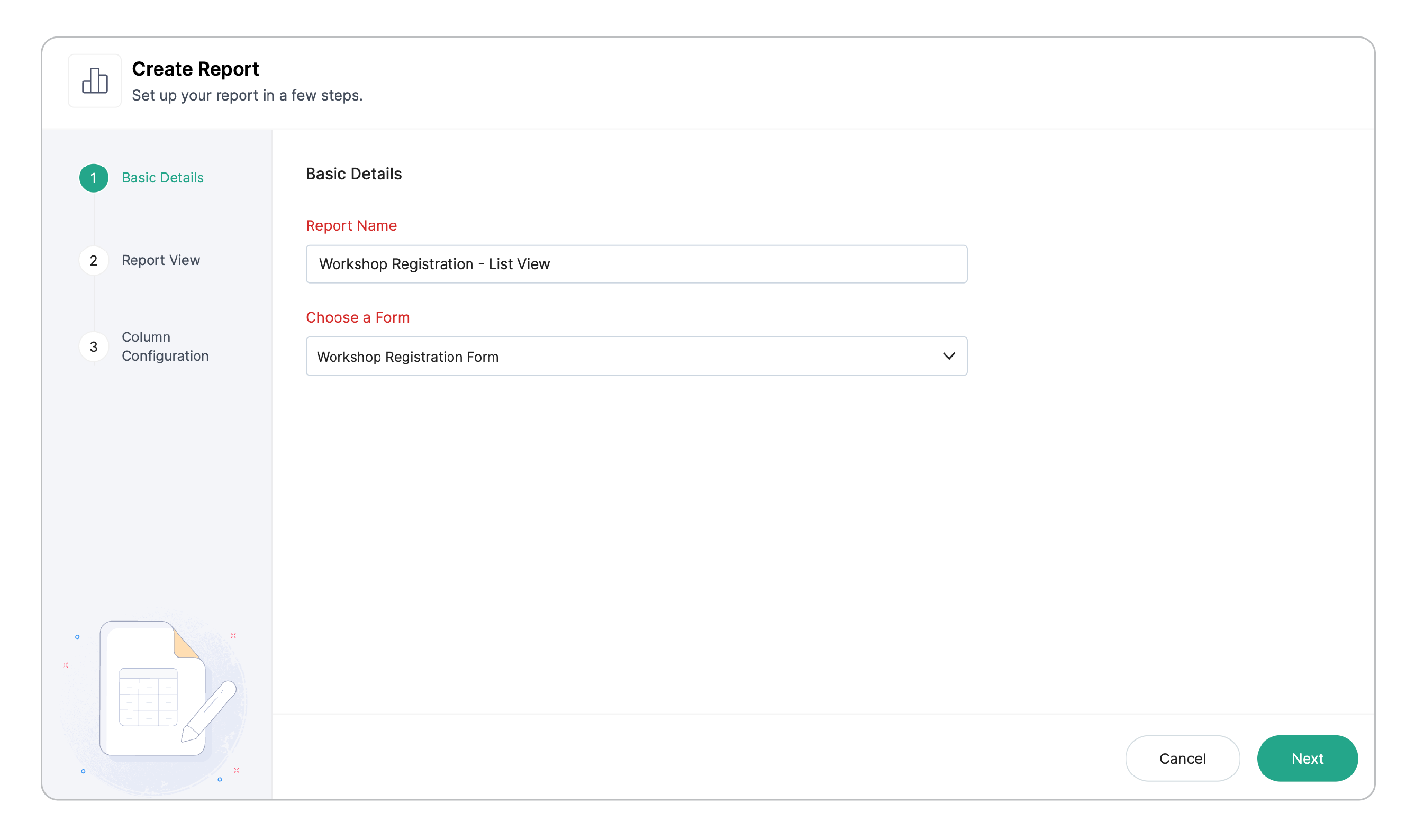
1. Enter a Report Name.
2. From the dropdown, choose a form whose entries you want to include in this report.
3. Click Next.
2. Report View Details
This is the second stage of the configuration. Zoho Forms provides two different ways to present your data: List View and Kanban View. Select your preferred view and click Next.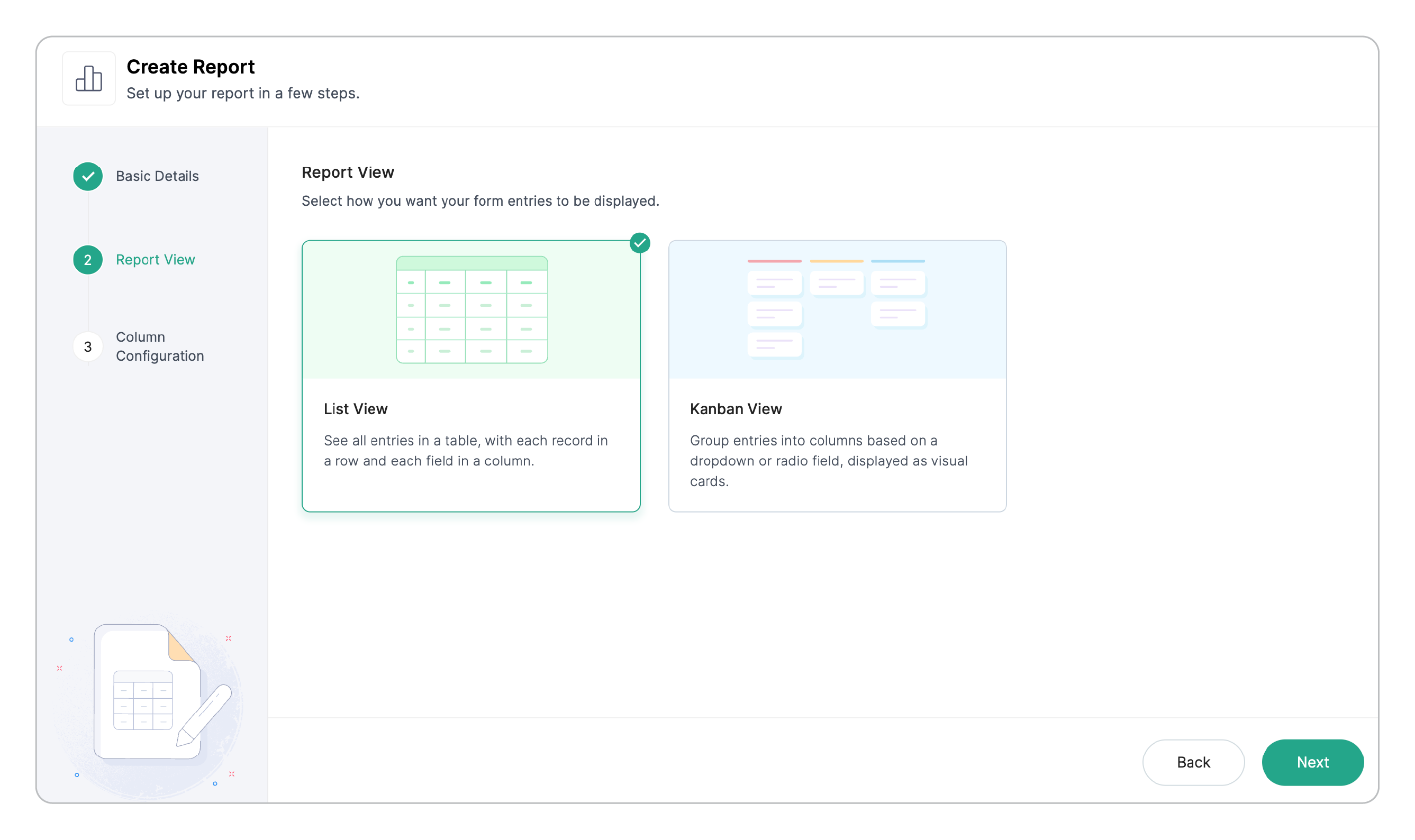
List View
View all your entries in a table, with each record in a row and each field in a column.
In this view, all entries are consolidated and presented in tabular format similar to spreadsheet. Using list view, you get a comprehensive view of your entire data set on a single screen. The field names are displayed as column headers, allowing you to see all your information at a single glance.
Kanban View
Group entries into columns based on a dropdown or radio field, displayed as visual cards.
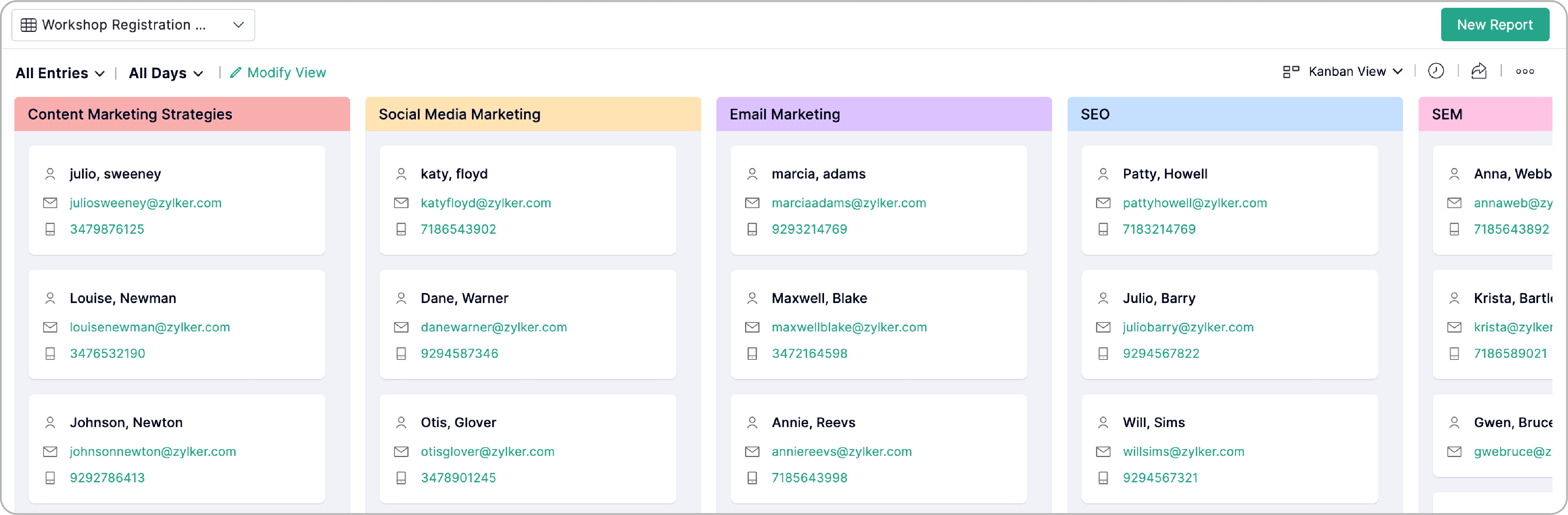
Kanban view reports offer a visually engaging way to represent your data. It uses selection fields like Dropdown or Radio fields to categorize entries. The selections made in your dropdown or radio buttons become the column headers. This creates a clear visual distinction between different categories within your data set. Each record in your report is transformed into a visual card. This card can display relevant information about the entry, making it easy to scan and understand. Entries are automatically grouped under the relevant column based on the selection made for that specific record. This allows you to see how many entries fall into each category at a glance.
Let's assume you're hosting a series of webinars on various digital marketing topics. You want to understand which webinars are attracting the most interest from registrants. Using Kanban View report, you can instantly categorise entries based on their selected webinar topic. This allows you to gauge audience interest and identify the most popular topics.
3. Column Configuration
For both the report views , the steps are same till this step or the 2nd step. Here in this 3rd and final step, it differs for both the views. Details below.
for List View Reports
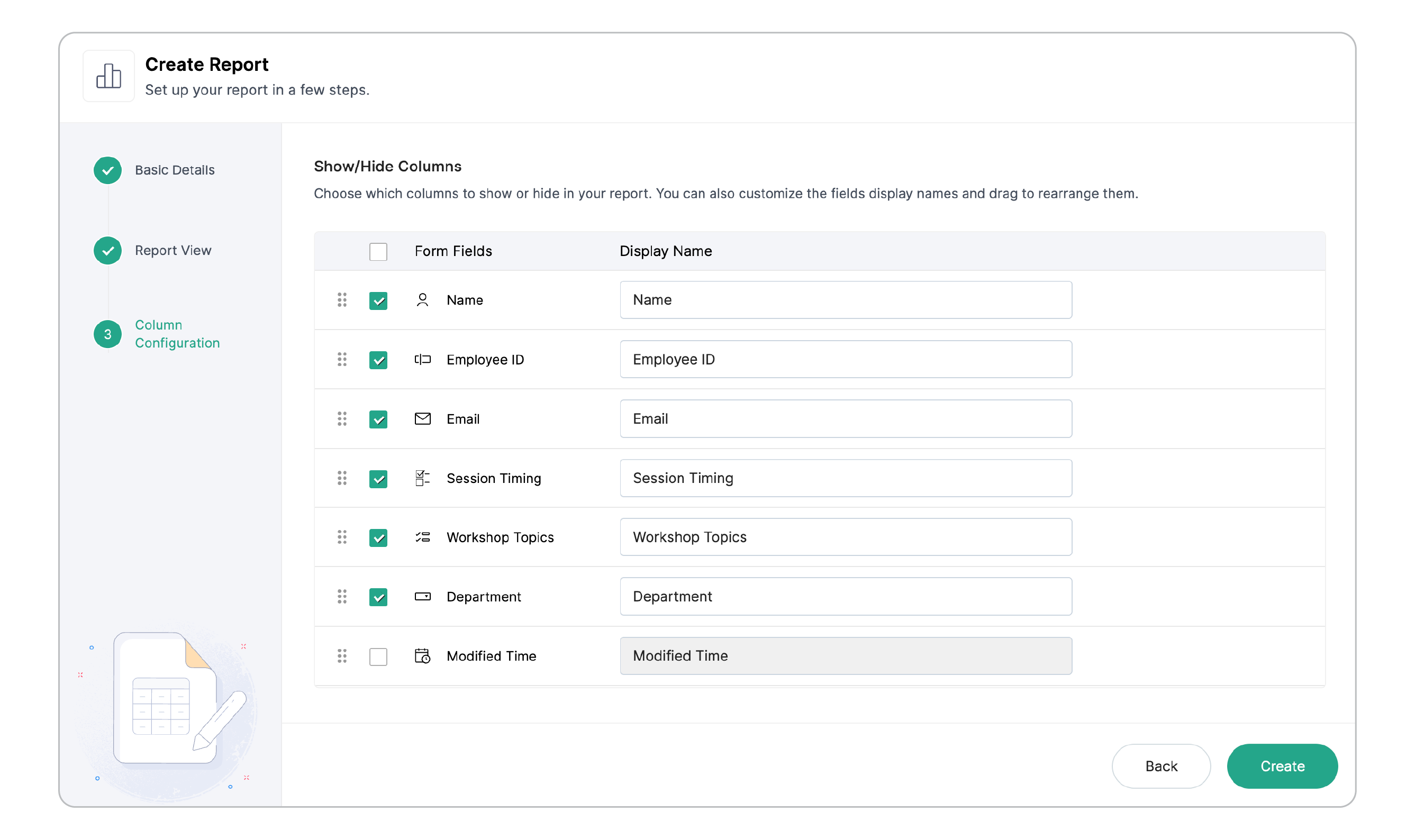
If you selected List View in Step 2, the Column Configuration stage lets you set up your columns.
- Show/Hide Columns: Choose which columns to show or hide in your report. You can also customize the fields' display names and drag to rearrange them.
Incase your form contains any subforms, click Modify Fields to expand and configure fields within the subform. - Click Create. Your list view report is now ready to view.
for Kanban View Reports
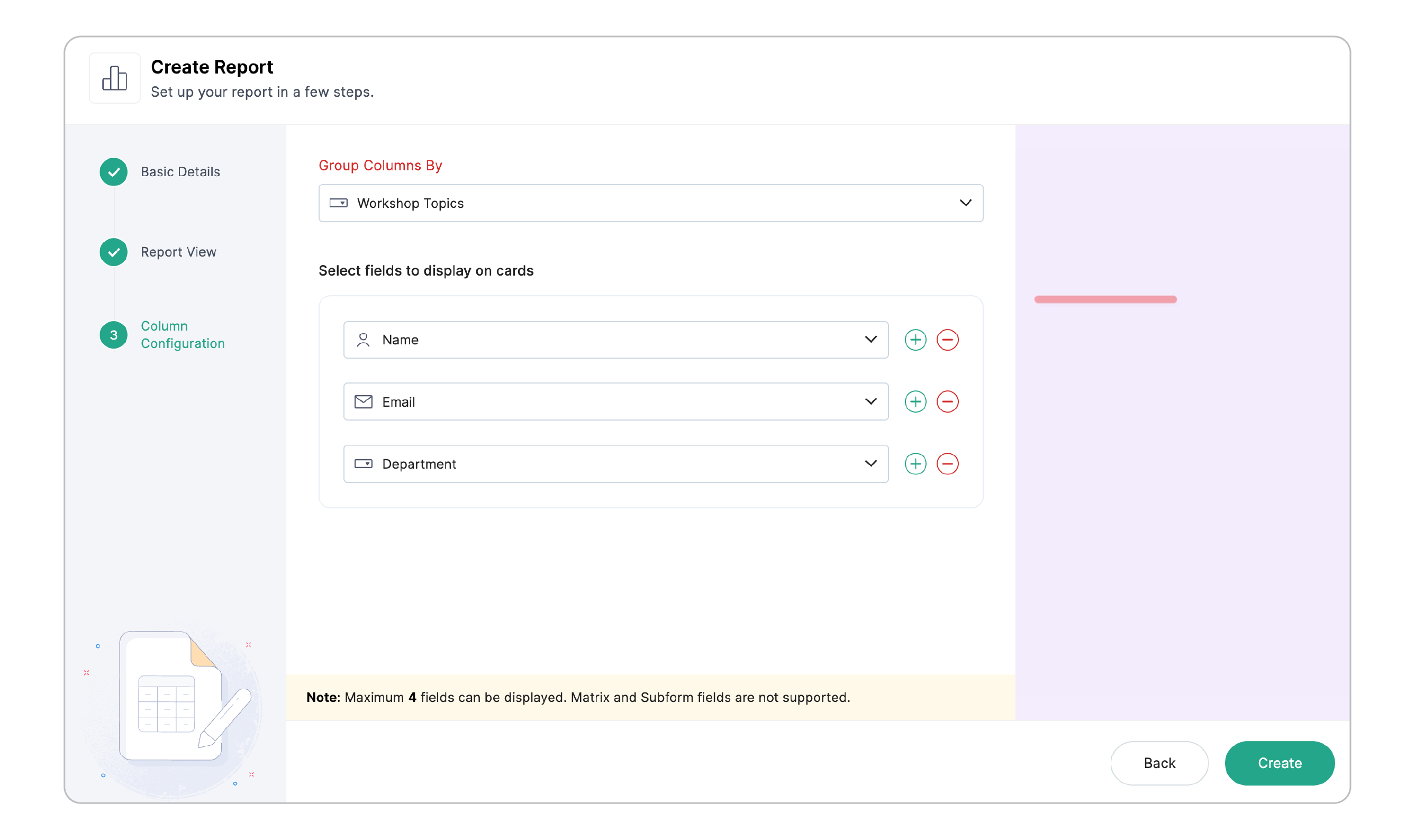
If you selected Kanban View in Step 2, the Column Configuration stage lets you set up your Kanban
columns and cards.
- Group Columns By: Select a Dropdown or Radio field to group entries into columns.
- Select fields to display on cards: Choose the fields to show on each Kanban card. Click
to add more fields.
- Click Create. Your kanban view report is now ready to view.

Note :
- Only Dropdown and Radio choice fields will be displayed in Group Columns By for you to choose from.
- You can add a maximum of four fields. Matrix and Subform fields are not supported in Kanban View.
- Kanban View can only display upto 20 columns in a report. If your grouping field has more than 20 choices, by default the first 20 choices will be displayed in columns. To edit the choices displayed in the report, click Modify View in the report.
- Each column can display a maximum of 1000 entries.
Report Options
You will have the following Report Options after creating a new report:

Note: Auto Filters option is available only in List view report builder.
General Settings
Report Name : You can change the name of your report here. You can rename your report at any time.
Date Format : Date in the report will be displayed in the format selected here.
Time Zone : Under the Date-Time column in your report, the time will be displayed based on the selected time zone.
Serial Number: This option allows you to display serial numbers for each record in the report. When you select Show, a column with serial numbers will be added to the report, providing an identifier for each entry based on its position in the list. By default, the serial number option might be hidden.
Name Delimiter : You can choose the delimiter that you wish to use between the First and the Last name elements of the Name field entries.
Address Delimiter : You can choose the delimiter that you wish to use between the entries of the Address field elements.
Custom Filters
Use this option to filter out entries that match the conditions you specify. Entries that match the set conditions will automatically be added to the report.
To do so,
- Click the Custom Filters tab, then click Configure Filter
- Here, you can give multiple conditions to filter out only those entries that you wish to include in your report. Select the Field Name and the condition it has to satisfy by choosing a Comparison from the drop-down list and the Value it has to match.
- To add a condition or delete a condition, click the + and - icons respectively.
- If you want your entries to satisfy two or more conditions, select the Match All option. For the entries to satisfy any one condition from the multiple conditions specified, select the Match Any option.
- Click Save.
To view your report, click the Entries tab.
Auto Filters
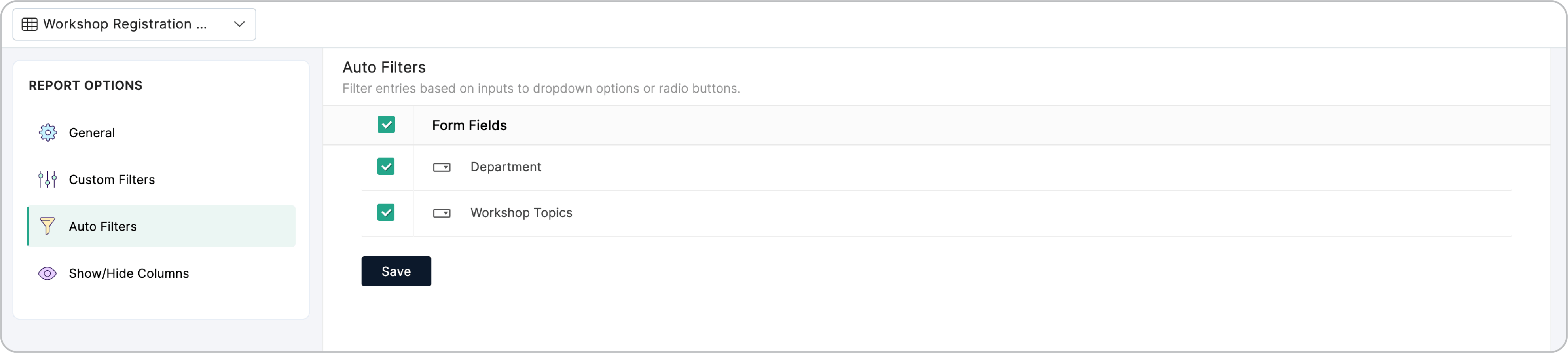
Enable Auto-Filter to display the Filter by Choice option in report searches. All form fields linked to the form's radio buttons and dropdowns will be listed in the Auto-Filter.
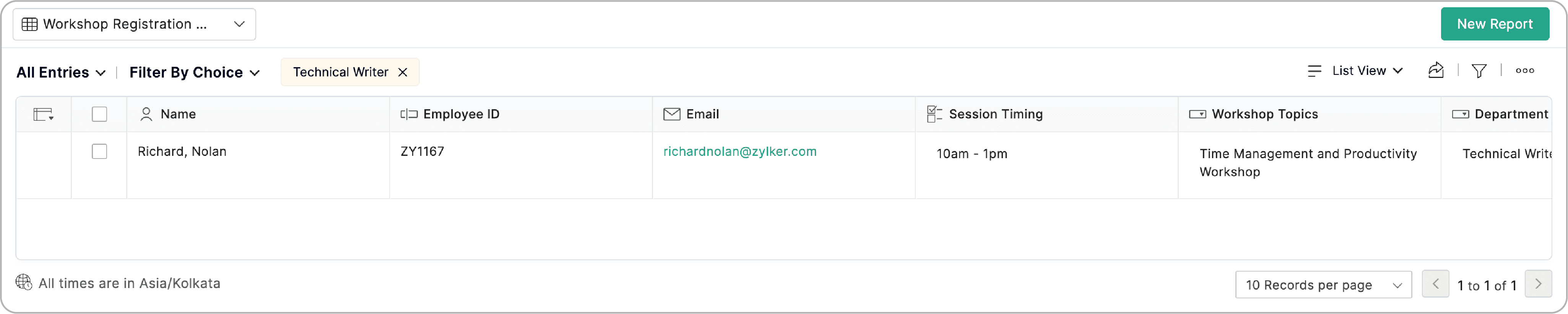
Use the Filter by Choice option on the report entries tab later to view data based on the selected choices.
Note: This option is available only in List view report builder.
Show/Hide Columns
Under Show/Hide columns,
- You can choose to show or hide the form fields from a report.
- You can modify the display names of the fields.
- To change the order of the fields in your report, drag and rearrange the fields.
If your form contains a subform, click Modify Fields to open the Show/Hide Subform Fields popup. From there, you can choose which fields within the subform to show or hide in your report, customize their display names, and drag them to rearrange thier order.
Note :
- Show/Hide Columns in Kanban View only affects how information is displayed in the Record Summary. These changes won't be reflected in the reports you generate.
- The fields used for configuring the Kanban View report will be pre-selected by default in Show/Hide Columns and cannot be hidden. This ensures that the Record Summary always includes the necessary information.