Adding entries to a related list
Overview
Related Lists are records that are associated with a parent record. For example, a Lead has Notes, Tasks, Events, and calls associated with it. These associated records are called Related Lists.
When you push form entries to a Zoho CRM module, you can also push records associated with each entry to a related list. For example, an Event can be added to a related list associated with a Lead. You can also choose to trigger certain actions in Zoho CRM each time a new entry is pushed to a related list.
You can add entries to a related list associated with a Zoho CRM module in two ways:
When you push a new record to a Zoho CRM module from Zoho Forms, you can also push entries associated with the new record to a related list using the same form.
When you have an existing record in Zoho CRM, you can push entries associated with the existing record from Zoho Forms to a related list in Zoho CRM using the Zoho CRM Field.
Setup
Adding entries to a Related List while pushing a New Record to Zoho CRM
To do this,
Navigate to the Integrations tab and click Zoho CRM under CRM from the left menu.
Configure the Integration setup to add a new record and click Integrate.
Under the Related List tab, the module selected while configuring the integration to add a new record will be listed. Select the required Related List and Layout to which you want to push the associated records.
Map all the mandatory Zoho CRM fields to the corresponding Zoho Forms fields.
To map more fields, click + Add Fields.
If you have a Subform in Zoho Forms, you can map the Subform fields to the corresponding Subform fields in Zoho CRM.
- While integrating your form with a module, you can configure a Lookup filter to look for existing fields in Zoho CRM that match the response of a form field under Lookup Mapping.
 Note: Lookup Mapping section is available only when you have added the Lookup Field in Zoho CRM.
 Select the Actions to be triggered in Zoho CRM each time an entry is pushed to a Related List and click Integrate.
Adding entries to a related list associated with an existing record in Zoho CRM
To do this,
Add and configure the Zoho CRM Field in your form.
Navigate to the Integrations tab and click Zoho CRM.
Click Related List.
The module selected while configuring the Zoho CRM field will be listed. Select the required Related List and Layout to which you wish to push the associated records.
Map all the mandatory Zoho CRM fields to the corresponding Zoho Forms fields.
To map more fields, click + Add Fields.
You can select the Actions to be triggered in Zoho CRM each time an entry is pushed to a related list.
Click Integrate to save your settings.
Distribute Prefilled forms from Zoho CRM
In your form, configure the setup to add entries to a related list associated with an existing record in Zoho CRM.
In your Zoho CRM, enable Pre-population of Data under Setup > Marketplace > Zoho > Zoho Forms.
You can include the pre-configured form's link directly while drafting an email to a selected contact or insert the form's link while configuring an email template in a module in Zoho CRM.
Pick your contacts from the Zoho CRM module and send the configured email with the link to a prefilled form.
Trigger Actions in Zoho CRM while adding Related Lists
- Signatures
- File upload/ Image Upload field attachments
- Merged documents (only the documents sent via email notifications can be pushed to Zoho CRM)
- PDF of form submissions
You can choose to push the Default Template, Custom Template(s), PDFs sent in form submission workflows, and PDFs sent in approval process as attachments to Zoho CRM. If you choose PDFs in form submission workflows, the PDF template sent to the respondent after submitting the form (for example, the PDF downloaded from the Thank You page, or any PDF sent via email notification) will be pushed to Zoho CRM as an attachment.
If you choose PDFs in approval process, the PDF template sent to the respondent along with the Final Approval Email will be pushed to Zoho CRM as an attachment.

Tag Records
Upsert Record
Here's how upsert works:
- First, it is checked if the email rebecca@zylker.com exists in Zoho CRM. If it does, then the mapped fields get updated to the record associated with that email address.
- In case the email address rebecca@zylker.com does not exist in Zoho CRM, it's checked if the company Zylker exists. If it does, then the mapped fields get updated to the record associated with that company name.
- If none of the field values exists, then a new record with all the mapped details is created in Zoho CRM.
- You can also choose to overwrite existing values in Zoho CRM with empty field values from Zoho Forms or exclude empty values while upserting a record.
- Click Done and save your preferences.
Set Alert on Integration Failure
Click Set Alert in the top-right corner.
Configure the email alert template as shown and click Save.
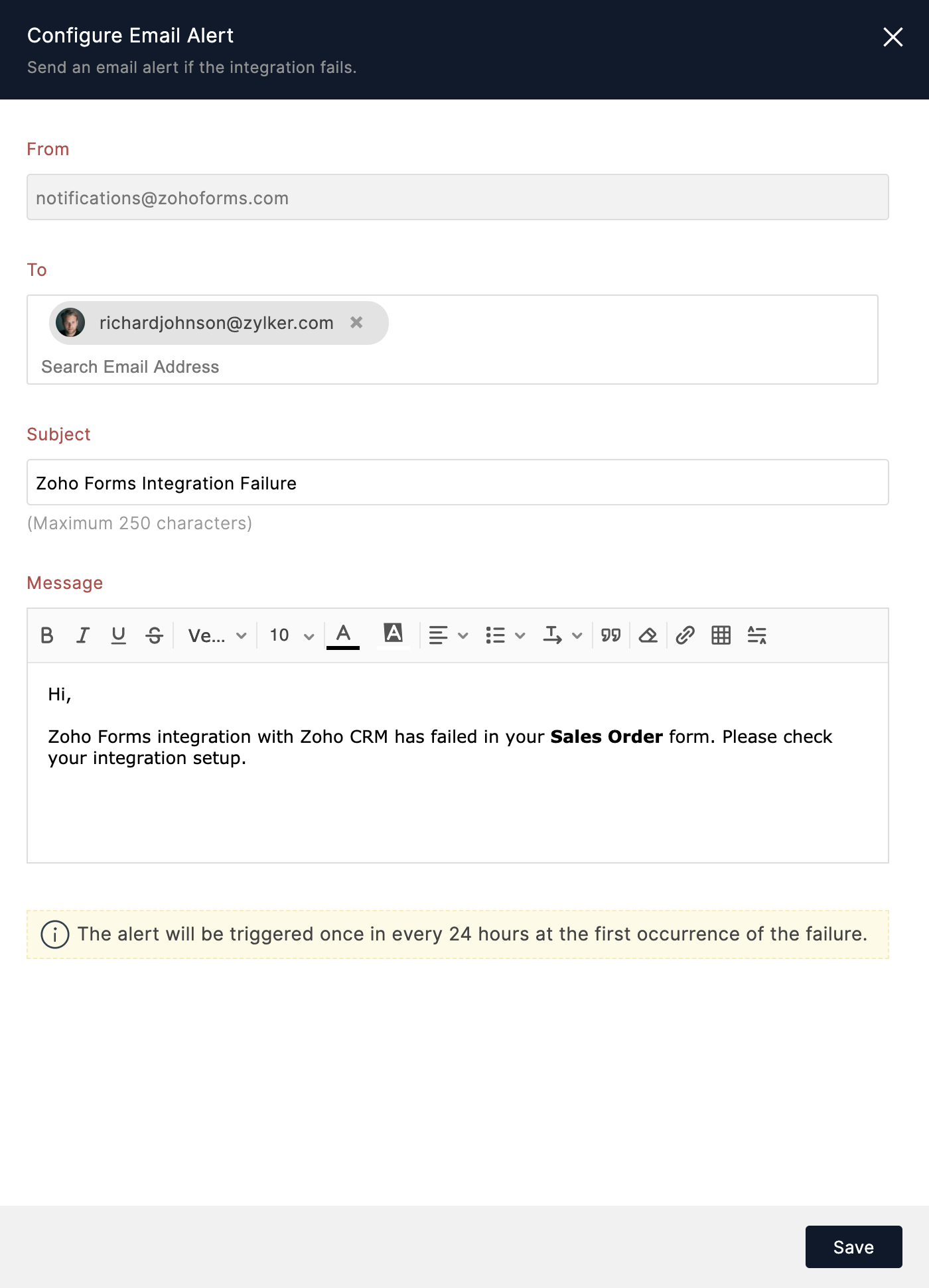
To stop receiving email alerts on integration failure, click Remove Alert.
- The option to set an email alert on integration failure is available only in our paid plans.
- You can send email alerts to a maximum of 5 users within your organization.
- An email alert will be triggered only on the first occurrence of integration failure every 24 hours.