Data Migration
Thank you for considering Zoho Recruit. If you are ready to migrate data from your ATS account to Zoho Recruit, follow the steps given below or contact us to assist you with the migration. If you would like us to do the migration for you, please fill in a request at https://www.zoho.com/recruit/migration-request.html
 Availability
Profile Permission Required: Users with the Data Migration permission in their profile can access this feature.
Supported Modules
The following modules can be migrated from other ATS software to Zoho Recruit:
- Users
- Candidates
- Clients
- Contacts
- Job Openings
- Campaigns
- Attachments
- Notes
- To-Dos (Tasks, Events, Calls)
- Interviews
Import Sequence
For best results, migrate your data (tabs and modules) in the sequence given below while importing data into Zoho Recruit.
Users => Campaigns => Candidates => Clients => Contacts => Job Openings => Association => Interviews => Notes => To-Dos (Tasks, Events, Calls) =>Attachments
 Note
NoteYou cannot import custom modules from other ATS to Zoho Recruit.
Based on the application from which you are migrating data, you may skip a couple of modules that are not relevant.
Prerequisites
We recommend that you go through the following points to make sure you're ready for the migration process:
- The files must be in CSV format.
- The file size can be a maximum of 4 GB. There is also a limit of 200 on the number of files that you can migrate at a time.
- You can upload a zip file with the following structure:
Data files from Zoho Recruit or any other ATS - There are two folders in this case. The Data folder should have all the data files, including the CSV file that contains information on the record and attachment mappings. The Attachments folder should contain the source files used as attachments in the Recruit account. - The above-mentioned folder structure is crucial for the Zoho Recruit system to identify and map attachment to the records during migration. In some cases, when you unzip files, extra folders are created. Make sure to delete them and maintain the structure mentioned.
- Tabs and modules cannot be migrated as a whole into Zoho Recruit, but you can always migrate the data from those modules. During the migration, Zoho Recruit identifies the data and suggests custom modules that can be created to accommodate the data.
-
Similarly, Zoho Recruit will suggest custom fields that are available in the import file but not in Zoho Recruit. If required, you can create these fields before the migration.
Based on the application that you are migrating data from, you can customize it the way you need them.
- When user data is migrated, only the first 2000 records will be imported.
- Two or more files can be mapped to a module. In this case, the column header in all the files should be the same before you can map them to a single module.
Migration Checklist
Before migrating data into Zoho Recruit, please go through the following checklist:
- File format - All the files to be imported must be in CSV format. Any other format is not supported.
- Date and Time format - The Date in the import file must be in yyyy-MM-dd format. (For example, 2020-05-01). The Date & Time in the import file must be yyyy-MM-dd and HH:mm:ss format. (For example, 2020-05-01 11.55.26). Date and Date & Time values in any other format will be ignored during import. You can change the format in yourCSV file by following the steps given below:Right-click on the Date column and choose Format Cells.
- Select Custom category in the Format Cells pop-up.
- Enter the date format as yyyy-MM-dd and the date & time format as yyyy-MM-dd HH:mm:ss - Checkbox fields - The values for checkbox fields in the import file must be either "True" or "False”. Imported data from checkbox fields are converted in Zoho Recruit as follows:
True - If checkbox is selected
False - If checkbox is not selected - Multi-select pick list fields - The values must be separated by a semicolon in the import file.
- Custom fields - If you have created custom fields in your Recruit account, you can only import the custom field data in Zoho Recruit if you create the same custom fields for the respective modules in your Zoho Recruit account. You can create the custom fields by following these steps:
- Navigate to Setup > Customization > Modules.
- Choose a module from the list.
- In the Layouts tab, add any other custom fields to the selected module.
- Click Save Layout.
- You can view the list of fields created for the selected module in the Fields tab.
- Migrating Users - You won't be able to migrate users who already have a separate Zoho Recruit account. The users will need to close their separate account with Zoho Recruit can they be imported in your company's Recruit account.
- Add One More User - If you have only added one user in your Recruit account, please add another user before migration. To add another user, navigate to Setup > Users & Control > Users. You don’t have to create all the users manually, as you will be importing users in CSV file in Zoho Recruit.
- Update Mandatory Fields - You need to have data for all the mandatory fields in Zoho Recruit in your import file. For example, "Last Name" is a mandatory field in Zoho Recruit. Make sure that the "Last Name" column in your Candidates import file has values. For the records that do not have a last name, you need to specify the values as 'not provided', 'none', or similar.
Note: If there are no values for the mandatory fields, the corresponding record will be ignored while importing.
Migrate Data
1. Log in to Zoho Recruit with Administrator privileges.
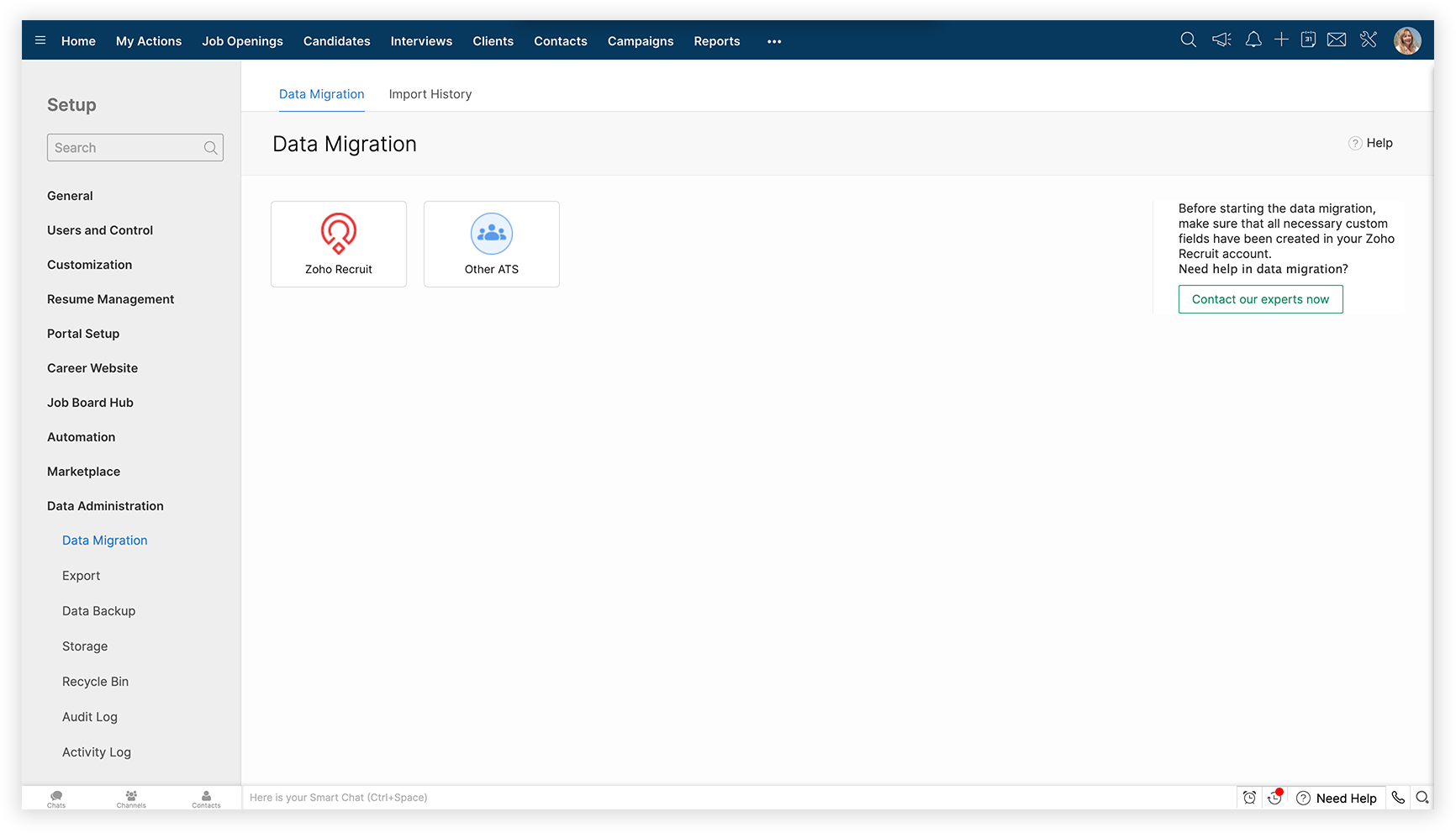
2. Navigate to Setup > Data Administration > Data Migration .
3. Select from Zoho Recruit or Other ATS that you want to import.
You can either drag and drop files, or browse and upload files from your system that needs to be migrated.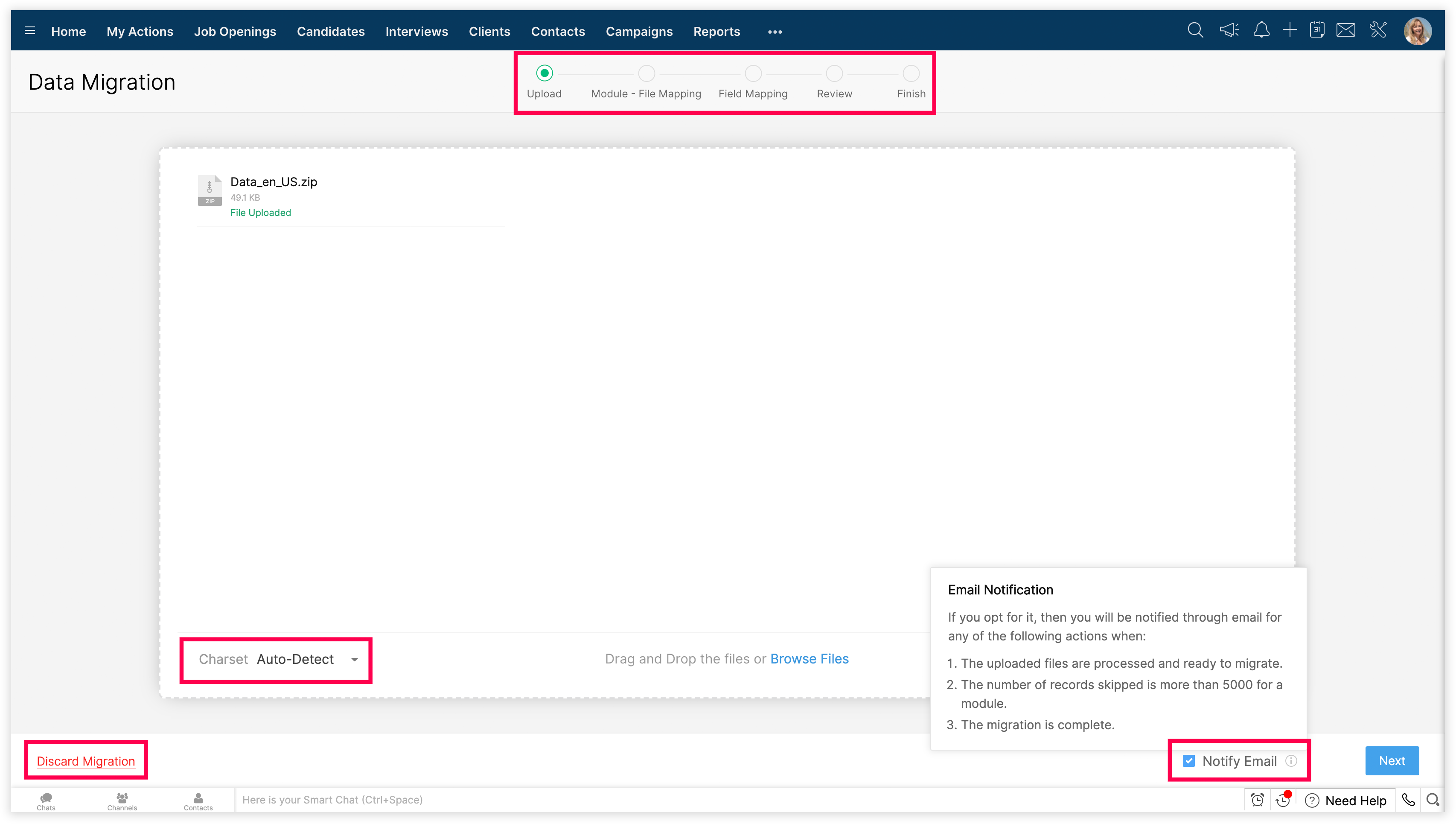
You can either drag and drop files, or browse and upload files from your system that needs to be migrated.
Select the Character Encoding for the CSV file.
Select the Send Notification Email checkbox to receive a notification mail about the import.
You can click Discard Migration if you wish to discontinue the process.
You can view the migration process status on top.
Click Next.
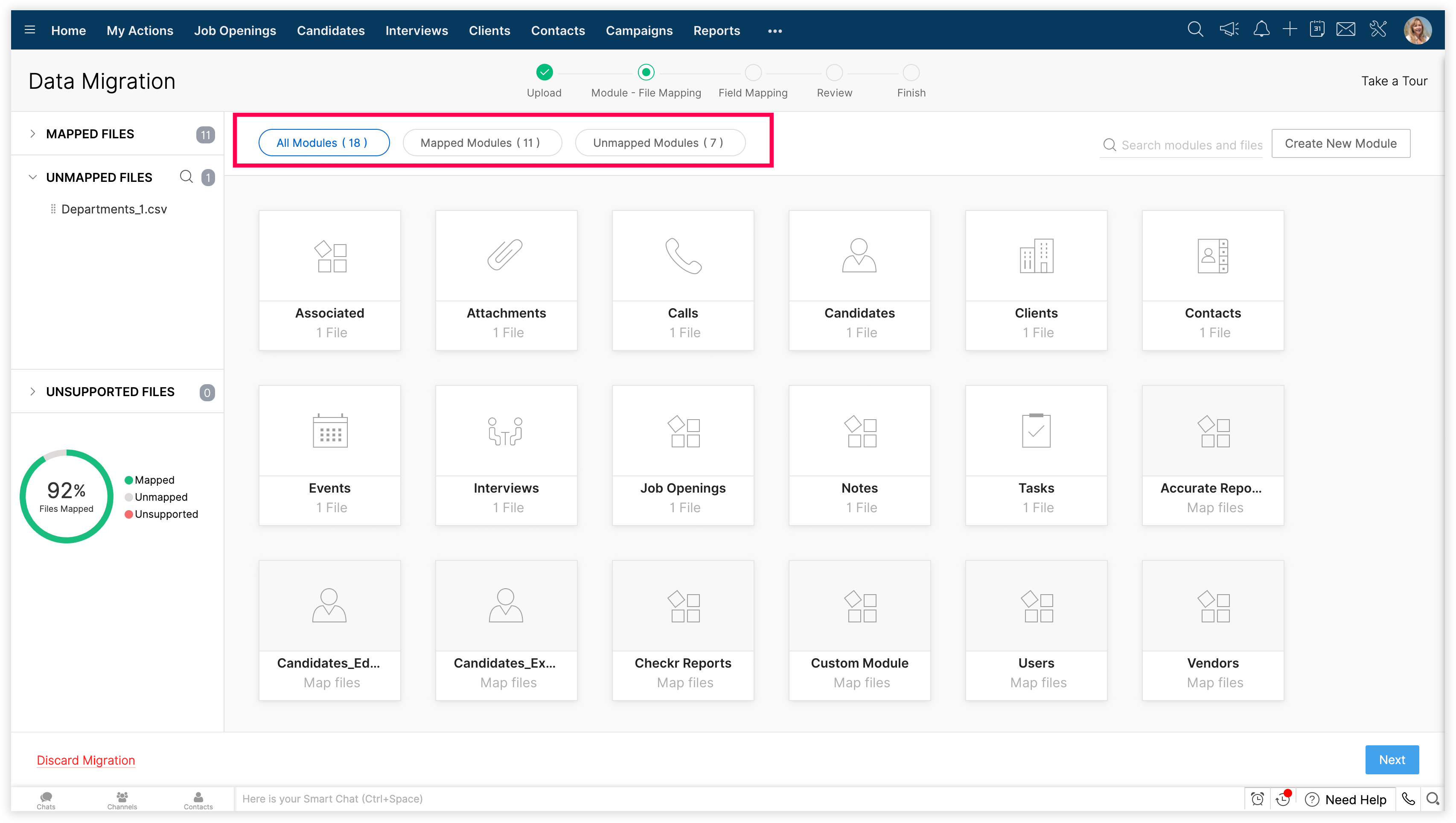
4. In the Module-File Mapping section, you can view All modules , Mapped Modules , and Unmapped Modules . The file names that you have used for the CSV file will be used for module mapping.
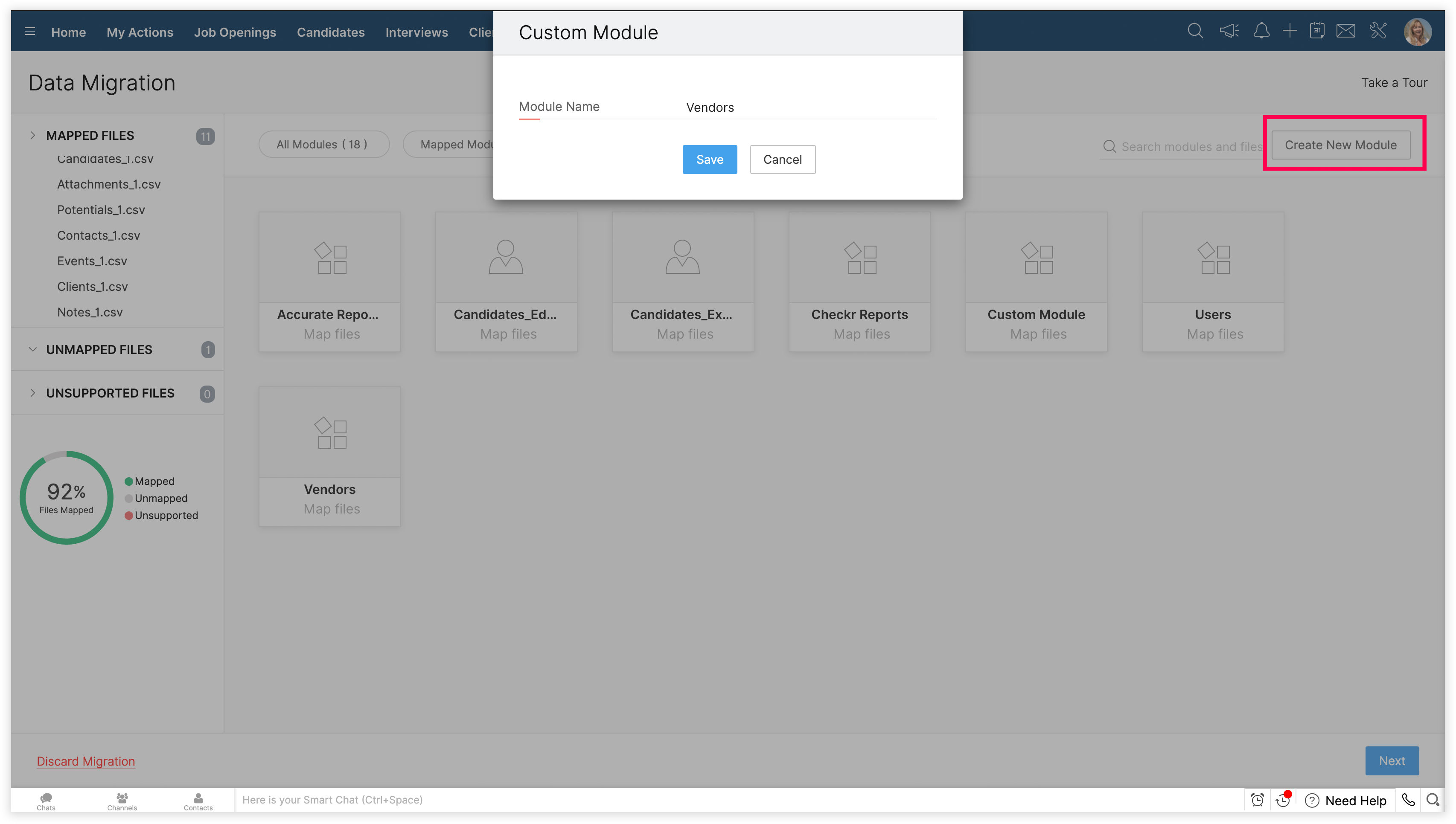
5. If necessary, you can also create a custom module by clicking the Create New Module button on top-right corner.
6. Click Next. You will be redirected to the Field Mapping window.
The column title used in the uploaded csv file will be used for field mapping.
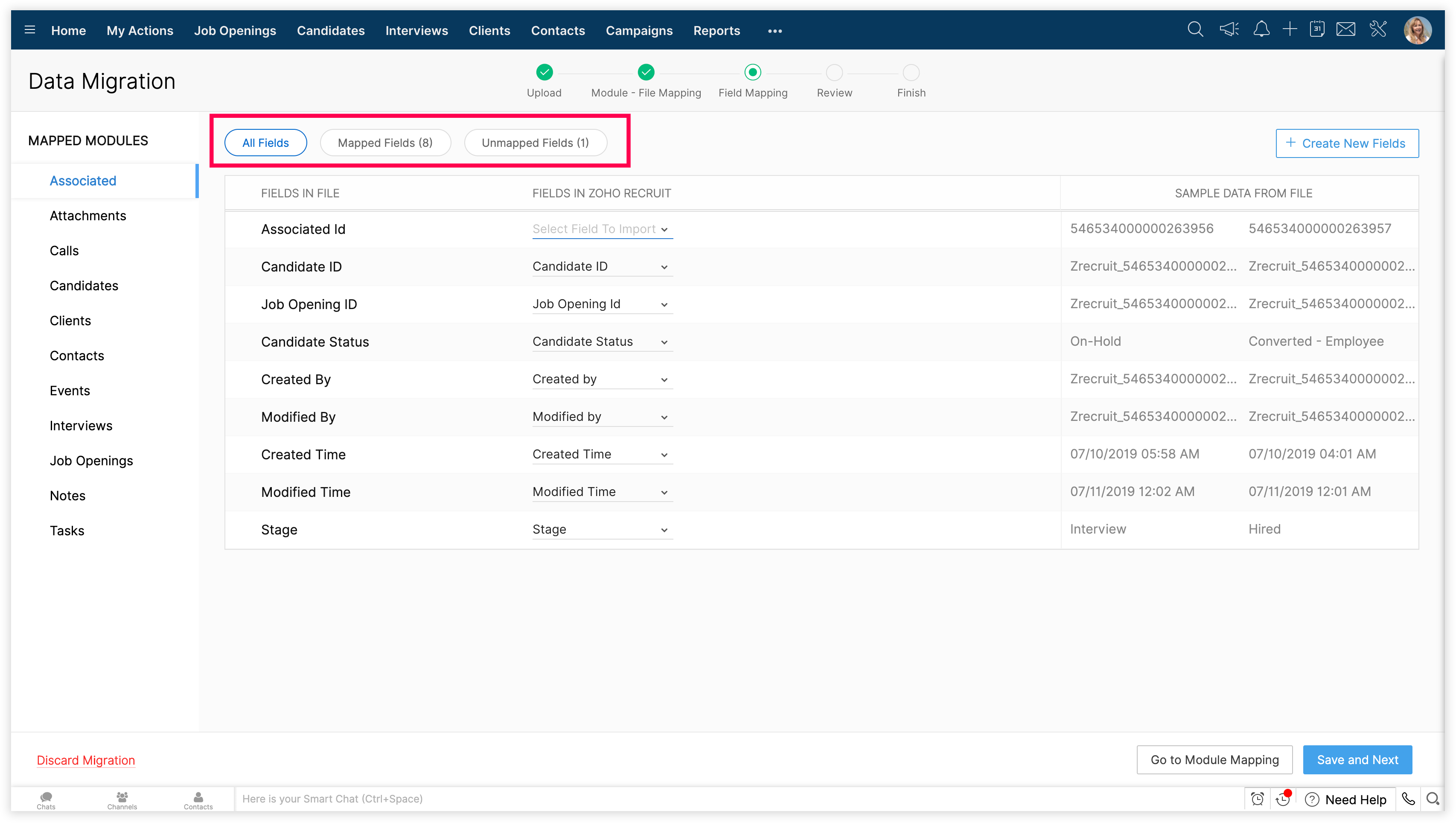
Similar to module mapping, you will be be able to select All Fields, Mapped Fields, and Unmapped Fields.
7. For unmapped fields, you can manually choose a field to map data from the dropdown list.
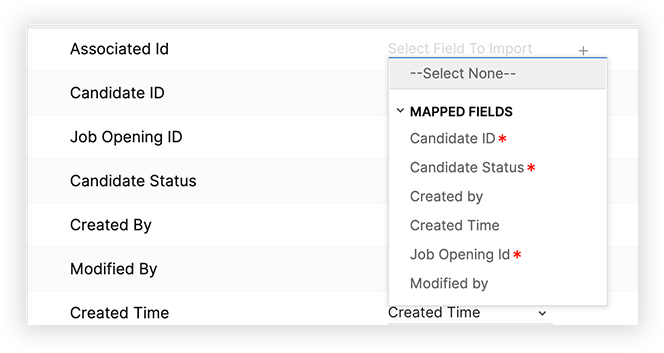
8. You can also create a new field by clicking the +Create New Field button in the top-right corner. In the following pop-up, you will have to choose the type of data from the dropdown list. Click Create to save the new field.
9. Click Save and Next as you finish mapping fields for all migrating modules.
Note: The left panel shows the status of field mapping. The green tick mark indicates that field mapping for the respective module was successful.
These step lets you review your module and field mapping status.
10. Click Start Migration to begin migrating the data from your other Zoho Recruit Account or Other ATS.
You can click Discard Migration anytime to cancel migration. If you would like to change any field mapping- click Edit Mapping and re-run Migration.
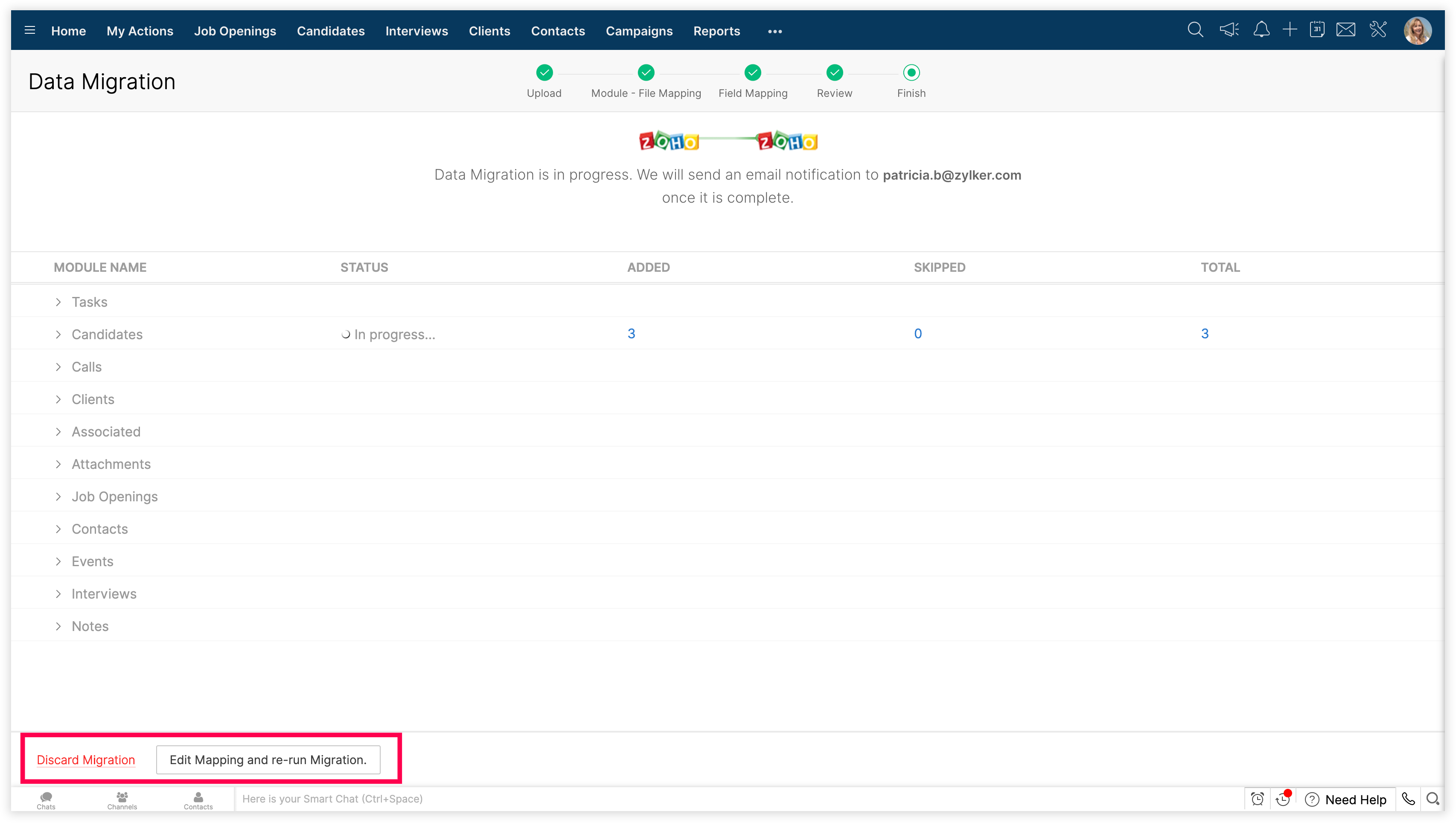
You can click Discard Migration anytime to cancel migration. If you would like to change any field mapping- click Edit Mapping and re-run Migration.
When the migration is complete, an email will be sent to the user (administrator) who imported the records. This will only occur if you have checked the Notify Email box provided at the beginning of the process (refer to step 3).
Check for Data Accuracy
After importing each file, check the data that has been imported. For example, after importing the users in Zoho Recruit, go to Setup > Users & Permissions > Users to check if all the users have been imported. Follow the same steps for Candidates, Clients, Contacts, and any other files. If you think the data has not been imported properly, or the fields have been wrongly mapped, you can delete the imported records and import them again.If you are stuck on any of the steps above, please feel free to contact us at support@zohorecruit.com. If you would like us to do the migration for you, please fill in the form https://www.zoho.com/recruit/migration-request.html and one of our representatives will contact you shortly.