Did you know?#3: How to target and run your experiment based on custom audience segments in PageSense
Whatever kind of online business you're running, defining your target audience is the key factor to delivering relevant messages and further positioning your brand in the industry. Most marketing efforts revolve around this basic strategy of segmenting people who have similar needs, values, or characteristics and later targeting them with products or services meant to appeal to these ideal audience groups.
Luckily, the same concept applies to website testing and optimization processes. By choosing a target audience for your experiment, you get to decide whom you should focus on and where you should run your experiments on your site. This method of audience targeting helps you reach the right consumers interested in your products or services with relevant messaging rather than entire audience groups who are less likely to convert on your website.
So, how do you target the right audience for your experiment?
Using Zoho PageSense's audience targeting, you can both target basic audience segments (for instance, visitors coming to your site for the first time, visitors from a social media platform, and more) and tailor your own segments using the custom audience feature.
In today's post, we'll learn about what custom targeted audience segments are and how to successfully build your own custom audience condition in PageSense to boost your website's conversions.
A custom audience in PageSense is a more refined approach of audience targeting. This feature lets you target and run your experiment to more precise subgroups or subsets of audiences based on visitor parameters like their geography, age, gender, browser used, purchase behavior, language, or industry type, which cannot be done using the preset audience segmentation options available in PageSense. Furthermore, the option allows you to create a more powerful combination of audience groups using the ‘AND’ and ‘OR’ operations.
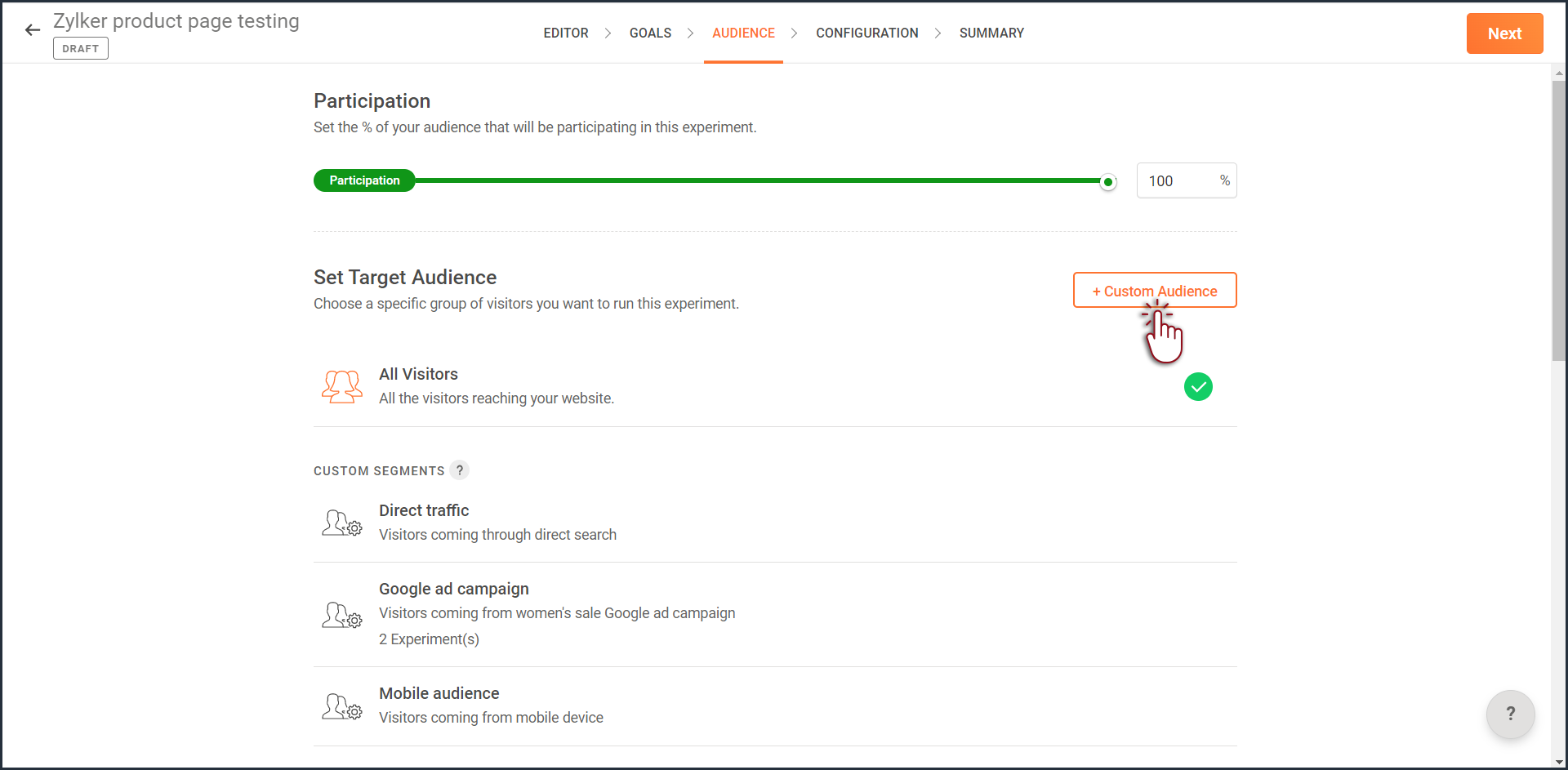
Say, for example, you run an ecommerce website and you want to A/B test the revamped product pages to visitors coming only from the United States region AND who access your website using Desktop devices. This could easily be done by manually creating custom audience conditions in PageSense as explained below:
- Click the +Custom Audience button on the AUDIENCE page of your experiment.
- Enter a title and description for the custom segment you want to create.
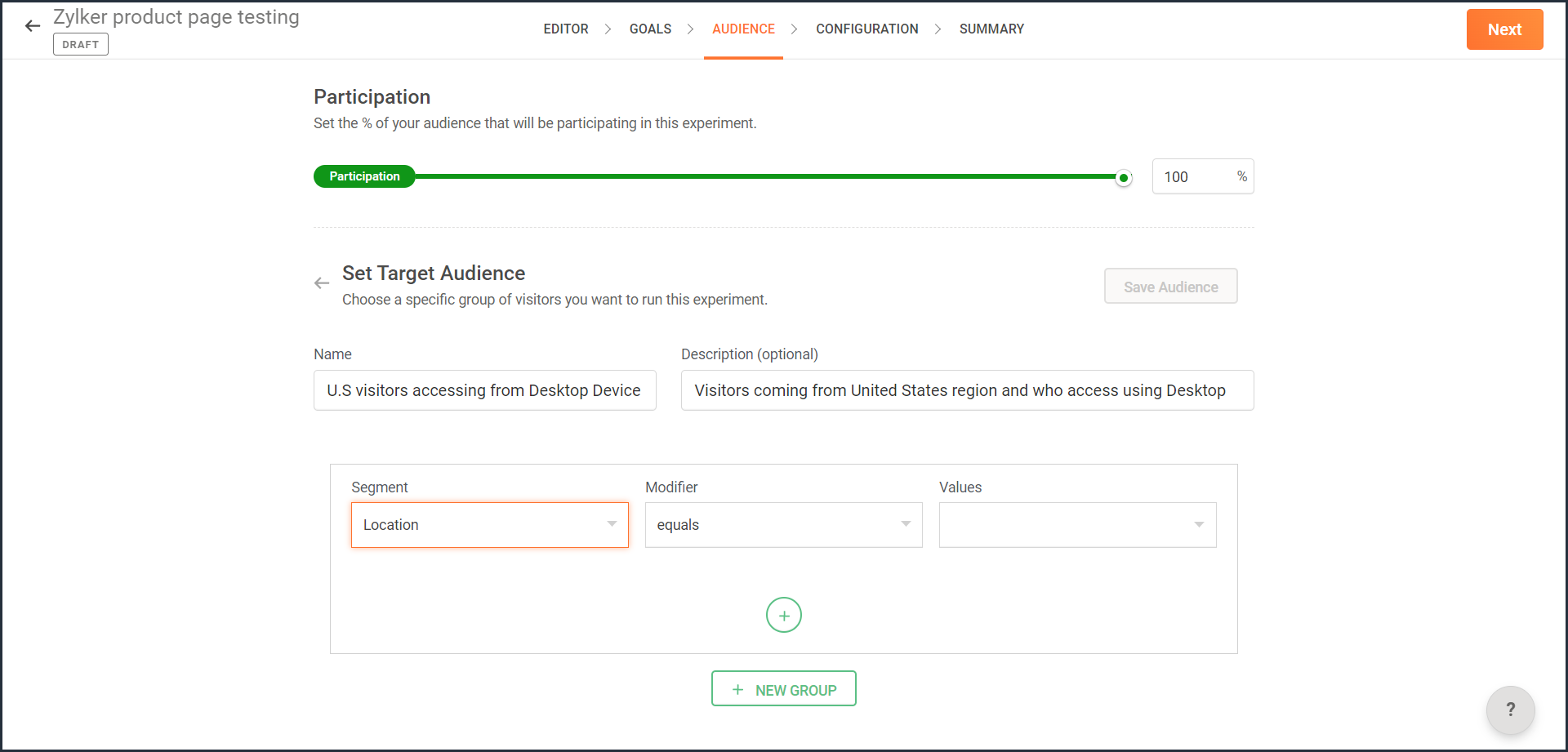
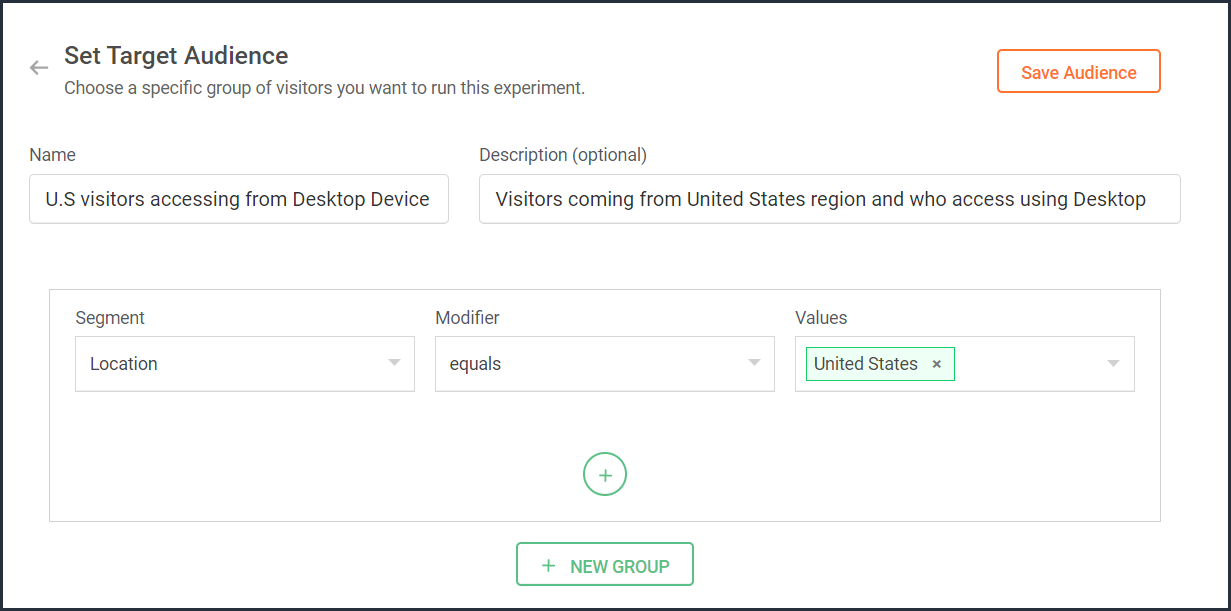
- From the Segment dropdown, choose the modifier and value for the selected audience segment as shown in the screenshot. Learn more about the different types of custom audience segments and the modifier conditions available in PageSense.
- Ensure you choose the condition as ‘AND’ or 'OR' depending on the segment you want to create.
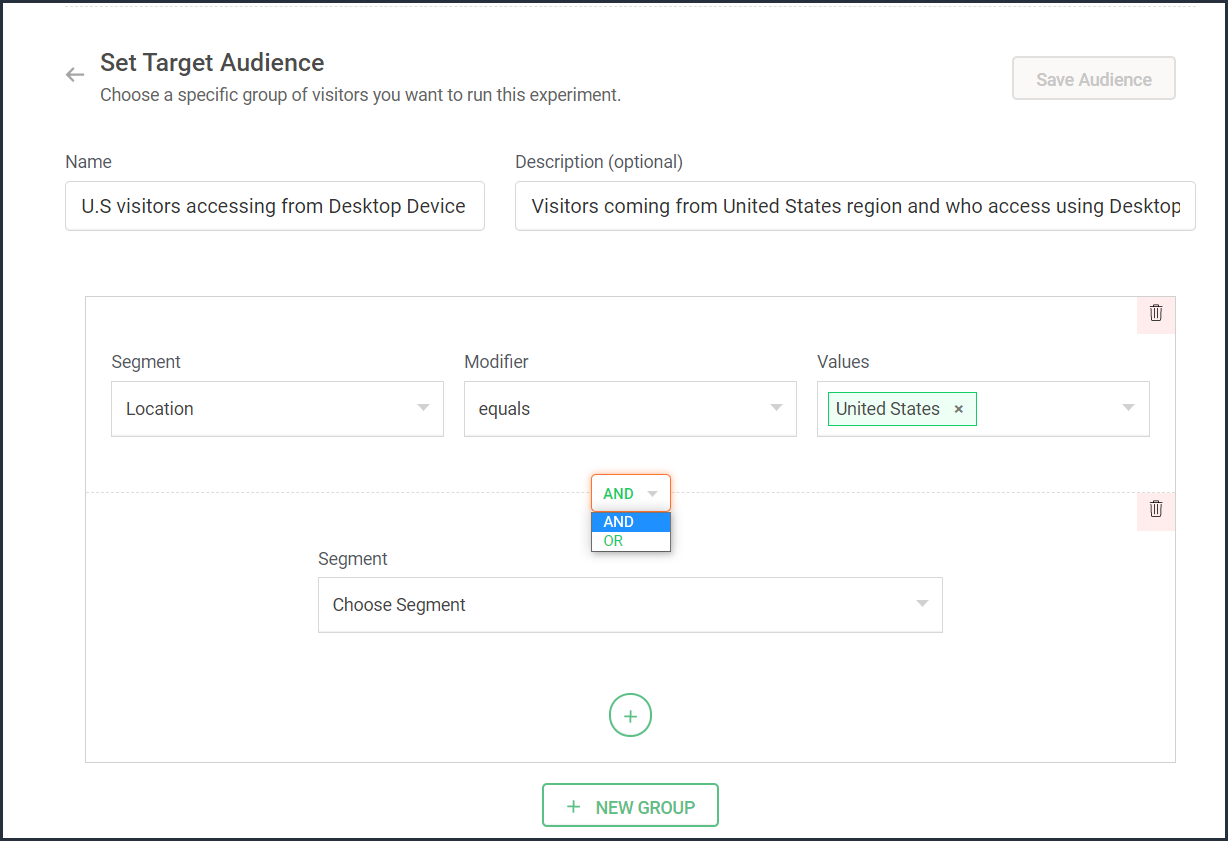
- From the Segment dropdown, choose the second modifier and value for the selected audience segment as shown in the screenshot.
The final selection looks like: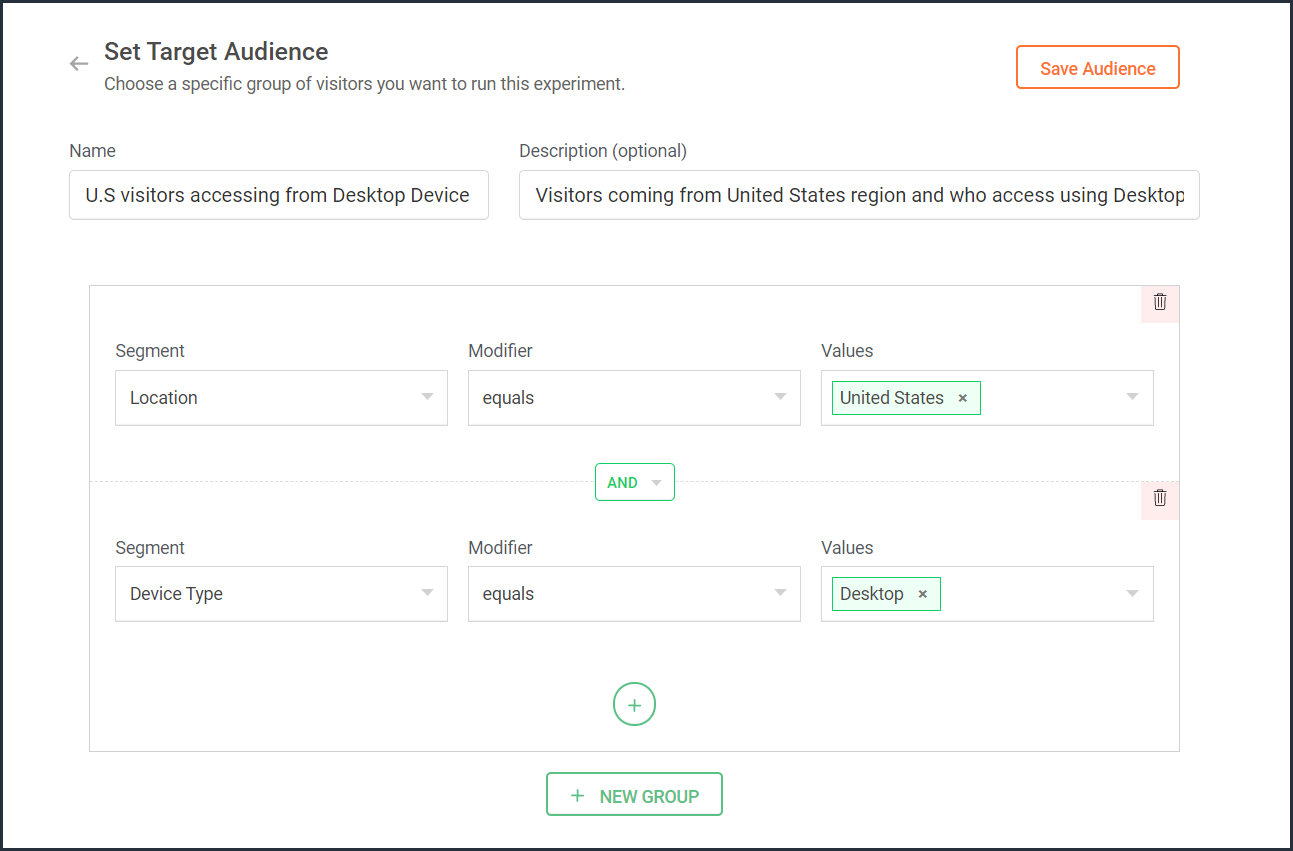
- Click the Save Audience button.
The saved segment will appear under the Custom Segments section across all of your experiments in PageSense and you can apply the same for any experiment.
Below are a few examples that show you the most effective ways to define custom audiences in PageSense for running your experiments better:
Target your experiment by geographical location
If you're looking to expand your online business to international audiences and want to understand which city or country markets are good for your business, choose to target your experiments to audiences based on the location.
Targeting your experiment by your visitors' geographic location, such as country, city, or region, is a powerful option when you want to show personalized web page content or run advertisement campaigns that match the interest of audiences from specific areas. This type of targeting is driven by factors like local festivals celebrated, popular regional news, tourism attractions, or business events happening in a region.
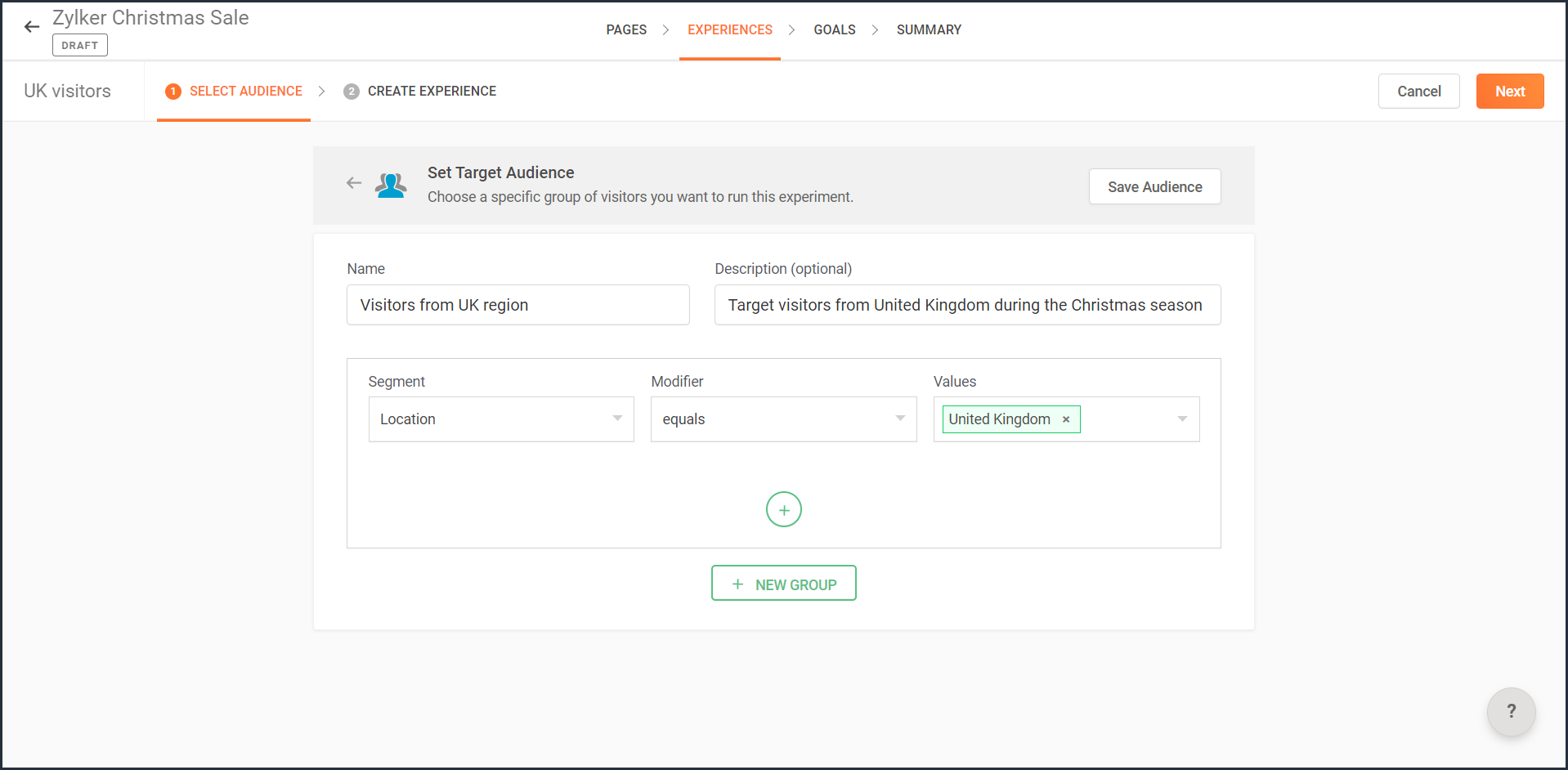
For example, say you own an ecommerce site, and you want to show personalized product recommendations to visitors from United Kingdom during the Christmas season. In this case, you can create a custom audience segment that targets your experiment page to visitors from this particular location as shown in the screenshot below.
Note: You can also use this option to target your experiment based on the languages spoken by visitors in different countries.
Target your experiment by query parameters
While running ad campaigns, it's important to both target the right consumers and provide the most relevant information to them on your website. If you find the right user who clicks on your ad, but the landing page for that ad isn’t customized, that conversion could be lost.
Targeting your experiment to visitors who reach your website pages that include (or exclude) a certain query string in their URLs could be useful when you want to understand the effectiveness of different ad campaigns on your website. This is usually tied to audiences who come through a specific utm_source like Facebook or Google and utm_campaigns like paid ads, Google Adwords, and more.
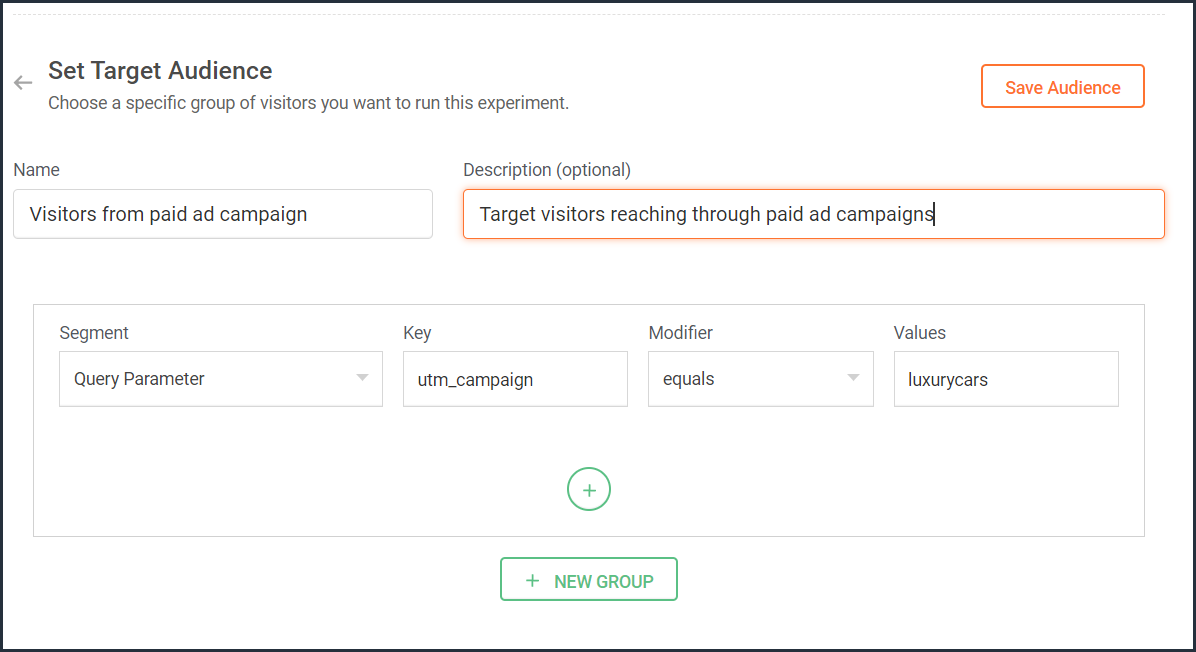
For example, say you own an online car dealership website and you want to redirect customers who click on a paid ad campaign with the utm_campaign=luxurycars to a landing page displaying luxury vehicles with prices and offers. For this, you can create a custom audience segment that explicitly targets your landing pages to visitors who contain this particular query string as shown in the screenshot below.
Target your experiment by user information
To achieve a specific goal or purpose of your online business, you will sometimes need to target your experiment to visitors with exact custom attributes such as age, email address, subscription plan, fields of interest, gender, marital status, or job role on your website. These attributes or visitor information can be collected when a user completes a form on your website, such as a signup, contact, purchase, or any other sort.
Targeting your experiment to visitors based on specific user attributes can help deliver the right message to the right audience and improve brand experience with ease. This is also considered the most precise method of audience targeting as it makes visitors stand out from the wide segment of users on your site.
For example, let's say you run a SaaS business and you want to show a personalized pricing page that offers an additional 30-day period to visitors who are subscribed to the Premium plan. In this case, you can create a custom audience segment to target your experiment to visitors who match this specific user attribute and value as shown in the screenshot below.
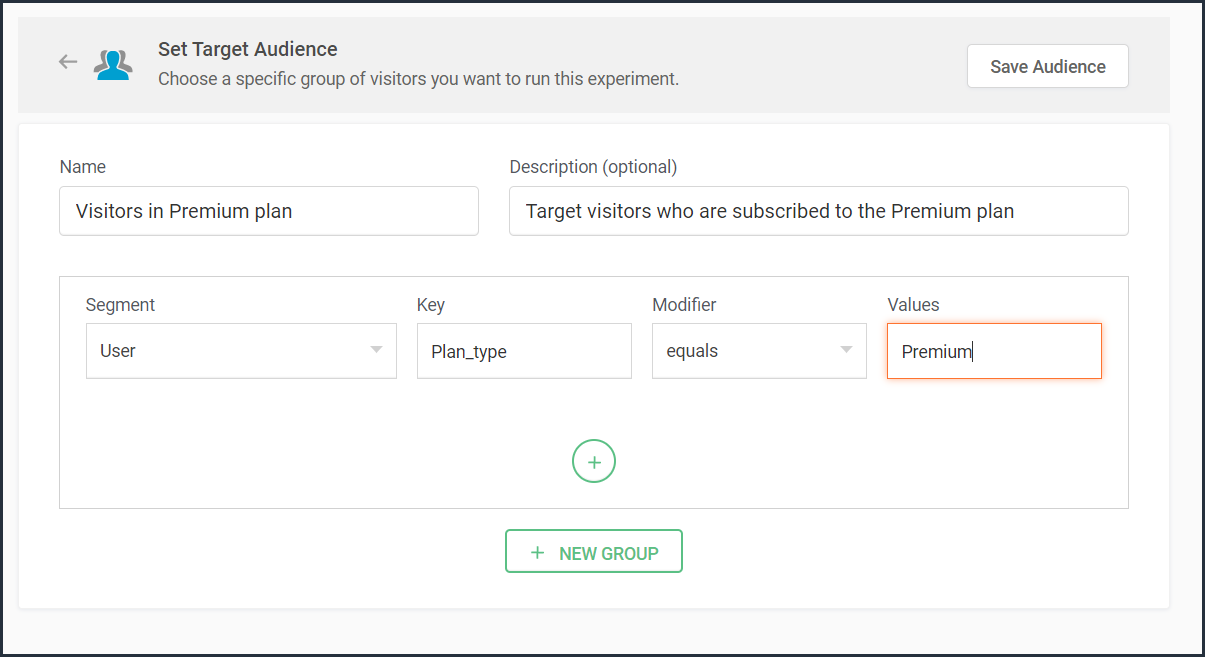
Note that to use 'user information' in audience targeting, you need to add an additional code snippet to your experiment page as explained in the steps here.
Target your experiment by weather/climatic conditions
Do you see your website sell more products when the temperature rises? Or does your tourism business attract more new bookings during cooler seasons?
Targeting your experiment based on the local weather of the visitors coming to your website is another modern technique used by marketers to craft influential website content, product pages, and ad campaigns. Weather-based audience targeting allows businesses to anticipate patterns of demand and tap into the needs and purchase intentions of customers during different seasons of the year. It's also a great way to gain a competitive advantage and increase the average value of orders and conversions on a website.
For example, say you run an ecommerce site and want to create a personalized homepage title for visitors living in climatic zones with temperatures below 41°F/5°C. In this case, you can create a custom audience segment to target your personalization experience based on audience's local weather as shown in the screenshot below.
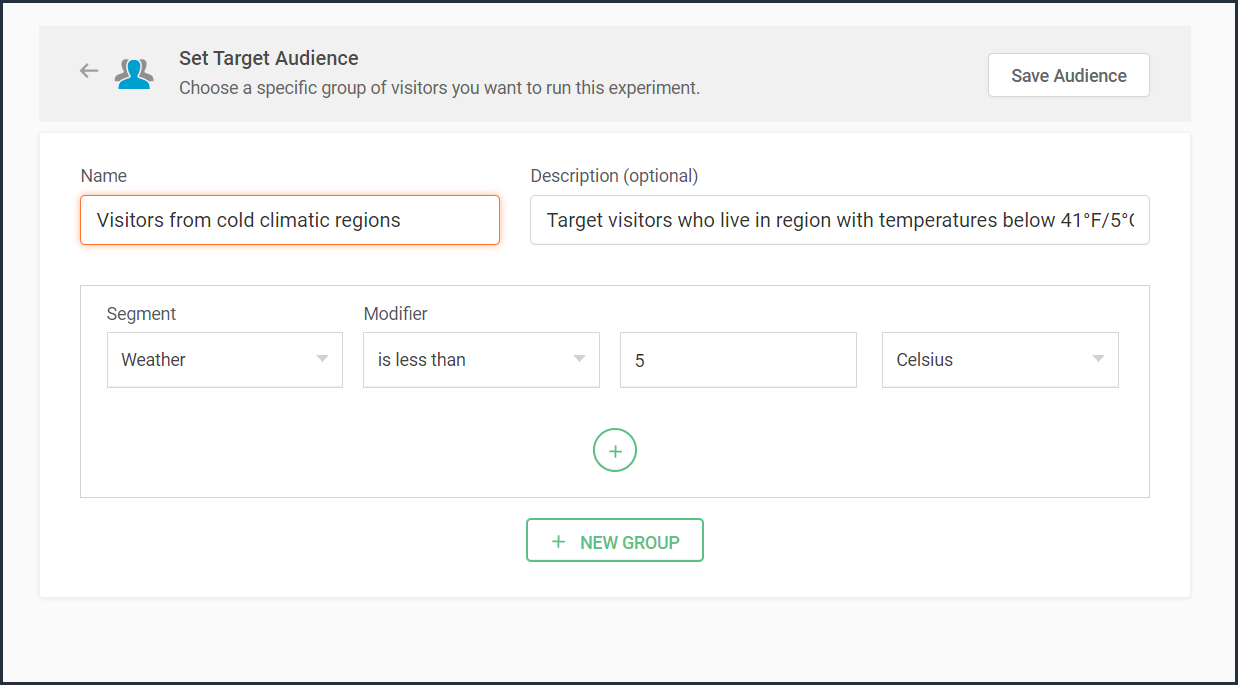
Target your experiment by visitor activity
Visitors coming to your website will have different intentions and behaviors. For example, some might be looking to subscribe to your newsletter, some might be checking out new product releases, and others might just be there for window shopping or research purposes. If you're going to show the same home/landing page content to all visitors, you're definitely going to lose conversions and sales.
Targeting your experiment based on what pages your visitor interacts with on your site and what actions they take (or do not take) can be a great way to provide a personalized website experience during their next visit. This includes buttons clicked, products viewed, items bought, and other actions your visitor performs, revealing what your audience wants, avoids, and purchases.
Using such specific visitor metrics, you can learn why specific actions or events on the site were not successful and later reach customers with more apt content or product offers based on their current activity.
For example, say you run an online tourism website and want to provide customized tourist packages with attractive coupon codes to customers who viewed the Adventure tourism package but exited your web page without completing a booking. In this case, you can create a custom audience segment to target your experiment for these segments of visitor interest and behavior as shown in the screenshot below.
Note that to use 'visitor activity' in audience targeting, you need to add an additional code snippet to your experiment page as explained in the steps here.
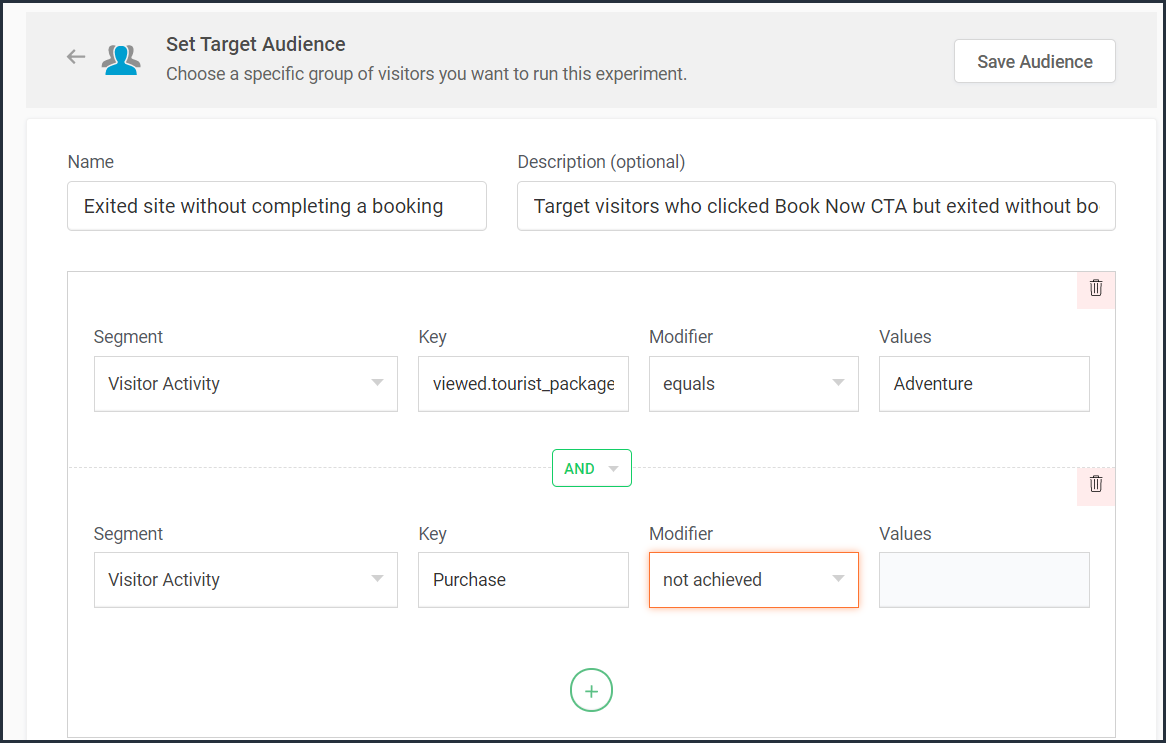
Currently, weather-, user-, and visitor-activity-based audience targeting options are only available for personalization experiments in PageSense. However, the user and visitor activity(custom dimensions) based segmentation option is available under report filtering across all of the experiments in PageSense except for push notifications. Learn how to filter reports based on custom dimensions.
Target your experiment by specific referral site URLs
Note that to use 'visitor activity' in audience targeting, you need to add an additional code snippet to your experiment page as explained in the steps here.
Currently, weather-, user-, and visitor-activity-based audience targeting options are only available for personalization experiments in PageSense. However, the user and visitor activity(custom dimensions) based segmentation option is available under report filtering across all of the experiments in PageSense except for push notifications. Learn how to filter reports based on custom dimensions.
Target your experiment by specific referral site URLs
Depending on the ways you market your website online, you'll likely have numerous different referral sources. Analyzing which source brings in more traffic and revenue to your business is a surefire way to get more traffic from multiple channels. Targeting your experiment based on referral URLs—sources that your visitors came from, such as Facebook, Google, Twitter, Quora, influencer blogs, and other external sites—can help you promote your website and products on these specific channels.
For example, say you own an ecommerce site, and you want your experiment to only target visitors referred by 'facebook.com'. In this case, you can create a custom audience segment to target visitors from this specific Referral site as shown in the screenshot below.
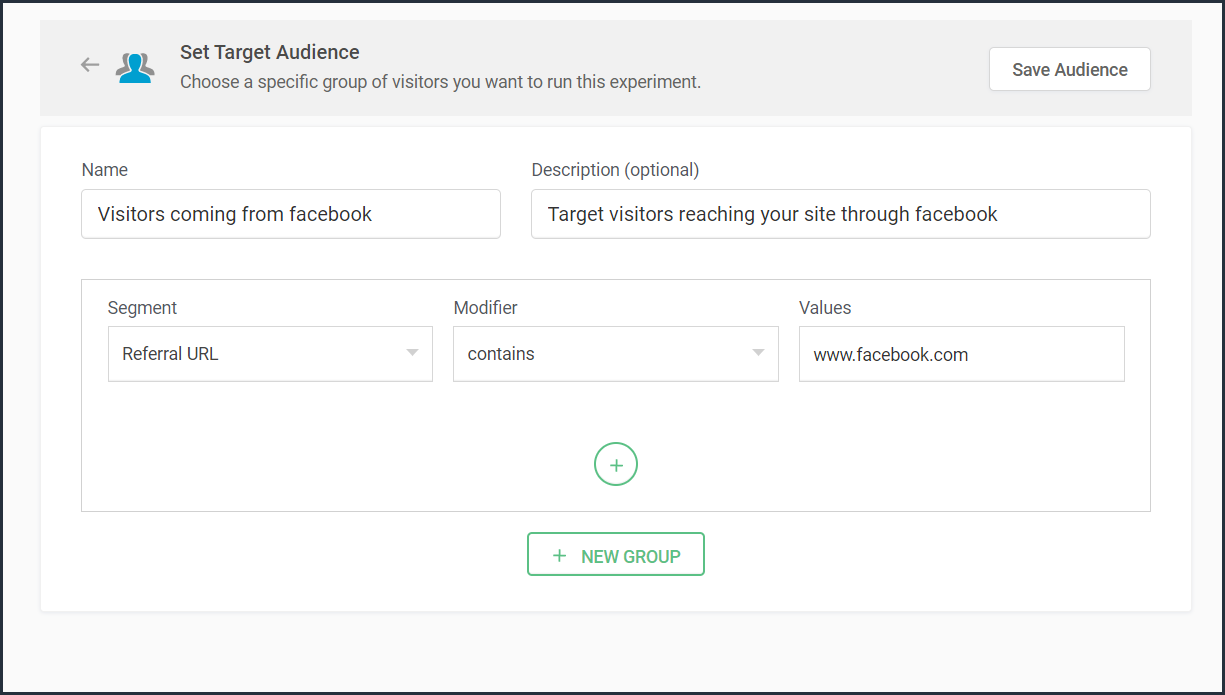
Bonus tip: Have no clear target audience in mind to run your experiments? Or don't know how to decide where to start when segmenting a target customer audience? Consider these points in choosing the right target audience segments:
- Do you have seasonal-only customers or customers who are only interested in certain types of products, services, or events?
- Are you an organization that needs to send different content to partners, sponsors, users, or other patrons?
- Does it matter if your contacts are local, domestic, or international?
- Have you thought about the requirements of users based on different weather conditions?
Was that useful? Please leave us your comment/feedback in the comment box below.
Are you looking to create a new custom audience segment to target in your experiment but aren't sure how to implement it? Just write to us at support@zohopagesense.com and we will be happy to guide you.
Are you looking to create a new custom audience segment to target in your experiment but aren't sure how to implement it? Just write to us at support@zohopagesense.com and we will be happy to guide you.
Start learning. Start customizing!
Topic Participants
Balarohini Paulraj
Sticky Posts
[Live Webinar] How to maximize your conversions using existing website traffic
Hello all, Did you know that on an average only 0.1% of your traffic converts? The rest are either heading towards your competitors or dropping off without being able to find what they came for. When you want to increase your conversions, it's naturalA/B Testing Idea #2: Make your headlines sound super cool.
Hello everyone, We're back with our second post in the CRO testing idea series. If you missed the first post, please check it out here: "Place irresistible and clear CTAs." In today's post, we'll look at how to effectively A/B test your headline content.A/B Testing Idea #1: Place irresistible and clear CTA buttons
Are you wasting much of your time and effort A/B testing every single idea that pops into your head, yet you're not generating sufficient traffic to your website? Don't worry—we've got you. We'd like to introduce you to the A/B Testing Ideas learningDid you know?#3: How to target and run your experiment based on custom audience segments in PageSense
Whatever kind of online business you're running, defining your target audience is the key factor to delivering relevant messages and further positioning your brand in the industry. Most marketing efforts revolve around this basic strategy of segmentingDid you know?#2: How to filter your report by custom date range in PageSense
Do you want to quickly view your experiment analysis or responses over different time periods? Want to effortlessly compare the performance of your website by specific weeks, months, or years? Also, see whether your new marketing strategies or efforts
Recent Topics
Enhanced Zoho CRM and Office 365 calendar synchronization features!
Dear customers, We're excited to share some significant improvements to our Office 365 calendar synchronization features, aimed at providing you with more control and a more personalized experience. What’s new Choose your Office 365 calendar: During theWhat are the best practices for managing tax records and financial information for a small business?
I’m interested in learning how other small business owners and accounting professionals organize their financial records and prepare for tax filing. With bookkeeping, expense tracking, income records, and tax documents all needing to stay accurate, havingHow to Open Google Takeout and Thunderbird MBOX Files?
MBOX files are used by email clients and services, such as Google Takeout and Mozilla Thunderbird, to store email messages. It can, however, be difficult to open such files if you don't have an email programme that is compatible. Google Takeout enablesConvert MBOX to PDF Free on Mac and Windows
MBOX files are widely used for storing email messages in email clients such as Thunderbird, Apple Mail, and other programs that support the MBOX format. Although this format is useful for handling emails, it can at times be inconvenient to access theHow to Convert Apple Mac Mail to PST for Outlook for Free?
Apple Mail is a widely used email program among Mac users, but what do you do if you want to transfer your emails to Microsoft Outlook? In such a situation—for example, when you are moving from a Mac to a Windows computer or when you need to use OutlookCannot apply tags to multiple items at once
It is very frustrating needing to apply tags to notes individually. Even worse that it takes multiple clicks to do it. Can there please be an update to: 1.) Allow us to apply tags to batches of notes in one go. 2.) Make it less clicks to add a tag 3.)Automating CRM backup storage?
Hi there, We've recently set up automatic backups for our Zoho CRM account. We were hoping that the backup functionality would not require any manual work on our end, but it seems that we are always required to download the backups ourselves, store them,not able to convert pdf to jpg and other forms and vice versa.
i want to change my pdf to jpg, word, etc and some times jpg to pdf. i don't know how to do in this.Changing an existing item to different accounts & inventory-tracked
Hi everyone, I have an item in Zoho Books that was originally set up as a non-inventory item. Over time, I associated it with different sales and purchase accounts, and I now have many invoices, bills, and reports that use this item. My business processAddress limits per customer by edition
I’m on the Standard edition and have reached a limit of 30 addresses under a single customer. Before I move to an annual Professional subscription, I need to confirm the following: What is the maximum number of addresses allowed under one contact, andHow to Convert Emails to PDF Format in Batch
It is helpful to convert emails into PDF format when you want to save important messages, when you need to share business correspondence, or when you wish to keep email records for future reference. PDF files can be readily opened, printed, and sharedMonths of WooCommerce–Zoho Inventory sync failures and repeated support requests – has anyone experienced this?
Months of WooCommerce–Zoho Inventory sync failures and repeated support requests – has anyone experienced this? I run a small retail business using WooCommerce and Zoho One. For months, I have been trying to resolve recurring synchronisation failuresFunction #24: Automatically display deal name from Zoho CRM on quotes in Zoho Books
Deals allow businesses to organize and visualize their sales pipeline. This provides a clear overview of all potential opportunities and helps in making informed decisions. Zoho CRM empowers you to create deals or potentials for your clients and monitorLookups and Custom Modules
I created a Custom Module that I'm calling "Item Purchasing Group". This module will store information for groups of Items that must be purchased together (including minimum overall quantities and/or values, etc.). This will have a one-to-many relationshipZoho Books | Product updates | October 2026
Hello users, October brings a range of new features and enhancements to Zoho Books, designed to simplify compliance, streamline accounting workflows, and improve inventory management. From the launch of the Nigeria Edition and France’s e-invoicing capabilitiesCreate custom rollup summary fields in Zoho CRM
Hello everyone, In Zoho CRM, rollup summary fields have been essential tools for summarizing data across related records and enabling users to gain quick insights without having to jump across modules. Previously, only predefined summary functions wereButton or Links order
Is there a way to re-order the buttons or links that are created? Moderation Update: With our recent enhancement to custom button creation from the layout editor, administrators can now reorder custom buttons directly from the layout editor, and thisZoho Books | Product updates | August 2026
Hello users, July has been an exciting month for Zoho Books! This month, we're excited to introduce HTML PDF Templates, Placeholders as Pills, expanded approval workflows for Sales Returns and Journals, and significant compliance updates across the India,Bulk updating tags
My organisation handles a number of restricted funds. We previously did this by having a chart of accounts where each restricted fund has its own income and expense accounts. However, our accountant changed this, moving all transactions into accountsDownload or Backup Bulk Emails from IMAP Server
Taking email messages from an IMAP server and saving them is a wise method for ensuring that important emails are kept safe and easy to access. No matter whether you have a business email address or a personal mailbox, keeping a local copy of your emailsZoho Writer Label Template Merge/Print Via API/Webhook/Flow
Short version of goal: To be able to kick off a Zoho Writer Label Template Document via API or Webhook or even using Zoho Flow. As of right now I have been unable to figure out a way to do that. Long version of goal: We would like to press a button (runKaizen #263: Using Zoho CRM Skill to Build Widgets
Hello everyone! Welcome back to another exciting Kaizen post. In the previous Kaizen posts, we introduced the zoho-crm skill.md and explored how it can help with Zoho CRM APIs, Client Scripts, complex COQL queries, and Skill to build Queries. In thisZoho notebook No login
Hello Team, I recently downloaded and installed the latest version of zoho notebook for windows. But I am not able to login without providing any sso or email address. Did you removed the no login feature for this app? This is just a windows app. canSearch is completely broken for PC
I go to note, try to search for "mtga" and it shows 702 results (it's a big note), highlights all letters "m" and I can't find anything. Same for "gathering" - it thinkgs I think only for "g". Looking for "zoho" shows as if I searched only for "z". UsingLosing description after merging tickets
Hello, We merge tickets when they are about the same topic from the same client. It happens sometimes. We recently noticed that after the merger only the description from the master ticket is left in a thread. And the slave-ticket description is erased.Behind a great customer experience is a team
Hi everyone, October is here, and the first week marks the Customer service week. Each year, we thank our customer service professionals. Service professionals are all around us, even in our own workplaces: They handle essential administrative work likeWhat's New - August and September 2026 | Zoho Backstage
Hello everyone, August and September bring a fresh wave of intelligence to Zoho Backstage. AI takes the spotlight with tools that help you create content, support attendees, and manage how AI fits into your events. Alongside AI, we’ve refined email communication,Images Not Displaying Properly in Zoho Desk
Hi, We are experiencing an issue with image rendering in Zoho Desk, affecting both incoming and outgoing emails. Images embedded in email conversations are not displaying properly. Instead, we see broken image icons or empty placeholders where the imagesAnnouncing the new SKILL.md for Zoho CRM and the updated OAS repository!
We are introducing a new zoho-crm skill to make working with Zoho CRM Developer tools (like APIs, functions, widgets, client scripts, queries etc) easier and faster, with the help of AI in your preferred AI harness like Claude Code, Codex, Cursor, VSCodeWidget Height were destroyed
All widget heights in the Details Canvas view are broken. Moderation Update: This is a known issue with widget heights in Client Script popups and flyouts. A fix is in progress, and this post will be updated once it's released.Zoho Projects - Has something changed regarding to linking Projects and Deals via the API?
I am trying to link Zoho Projects to Deals in CRM using the API, but each time, the Deal Contact is added as a Client user and receives an email invite asking them to join the organisation. These are internal projects and the customer should not haveHow long does it take to review campaigns?
Hello Zoho, i scheduled my campaigns yesterday afternoon and it has been under review for over how many hours and those campaigns were supposed to be out yesterday so new ones can go out today. Is there something i'm doing wrong?Convert MSG to PDF in Bulk with Attachment Free
Microsoft Outlook saves each email as an MSG file, keeping with it key information like the sender, the recipient, the subject, the date, the body of the message, and any attachments. It can, however, be quite difficult to access a large number of MSGUsing Mail Merge Template to Print Documents with One Subform Record's Fields per Document
Hello, We have a Mail Merge template created in Zoho Writer which is not able to perform the functionality which is currently required to automate the documentation task portion of our process. The CRM module we are primarily using is based on a "Loans"Convert MBOX to PST File Using Free Methods
MBOX is a mailbox format that is used by various email clients and services, such as Thunderbird, Apple Mail, Eudora, and Google Takeout. Yet, in order to be able to open your MBOX emails in Microsoft Outlook, you have to convert them from MBOX to PSTZoho Community Digest - September 2026 | Part 4
Hi everyone, and welcome back! The final week of September brought a revamped Books integration in Zoho CRM and Zoho Key Service for LLM access without API keys, Zoho Creator's audit trail becoming a full enterprise-grade auditing system, and Zoho OneAutomate weekly reports from Channels | Zoho Cliq AI use case #01
Scrolling endlessly through numerous threads in a Cliq channel and manually counting how many have been closed, how long people took to reply, and who actually participated can be tedious. After 20 minutes, you might have a number that no one can verify.Apple Mail to Outlook Converter - Export Apple Mac Mail to PST File
Apple Mail is a well-known email application among people who use Macs, whereas Microsoft Outlook is widely employed for both personal and business use. Should you decide to move from Apple Mail to Outlook, you'll probably need to transfer your mailboxCreator -Dynamic addition of Customer Portal User Licenses
Hi, We have a Creator App for B2C about to get released. We are experiencing the Portal User license challenge. Unable to predict the number of users who will download and Subscribe. When a User is about Subscribe and the portal licenses does not exists,Zoho Tables is now part of Zoho One!
Hey everyone! We've got some exciting news to share. Zoho Tables is now included in your Zoho One subscription at no extra cost. If you're already on Zoho One, head to your app list, add Zoho Tables, and get started right away. You don't need a separateNext Page