Advanced factors for multiple scoring rules: Now with Zia scoring automations for all modules
Greetings all,
We're happy to offer improved scoring features by adding extra scoring factors, including Zia Scores, in our multiple scoring rules (MSR) feature. These new factors—which empower existing traditional scoring factors—include criteria for different communication channels, and thus enable businesses to delve deeper into customer behavioral insights. This update introduces the ability to capture VoC data through Zia and assign scores based on sentiment, intent, competitor mentions, and more.
Additionally, we're rolling out a major enhancement to Zia Scores: Now, Zia Scores are merged with other scoring rules and can be used to set automation triggers across all modules.
What's new?
- Scoring Rules under Automation now includes Manual score and Zia Score. This new user experience keeps both the standard score and Zia Scores under the same roof so you can handle all scoring factors easily.

- Using manual scores, businesses assess prospects according to scoring rules that consider behavior, demographics, and other key details. Previously, we offered a much more limited number of scoring rule factors and conditions. Now, we've extended the number of channels, factors, and operators available in order to make scores more robust. On the scoring configuration page, you can only define rules for features and integrations that are enabled.

- Zia Scores now include a variety of scoring types, such as health scores, engagement scores, follow-up scores, field attribute scores, and conversion scores. This flexibility enables businesses to tailor the scoring mechanisms to align with their processes better, enhancing decision-making and outcome prediction.
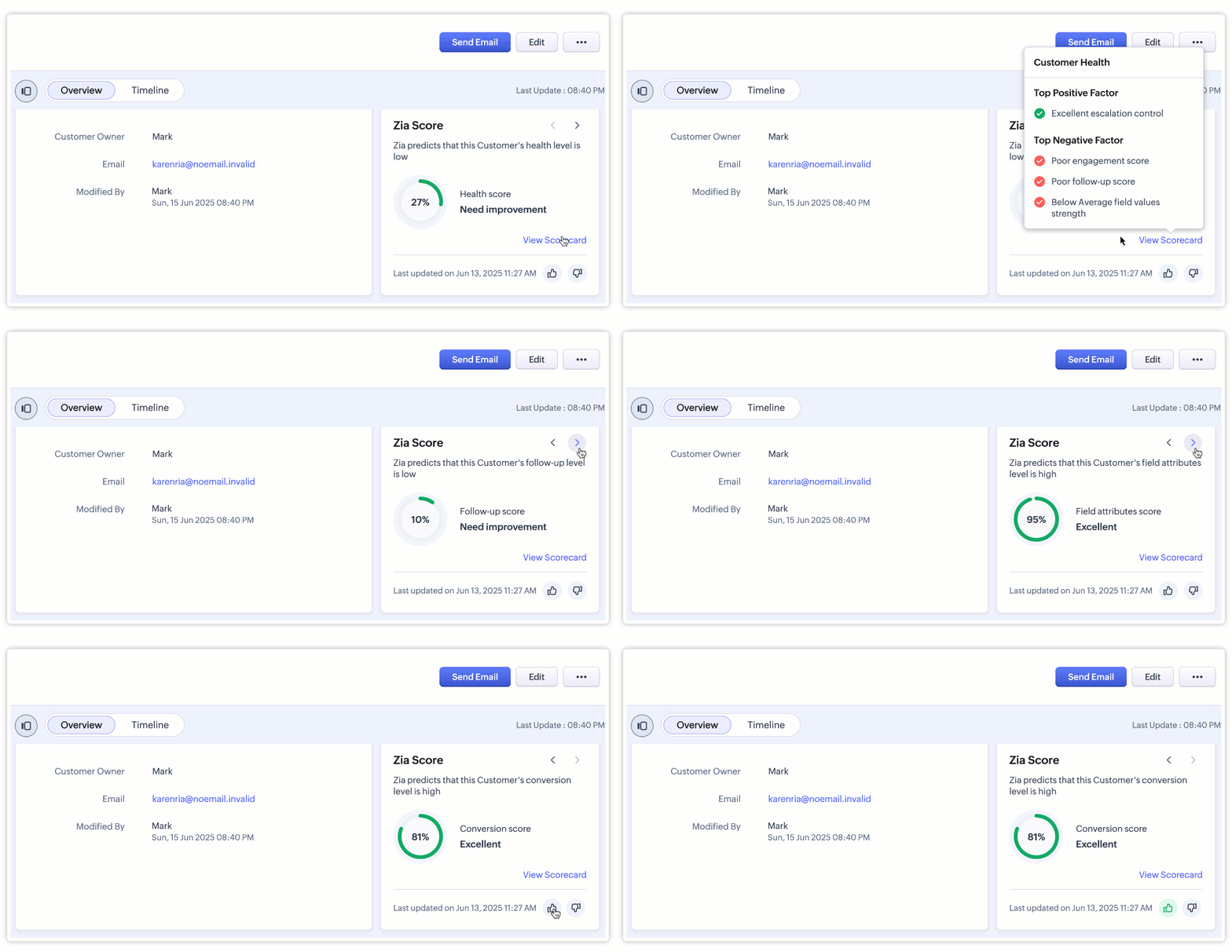
This feature extends the power of Zia's AI-driven insights across all modules and improves Zoho CRM's adaptability to diverse business needs.
Manual Scores
Let's look at the enhancements to manual scores in detail:
- The MSR feature now includes VoC Insights as a separate channel, which provides users with a deeper understanding of each record's interactions by setting conditions and points based on VoC.
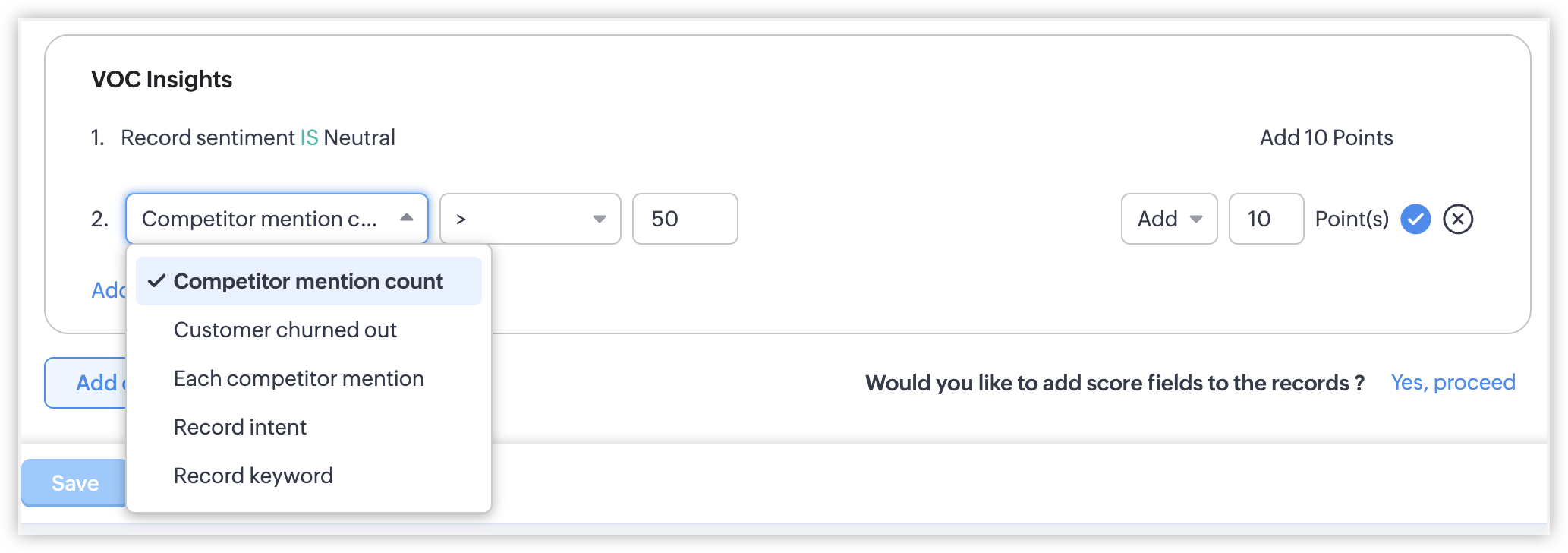
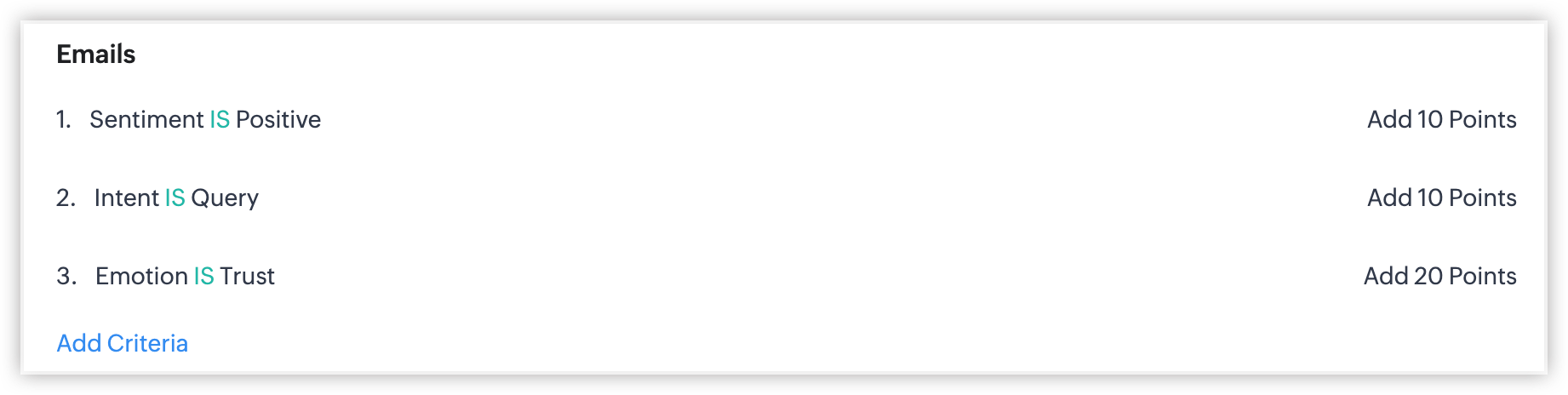
- To a few channels—like surveys, emails, help desk, phone, and social media—we've added AI factors like sentiments, emotions, intents, and insights, all captured through VoC. This overcomes the previous limitation of traditional CRM metrics lacking VoC data.
- Scoring rules provide additional operator options, such as setting criteria for specific time frames, checking number values, and more. For instance, you can add 10 points specifically for those who attended calls in the last 20 days.
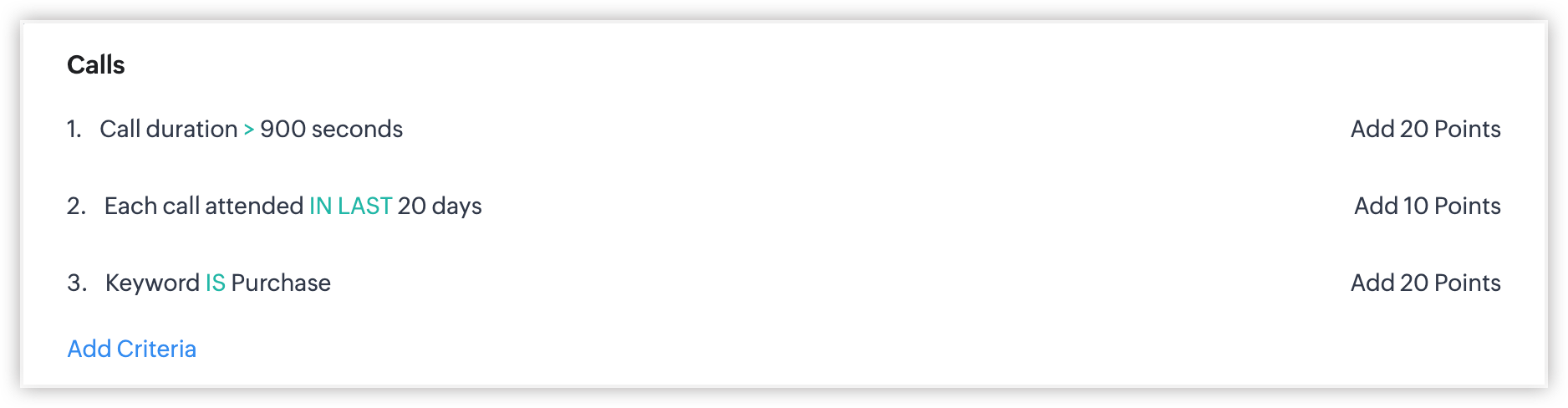
Operators determine how rules should operate for the points being added or subtracted. - We've combined factors listed under Email and Email Insights into one channel—Email—to avoid confusion.

Please refer to the table below for the consolidated list of the new factors against their respective channels:
Channel | New Factors | |
Business message | Incoming message | |
Sales IQ | Each SalesIQ chat missed | |
Calls | Each call made Call attended Call unattended Call received | Call duration Call sentiment Call emotion Call keyword |
Desk | New ticket New rating Ticket escalated New comment New response | Ticket overdue Mention Sentiment Intent Keyword |
Total emails received Competitor mentions Competitor mention count | Keyword Sentiment Intent Emotion | |
Survey | Sentiment Intent | Keyword |
VoC Insights | Record sentiment Record intent | Competitor mention Competitor mention count Churn out |
Deal Insights (VoC) | Closed won | Closed lost |

Notes:
- You can only set scoring rules for features whose integrations are enabled, except for Calls and VoC Insights.
- Any new record that meets the scoring criteria will not be affected by scoring rules that are no longer active.
- When a signal is disabled in a scoring rule, any data or insights related to that specific signal will no longer contribute to the scoring calculation.
- The scoring system continually resets scores for records based on each customer's most recent activity and engagement. This ensures that the record's score is up to date and reflects the latest customer interactions.
- If the rule configuration includes duration-based factors like "IN LAST 15 days," old records will be automatically updated by default.

Availability
DC: All DCs
Note:
- VoC dashboards are accessible to Enterprise, Ultimate, CRM Plus, and Zoho One organizations with 15+ user licenses. Early access is also open to EU, AU, IN, and US DC registered organizations. Accordingly, VoC insights are available only to these organizations.
- Zia Call Intelligence is accessible only to users in the US, EU, IN, CA, and SA DCs. Accordingly, scoring factors that depend on Call Intelligence are only available to these DCs.
Edition: Enterprise | Ultimate
Release plan: This enhancement to manual scoring rules is released to all DCs.
That's everything about Manual Scores under Scoring Rules.
Zia Scores
Let's look at the enhancements to Zia Scores under Scoring Rules in detail.
Zia Scores, which was previously located under System Recommendations, is shifting to Scoring Rules. We've introduced the field "Type," where you can choose to set either manual or Zia Scores while creating a rule.

Types of Zia Scores

Zia Scores are classified into five types:
- Field attribute score: This record score is automatically calculated based on the selected module's fields and the data in the record. It assesses the relevance, completeness, and accuracy of the data presented in those categories.
- Conversion score: For modules that have customer journey-based use cases (like Leads or Deals), the customer's conversion score is created by taking information from all the chosen related modules' data.
- Engagement score: Engagement scores use data from selected and related modules: Calls, Emails, and Meetings. Determining a customer's engagement score involves considering the level of interest the customer has, as sourced from incoming signals.
- Follow-up score: A salesperson's follow-up score assesses the timeliness, relevance, and impact of their follow-up communications or activities.
- Health score: Health scores for a customer's relationship with a business are for modules that don't depend on the record's definitive journey. Every touchpoint is taken into consideration, whether it's products purchased, deals made, communications made, tickets raised, or campaigns launched. It also considers customer engagement and user follow-up interactions.
Training data
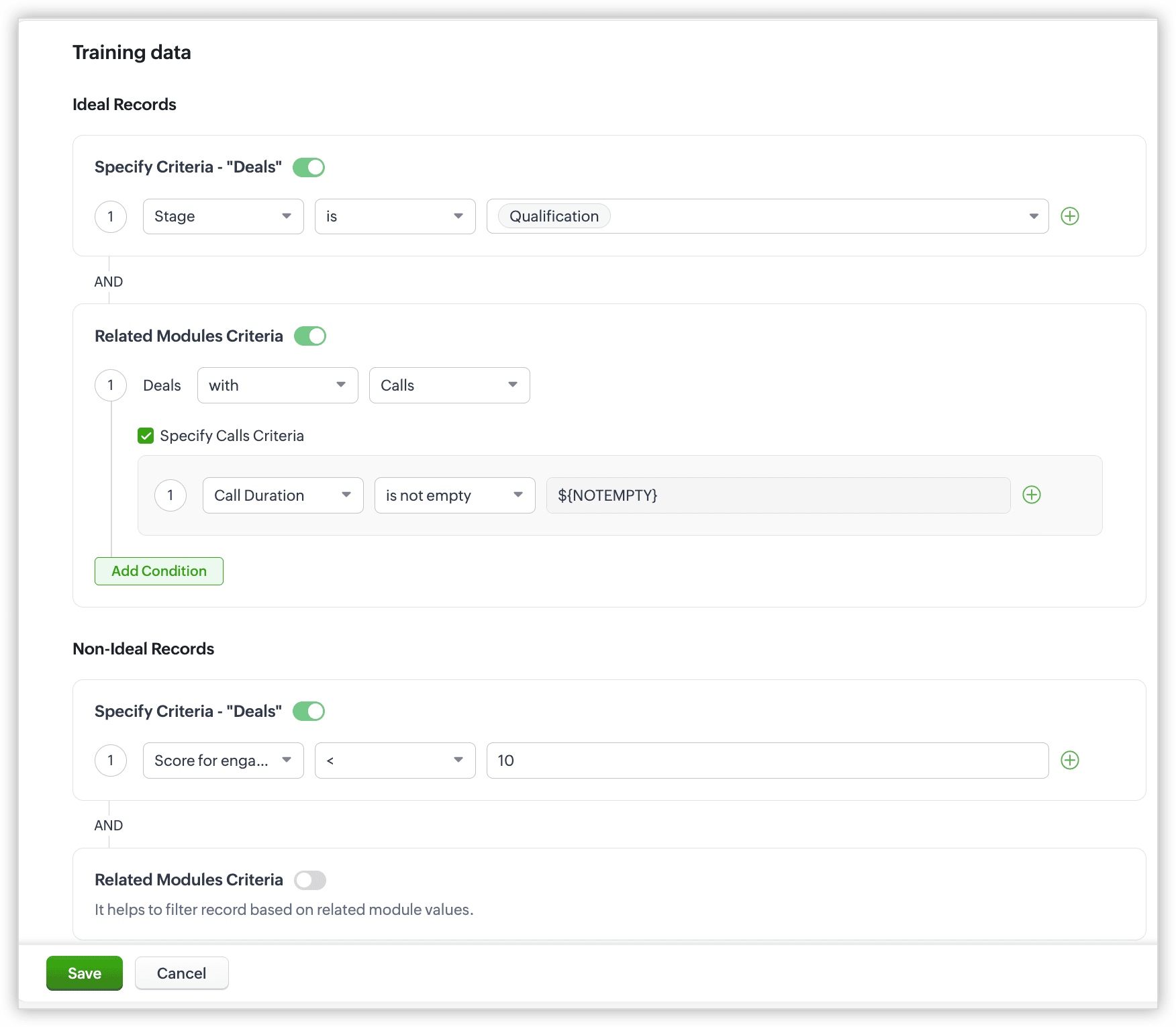
Training data enables Zia to identify meaningful patterns by comparing ideal and non-ideal records and assigning scores accordingly. It's important to establish criteria for these conditions (training data) for the records. Training data is a mandatory requirement to generate conversion and field attribute scores.
Limitations
- Zia Scores will not automatically apply to old (already existing) records. It applies to any existing record only when the record is edited after enabling Zia Scores.
- In manual scoring rules, a pop-up appears asking if the rule should apply to only new records or old records as well. For Zia Scores, by default, the rule applies to all new records added from the day after creating the rule.
- In the Enterprise edition, the limit is five scoring rules per CRM account.
- In the Ultimate edition, the limit is 10 scoring rules per CRM account.
Availability
DC: All DCs
Editions: Enterprise | Zoho One | Ultimate | CRM Plus
Release plan: This enhancement is released to all customers of all DCs. (Updated on 30th, July 2025)
That's everything about the enhancements to Zia Scores. Feel free to share your questions and suggestions as comments.
Help resources
Regards,
Fiona