Kaizen #193: Creating different fields in Zoho CRM through API
🎊 Nearing 200th Kaizen Post – We want to hear from you!
Do you have any questions, suggestions, or topics you would like us to cover in future posts? Your insights and suggestions help us shape future content and make this series better for everyone.
Hello all, welcome back to another exciting Kaizen post!
In Zoho CRM, you have the option to tailor modules according to your organization's unique needs using custom fields. These can be created manually in the module builder or via API.
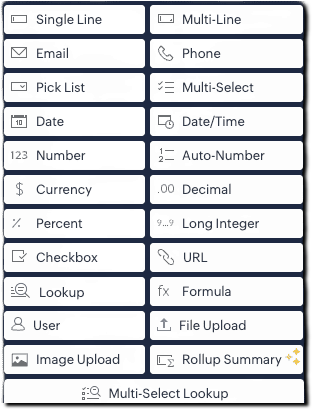
From Zoho CRM API version 6, you can add custom fields via API using the below endpoint:
|
POST
{api-domain}/crm/{version}/settings/fields?module={module_API_name}
|
From Zoho CRM API version 8, additional field types like multi-select lookups, multi-user lookup additions are also supported.
This article is intended to be a guide on how to create fields through the API.
|
Field Type (UI)
|
Field Data Type
|
|
Single Line
|
text
|
|
Multi-Line
|
textarea
|
|
Email
|
|
|
Phone
|
phone
|
|
Pick List
|
picklist
|
|
Multi Select
|
multiselectpicklist
|
|
Date
|
date
|
|
Date/Time
|
datetime
|
|
Number
|
integer
|
|
Auto-Number
|
autonumber
|
|
Currency
|
currency
|
|
Decimal
|
double
|
|
Percent
|
percent (only in POST)
|
|
Long Integer
|
bigint
|
|
Checkbox
|
Boolean
|
|
URL
|
website
|
|
Lookup
|
lookup
|
|
Formula
|
formula
|
|
User (Type- Single User)
|
userlookup |
|
User (Type- Multiple Users)
|
multiuserlookup
|
|
File Upload
|
fileupload
|
|
Image Upload
|
imageupload
|
|
Rollup Summary
|
rollup_summary
|
|
Multi-Select Lookup
|
multiselectlookup
|
The fields in below JSON are common for all fields. Field types such as single line text, phone, email, date, datetime, integer, and url fields consists of the below common fields alone and there are no dependent fields for them.
|
{
"fields": [
{
"field_label": "Your Field Label",
"data_type": "<field_type>",
"length": "<length>",
"tooltip": {
"name": "static_text",
"value": "Tooltip message"
},
"profiles": [
{
"id": "<profile_id_1>",
"permission_type": "read_write"
},
{
"id": "<profile_id_2>",
"permission_type": "read_only"
}
],
"external": {
"type": "user",
"show": false
},
"crypt": {
"mode": "decryption"
}
}
]
}
|
|
Key
|
Mandatory
|
Description
|
|
field_label
|
Yes
|
Display name of the field
|
|
date_type
|
Yes
|
Field type
|
|
length
|
No
|
Max number of characters allowed for a field |
|
filterable
|
No
|
Whether field can be used in filters. When set to true, the field will be available for use in Criteria Pattern Editors. Note that it is not applicable for imageupload, fileupload, textarea, and formula fields |
|
tooltip
|
No |
Field help text; name can be static_text or info_icon
|
|
profiles
|
No
|
Access control per profile (read_write, read_only, hidden)
|
| crypt |
No
|
Whether to encrypt the field (encryption or decryption)
|
|
unique
|
No
|
Enforce uniqueness across records
|
|
hipaa_compliance_enabled
|
No
|
Enable HIPAA protection
|
|
private
|
No
|
Enable GDPR-level handling (Low or High)
|
Single line Field
The single line field is a string field that can store 255 characters, and alphanumeric and special characters. It can be used to store fields like name, company, account name, etc. To create a single line field, give data_type as text.
A single line field can be marked as an external field. An external field is used to hold a record's unique ID available in an external system.
|
{
"fields": [
{
"data_type": "text",
"field_label": "External ID",
"external": {
"type": "org",
"show": true
}
}
]
}
|
Multiline Fields
The multi line field is a string field that can be used when you need a larger string field. It accepts alphanumeric and special characters. Multiline fields are of three types: plain text small, plain text large, and rich text field.
|
Multi-line field type
|
Character limit
|
Can be marked Mandatory?
|
Can be Encrypted?
|
|
Plain text small
|
Up to 2000
|
Yes
|
Yes
|
|
Plain text large
|
Up to 32000
|
Yes
|
No
|
|
Rich text (RTF)
|
Up to 50000
|
No
|
No
|
1) Plain Text Small Field
This type of multi-line field is ideal for concise entries up to 2000 character size. To create a plain text small multi line field, give data_type as textarea and type key in text area JSON object as "small".
|
{
"fields": [
{
"field_label": "Apartment_details",
"data_type": "textarea",
"length" : 2000,
"textarea": {
"type": "small"
}
}
]
}
|
2) Plain Text Large Field
This type of multi line field is ideal for more extensive entries of up to 32000 character size. To create a plain text large multi line field, give data_type as textarea and type key in text area JSON object as "large".
|
{
"fields": [
{
"field_label": "Apartment_details",
"data_type": "textarea",
"length" : 32000,
"textarea": {
"type": "large"
}
}
]
}
|
3) Rich text Field
Rich text field is ideal when formatted text needs to be entered. The length of the entry can be up to 50000 characters. To create a plain text large multi line field, give data_type as textarea and type key in text area JSON object as "rich_text"
|
{
"fields": [
{
"field_label": "Apartment_details",
"data_type": "textarea",
"length" : 50000,
"textarea": {
"type": "rich_text"
}
}
]
}
|
Picklist Field
Picklist is a field that lets you choose a value from a set of predefined values. The pick list value accepts all alphanumeric and special characters.
To create a picklist field, give data_type as picklist .Picklist fields have dependent JSON array - pick_list_values.
- pick_list_values: This JSON array comprises the options for the picklist field. Inside the array, display_value and actual_values stores the label shown for the picklist value in the CRM UI and the actual internal value of the picklist option respectively. The colour_code field consists of the color code of the picklist option in hex format, if color code is enabled.
- enable_colour_code - Boolean value that represents whether color code is enabled for the script
- history_tracking_enabled - This key when set as true audit/history tracking for the picklist field is enabled. Users with Module Customization permission can enable picklist history tracking. You can enable tracking for one picklist field per module, and this will be applicable across all layouts.
|
{
"fields": [
{
"field_label": "Your picklist's field label",
"data_type": "picklist",
"enable_colour_code": true,
"history_tracking_enabled": true,
"pick_list_values": [
{
"display_value": "Option 1",
"colour_code": "#af38fa",
"actual_value": "Option 1"
},
{
"display_value": "Option 2",
"colour_code": "#ffd6bc",
"actual_value": "Option 2"
},
{
"display_value": "Option 3",
"colour_code": "#cfddbc",
"actual_value": "Option 3"
}
]
}
]
}
|
Global picklist Field
Global sets in Zoho CRM is a type of picklist that helps you easily manage picklist values that recur across modules. To create a global picklist, use the Create Global Picklist API. The global picklist can then be associated to a module in the below format using the Create Custom Field API.
|
{
"fields": [
{
"field_label": "Source",
"data_type": "picklist",
"global_picklist": {
"id": "72223455366"//Id of the global picklist
}
}
]
}
|
Multi-Select Picklist Field
Multi-select picklist allows you to select multiple values while creating or editing record. The pick list value accepts all alphanumeric and special characters. To create a multi select picklist, give data type as multiselectpicklist.
Note that Picklist tracking is not supported for multi-select picklists
|
{
"fields": [
{
"field_label": "Preferred working days",
"data_type": "multiselectpicklist", // Specify the data type as multiselectpicklist*
"pick_list_values": [
{
"display_value": "Monday",
"actual_value": "1"
},
{
"display_value": "Tuesday",
"actual_value": "2"
},
{
"display_value": "Wednesday",
"actual_value": "3"
},
{
"display_value": "Thursday",
"actual_value": "4"
},
{
"display_value": "Friday",
"actual_value": "5"
}
],
"pick_list_values_sorted_lexically": true,
"enable_colour_code": true
}
]
}
|
Auto Number Field
Auto Number fields are used for assigning a unique incremental number automatically to each record, making identification easy. To create an auto number field, set "data_type" as "autonumber" and include an auto_number object with the following keys:
- start_number (mandatory) – Starting value for the auto-number sequence.
- prefix (optional) – (String) to prepend to the number.
- suffix (optional) – (String) to append to the number.
- _update_existing_records (optional) – (Boolean). If set to true, updates existing records with new auto-numbers based on the current format. Default value is false.
|
{
"fields": [
{
"field_label": "Order ID",
"data_type": "autonumber",
"auto_number": {
"start_number": 1000,
"prefix": "ORD-",
"suffix": "-2025",
"_update_existing_records": true
}
}
]
}
|
Currency Field
Currency field is used to store amount values. To create a currency field, set "data_type" as "currency" and define the currency JSON object with the following keys:
- rounding_option(mandatory) – Specifies how values should be rounded:
- "normal" – No rounding.
- "round_off" – Rounds to nearest based on precision.
- "round_up" – Always rounds up based on precision.
- "round_down" – Always rounds down based on precision.
- precision(optional) – Number of decimal places displayed in the UI (e.g., 123.466 with precision 2 becomes 123.47).
- decimal_place(optional) – Maximum number of decimal places stored. Values beyond this are truncated. Max allowed decimal places: 9.
|
{
"fields": [
{
"field_label": "Deal Amount",
"data_type": "currency",
"currency": {
"rounding_option": "round_up",
"precision": 2,
"decimal_place": 3
}
}
]
}
|
Decimal Field
Decimal field is used to store decimal numbers. To add a decimal (floating point) number field, use "data_type": "double".
- length(optional) – Total number of digits allowed, including both sides of the decimal point.
- decimal_place(optional) – Number of digits to allow after the decimal point (e.g., 2 means values like 123.45).
|
{
"fields": [
{
"field_label": "Discount Rate",
"data_type": "double",
"length": 16,
"decimal_place": 2
}
]
}
|
Percent Field
This field type is used to capture percentage values, such as scores or growth rates. To create a percentage field, use "data_type": "percent".
|
{
"fields": [
{
"field_label": "Enrollment number",
"data_type": "bigint",
"length": 18,
"separator": true
}
]
}
|
Long Integer Field
Long Integer Fields are number fields that accept up to 18 digits. To create a long integer field, use "data_type": "bigint".
|
{
"fields": [
{
"field_label": "Enrollment number",
"data_type": "bigint",
"length": 18,
"separator": true
}
]
}
|
Separator: a Boolean key that indicates whether the number is formatted for better readability. It is applicable for data types integer, double, bigint. Refer to this article on changing locale information for information on how to change it.
Checkbox Field
Checkbox value allows you to select or unselect a value indicating true or false. To create a checkbox field, use "data_type": "boolean".
|
{
"fields": [
{
"field_label": "Previously Employed?",
"data_type": "boolean"
}
]
}
|
Lookup Field
Use "data_type": "lookup" to associate records from another module. The lookup JSON object defines the target module, display label, and optional filter criteria.
-
module.api_name(mandatory) – API name of the target module (get via Modules API).
-
display_label(mandatory) – Label shown in the related list.
-
query_details(optional) – Used to define lookup filters. Inside query_details JSON Object following keys are present:
-
criteria(mandatory if query_details is used) – Filter logic.
-
group_operator – "AND"/"OR" (required for multiple conditions).
-
group – Array of filter conditions. Each condition includes:
-
field.api_name: Field in the target module
-
comparator: Operator like contains, equal
-
value: Value to match
-
revalidate_filter_during_edit(optional) – If true, validates filter conditions on record edit.
|
{
"fields": [
{
"field_label": "Your lookup",
"data_type": "lookup",
"lookup": {
"module": {
"api_name": "Contacts"
},
"display_label": "Contact Lookup",
"revalidate_filter_during_edit": true,
"query_details": {
"criteria": {
"group_operator": "AND",
"group": [
{
"field": {
"api_name": "Phone"
},
"comparator": "contains",
"value": "91"
},
{
"field": {
"api_name": "Lead_Source"
},
"comparator": "equal",
"value": [
"Cold Call"
]
}
]
}
}
}
}
]
}
|
Formula Field
Formula fields are used to calculate different types of values, including numeric values, text values, date values, etc. Use "data_type": "formula" to calculate dynamic values based on other fields.
For more details on all the available usages in the formula field, refer to this help doc on formula field. The formula object defines the logic and output type.
- formula.return_type (mandatory for formula field) – Output type of the formula. Possible values: double, currency, text, date, datetime, boolean
- formula.expression(mandatory) – The actual formula logic (e.g., "Sqrt(Len(${Email}))").
- decimal_place(optional) – Number of decimal places (only for double or currency).
- number_separator(optional) – If true, formats the number using separators (default is true).
|
{
"fields": [
{
"field_label": "Total amount",
"data_type": "formula",
"formula": {
"return_type": "double",
"expression": "${Amount} + 150"
},
"decimal_place": 0,
"number_separator": false
}
]
}
|
Auto refresh formula field
These type of formula fields are used when you need an accurate time measurement whenever you view the record. The key "dynamic" set as true indicates that the field is an auto refresh formula field.
For example, the age of a deal can be calculated by comparing the created time of the deal with the current time. A condition can be given to stop computing the value of the auto refresh field.
- dynamic: When set as true, indicates that the formula field is an auto refresh field.
- stop_compute_conditionally: When set as true, indicates that the computation of field stops when the condition given in stop_compute_expression key
-
stop_compute_expression: Mandatory when stop_compute_conditionally is true. Consists of the condition for stopping computation of the auto refresh formula field.
|
{
"fields": [
{
"field_label": "Deal Age",
"data_type": "formula",
"formula": {
"expression": "Datecomp(${Created_Time},Now())",
"return_type": "double",
"dynamic": true,
"stop_compute_conditionally": true,
"stop_compute_expression": "${Probability}==100"//When the deal probability is 100, the calculation gets stopped.
}
}
]
}
|
User lookup Field
User lookup field is used to associate a specific user to a record of the module. Use "data_type": "userlookup" to add a user lookup field.
The lookup JSON object defines the key properties of the user lookup
- query_details (JSON object): Defines filters to restrict which users are selectable.
- criteria: Uses a group of field conditions (field, comparator, value) with a group_operator (AND, OR) to filter users.
- revalidate_filter_during_edit (Boolean): If true, the criteria is reevaluated on record edit for the value selected on the record creation. This option is useful when associated values or fields have changed due to updates. It allows users to re-check and confirm that the correct records are still linked when editing the record.
- sharing_properties (JSON object): Contains details of access given to users
- share_preference_enabled (Boolean): If true, enables access to the records for the users.
- share_permission (String): Defines what level of access the associated user has (e.g., "read-only", "full-access", "read-write").
|
{
"fields": [
{
"field_label": "Assigned Sales Rep",
"data_type": "userlookup",
"tooltip": {
"name": "info_icon",
"value": "Sales user responsible for this lead"
},
"lookup": {
"revalidate_filter_during_edit": true,
//associate only users from countries India, and email containing "zylker.com".
"query_details": {
"criteria": {
"group_operator": "AND",
"group": [
{
"field": {
"api_name": "country"
},
"comparator": "equal",
"value": "India"
},
{
"field": {
"api_name": "email"
},
"comparator": "contains",
"value": "@zylker.com"
}
]
}
}
},
"sharing_properties": {
"share_preference_enabled": true,
"share_permission": "read-only"
}
}
]
}
|
Multiuser lookup Field
Multi-user look up is a lookup field that lets you add multiple users to a module record. It allows you to establish many-to-many relationships between modules and users in CRM.
Multi user lookup can be added by using the data_type "multiuserlookup".
- record_access: This Boolean key when marked as true indicates that the added user has access to the record. The users selected in the multi-user lookup field will be able to 'Edit', 'Delete', 'Change the owner' of that respective record
|
{
"fields": [
{
"field_label": "Associated_Agents",
"data_type": "multiuserlookup",
"multiuserlookup": {
"record_access": true
}
}
]
}
|
File Upload Field
User data type "fileupload" to add a file upload field
|
{
"fields": [
{
"field_label": "Resume Upload",
"data_type": "fileupload",
"length": 1,// Allow only 1 file, Maximum length : 5
"tooltip": {
"name": "info_icon",
"value": "Upload the applicant's resume in PDF or DOC format"
}
}
]
}
|
Image Upload Field
User data type "imageupload" to add an image upload field
|
{
"fields": [
{
"field_label": "Profile Photo",
"data_type": "imageupload",
"length": 1, // Only 1 profile photo allowed, Maximum length 10
"tooltip": {
"name": "info_icon",
"value": "Upload a professional head shot for the employee record"
}
}
]
}
|
Rollup Summary Field
Rollup Summary is a field that aggregates or summarizes a desired related list field. Rollup Summary Fields are of two types - Custom Rollups and Predefined Rollups. You can create only custom rollups using APIs. Supported related modules for APIs are Calls, Meetings, and Tasks
- function - Indicates the mathematical function applied to calculate the rollup summary.
- field_label - Represents the label of the field as it appears in the UI.
- data_type - This must be set to "rollup_summary" for rollup summary field.
- rollup_summary - This object contains all the configuration details for the rollup field.
- return_type - Specifies the type of value returned.
- expression - Defines the calculation logic for the rollup.
- function_parameters An array containing parameters needed by the function, typically including:
- api_name: The field being summarized.
- criteria Defines the filters to apply to the related records. Each condition includes:
- group_operator: If there are multiple conditions, you should also include AND or OR as the group operator for the conditions. It consists of an array of conditions.
- group: Array element of a condition
- field
- api_name: The API name of the field.
- comparator: The comparison operator (e.g., equal, greater_than, contains).
- value: The value used in the comparison.
- function - The function to be applied to the filtered records. Allowed functions : COUNT, MAXIMUM, MINIMUM, AVERAGE, RECENT, UPCOMING, EARLIEST.
- based_on_module - Specifies the module from which to summarize related records.
- related_list - Indicates the related list within the module (e.g., "Deals", "Contacts") to summarize from.
|
{
"fields": [
{
"field_label": "Total Invoice Amount",
"data_type": "rollup_summary",
"rollup_summary": {
"return_type": "currency",
"expression": {
"function_parameters": [
{
"api_name": "Grand_Total"
}
],
"criteria": {
"group_operator": "AND",
"group": [
{
"comparator": "equal",
"field": {
"api_name": "Billing_Country"
},
"value": "United States"
},
{
"comparator": "greater_than",
"field": {
"api_name": "Invoice_Date"
},
"value": "2024-01-01"
}
]
},
"function": "SUM"
},
"based_on_module": {
"api_name": "Invoices"
},
"related_list": {
"api_name": "Invoices"
}
}
}
]
}
|
Multi-Select Lookup Field
Multi-Select Lookup Field enables you to establish a many-to-many relationship between two modules in CRM.
- multiselectlookup : The mulitselectlookup JSON object specify the linking details between the module in which the field is present and another module
- connected_details: This JSON object contains details about the module you want to connect the current module with.
- module.api_name: Specify the module API name you want to link the current module with.
- field.field_label: When connecting a module, the system creates a new lookup field in the connected module for the current module. Use this key to specify a field label in the connected module.
- linking_details: When creating a multi-select lookup field, the system creates a separate module connecting these two modules, which contains their common details. This module is called the linking module
- module: Consists of the details of the linking module.
- plural_label: Specify a plural label for the linking module.
|
{
"fields": [
{
"field_label": "Skills",
"data_type": "multiselectlookup",
"multiselectlookup": {
"connected_details": {
"module": {
"api_name": "Skills"
},
"field": {
"field_label": "SkillName"
}
},
"linking_details": {
"module": {
"plural_label": "EmpXSkill"
}
}
}
}
]
}
|
Previous Kaizen Post : Kaizen #192 - Implementing Custom Token Persistence|Kaizen Directory
Topic Participants
Mable Mary M P
Juan
Maria Antony Betson M
Jeganprabhu S
Sticky Posts
Kaizen #198: Using Client Script for Custom Validation in Blueprint
Nearing 200th Kaizen Post – 1 More to the Big Two-Oh-Oh! Do you have any questions, suggestions, or topics you would like us to cover in future posts? Your insights and suggestions help us shape future content and make this series better for everyone.Kaizen #226: Using ZRC in Client Script
Hello everyone! Welcome to another week of Kaizen. In today's post, lets see what is ZRC (Zoho Request Client) and how we can use ZRC methods in Client Script to get inputs from a Salesperson and update the Lead status with a single button click. In thisKaizen #222 - Client Script Support for Notes Related List
Hello everyone! Welcome to another week of Kaizen. The final Kaizen post of the year 2025 is here! With the new Client Script support for the Notes Related List, you can validate, enrich, and manage notes across modules. In this post, we’ll explore howKaizen #217 - Actions APIs : Tasks
Welcome to another week of Kaizen! In last week's post we discussed Email Notifications APIs which act as the link between your Workflow automations and you. We have discussed how Zylker Cloud Services uses Email Notifications API in their custom dashboard.Kaizen #216 - Actions APIs : Email Notifications
Welcome to another week of Kaizen! For the last three weeks, we have been discussing Zylker's workflows. We successfully updated a dormant workflow, built a new one from the ground up and more. But our work is not finished—these automated processes are
Recent Topics
Automation #3 - Auto-sync email attachments to tickets
This is a monthly series where we pick some common use cases that have been either discussed or most asked about in our community and explain how they can be achieved using one of the automation capabilities in Zoho Desk. Most of our customers use emailAutomation #11 - Auto Update Custom Fields with Values from Emails
This is a monthly series designed to help you get the best out of Desk. We take our cue from what's being discussed or asked about the most in our community. Then we find the right use cases that specifically highlight solutions, ideas and tips to optimizeAutomation #13 - Auto assign tickets based on agent shift time
This is a monthly series designed to help you get the best out of Desk. We take our cue from what's being discussed or asked about the most in our community. Then we find the right use cases that specifically highlight solutions, ideas and tips to optimizeAutomation #14: Capture Jira Issue Key/ID in a Ticket Custom Field
Hello Everyone! This month's edition brings you a custom function to consolidate your records associated with Jira integration. Jira integration enables support engineers and R&D units to collaborate seamlessly on feature development, product improvement,Automation #16: Automate Ticket Reopening on Scheduled Timestamp
Hello Everyone! This edition uncovers the option to schedule reopening a ticket automatically. Zylker Finance tracks insurance policyholder activities through Zoho Desk. For policyholders who pay monthly premiums, tickets are closed upon payment completion.Automation#19:Auto-Close Tickets Upon Task Completion
Hello Everyone! We’re excited to bring you another custom function this week. In this edition, we’ll show you how to automatically close tickets when all associated tasks are marked as completed. Let’s see how ZylkaPure, a leading water filter company,Automation #15: Automatically Adding Static Secondary Contacts
Rockel is a top-tier client of Zylker traders. Marcus handles communications with Rockel and would like to add Terence, the CTO of Zylker traders to the email conversations. In this case, the emails coming from user address rockel.com should have TerenceImproved UX design for Projects CRM integration
The current integration embeds the entier projects inteface into the CRM this is confusing and allows users to get lost. For example as a user i navigate to an account and go down to the related projects list and want to get information about a specificLink Purchase Order to Deal
Zoho Books directly syncs with contacts, vendors and products in Zoho CRM including field mapping. Is there any way to associate vendor purchase orders with deals, so that we can calculate our profit margin for each deal with connected sales invoicesTransformer vos stocks en décisions intelligentes avec Zoho Inventory et Zoho Analytics
Zoho Inventory permet de suivre facilement les niveaux de stock et d’anticiper les restockages. Pour de nombreuses entreprises, cela suffit à gérer les opérations au quotidien. Mais à mesure que l’activité se développe, cette clarté peut commencer à montrerZoho Commerce - Poor Features Set for Blogging
Hi Zoho Commerce team, I'm sure you will have noticed that I have been asking many questions about the Blogs feature in Commerce. I thought that it would be useful if I share my feedback in a constructive way, to highlight the areas which I feel needSecurity Enhancements | Migrate to the Updated Policies
Hello everyone, Zoho Directory's security policies have been updated and reorganized into three new policies with features that enhance the overall organization security. These policies provide a stronger and more secure sign-in methods and improve theBring Zoho Shifts Capabilities into Zoho People Shift Module
Hello Zoho People Product Team, After a deep review of the Zoho People Shift module and a direct comparison with Zoho Shifts, we would like to raise a feature request and serious concern regarding the current state of shift management in Zoho People.Facturation électronique 2026 - obligation dès le 1er septembre 2026
Bonjour, Je me permets de réagir à divers posts publiés ici et là concernant le projet de E-Invoicing, dans le cadre de la facturation électronique prévue très prochainement. Dans le cadre du passage à la facturation électronique pour les entreprises,Quick Create needs Client Script support
As per the title. We need client scripts to apply at a Quick Create level. We enforce logic on the form to ensure data quality, automate field values, etc. However, all this is lost when a user attempts a "Quick Create". It is disappointing because, fromHow to block a WhatsApp user for sending spam
Is there a way to block those whatsapp users that just come to play and annoy our service, they also spam us. We have a waba service with sales iqInquiry regarding auto-save behavior for Zoho Sign Embedded Sending
Dear Zoho Support Team, I am currently integrating Zoho Sign's Embedded Sending functionality using iframes on my website. I would like to know if there is a way to ensure that the document state (including any added fields) is automatically saved asIntroducing Connected Records to bring business context to every aspect of your work in Zoho CRM for Everyone
Hello Everyone, We are excited to unveil phase one of a powerful enhancement to CRM for Everyone - Connected Records, available only in CRM's Nextgen UI. With CRM for Everyone, businesses can onboard all customer-facing teams onto the CRM platform toAutomation#17: Auto-Create Tasks in Zoho Projects Upon Ticket Creation in Zoho Desk
Hello Everyone, This edition delivers the solution to automatically create a task in Zoho Projects when a ticket is created in Zoho Desk. Zylker Resorts uses Zoho Desk for bookings and handling guest requests. Zylker resorts outsources cab bookings toAutomation#20 : Auto-Add Ticket Tags based on Keywords
Hello Everyone! Welcome to unveiling custom functions on our Community series. This week's post lets you add tags to your tickets automatically based on the keywords in the ticket subject and the ticket thread. Discover how this custom function helpsAutomation#21: Track Ticket Transfers Across Departments
Hello Everyone! With Halloween just around the corner, we'd like to let you know the Zoho Desk team is always there to sweep away your customer service troubles! This week, we’re excited to introduce a custom function that tracks tickets moved betweenEmail Integration - Zoho CRM - OAuth and IMAP
Hello, We are attempting to integrate our Microsoft 365 email with Zoho CRM. We are using the documentation at Email Configuration for IMAP and POP3 (zoho.com) We use Microsoft 365 and per their recommendations (and requirements) for secure email we haveHomepage not assignable to group
MS Teams for daily call operations
Hello all, Our most anticipated and crucial update is finally here! Organizations using Microsoft Teams phone system can now integrate it effectively with Zoho CRM for tasks like dialling numbers and logging calls. We are enhancing our MS Teams functionalityAutomation#22 Track Ticket Duration at Specific Status
Hello Everyone! Welcome back to the Community Learning Series! Today, we explore how Zylker Techfix, a gadget servicing firm, boosted productivity by tracking the time spent at a particular ticket status in Zoho Desk. Zylker Techfix customized Zoho Desk’sAutomation#23: Automate Guided Conversations in Zoho Desk with Business Hours
Hello Everyone, This week's edition introduces a custom function designed to automate Guided Conversations in Zoho Desk, based on your business hours. With this feature, you can align the bot's behavior with your business schedule, ensuring a smooth andAddress changes in quote form
When entering a quote, the first piece of information required is the Account, which properly populates the billing and shipping address fields. Then I use the lookup function to select a contact, and when I do, the billing and shipping addresses areAutomation#24: Auto-Update custom field from Accounts to Tickets
Hello Everyone! Welcome back to the Community Learning Series! This episode dives into how Zylker Techfix streamlines account-related ticket references. Previously, employees had to manually check account details to retrieve specific customer information,Kaizen #227 : Client Script Support for List Page (Canvas)
Hello everyone! Welcome to another week of Kaizen. In today's post lets see how Client Script can be used in Canvas List Page to mask sensitive information from specific roles and add colors to Canvas List Page records based on custom criteria.This useImplement Date-Time-Based Triggers in Zoho Desk
Dear Zoho Desk Support Team, We are writing to request a new feature that would allow for the creation of workflows triggered by specific date-time conditions. Currently, Zoho Desk does not provide native support for date-time-based triggers, limitingAutomation#25: Move Tickets to Unassigned When the Owner Is Offline
Hello Everyone, Welcome to this week's Community Series! 'Tis the holiday season—a time when work often takes a brief pause. The holiday spirit is in full swing at Zylker Techfix too, with employees taking some well-deserved time off. During this period,Automation#27: Retain Ticket Owner on Moved Tickets
Hello Everyone! This week, we present to you a custom function that retains the ticket owner when a ticket is moved from one department to another. Here’s more to help you understand the custom function: At Zylker Techfix, Alex, the Support Engineer managesAutomation#28 Notify Agents on Article Expiry
Hello Everyone! This week, we’re bringing you a feature that notifies your team when articles in the Knowledge Base are set to expire to keep your content relevant and helpful for customers. The Zoho Desk's Knowledge Base is an asset for customers toAutomation#29 Retain ticket status on moved tickets
Hello Everyone, Hear out Zylker Techfix’s Success Story on Smoother Ticket Transitions! Zylker Techfix, a gadget servicing firm committed to quick repairs and timely deliveries, faced a challenge when ticket statuses changed automatically while movingAutomation#32:Auto Add New Portal Users to the Help Center User Groups
Hello Everyone, Introducing a custom function that automates the process of adding new portal users to Help Center user groups, making user management effortless! By default, Zoho Desk allows you to assign new portal users to groups manually. But withAutomation#34 : Automate Email threading for Ticket notification
Hello Everyone, It's been a while since we've presented an automation. However, our community has been buzzing with ideas, use cases, and discussions with our community experts and Ask the Experts session. So, here we are again, presenting an automationAutomation#35 : Auto-Add Comments under the Owner's Name in Tickets via Macros
Hello Everyone, This week's custom function provides simple steps to configure a Macro for adding comments to tickets with the name of the Comment owner. When managing tickets, you can use the Comment feature to communicate internally with your team andAutomation#36: Auto-create time-entry after performing the Blueprint transition
Hello Everyone, This week’s edition focuses on configuring a custom function within Zoho Desk to streamline time tracking within the Blueprint. In this case, we create a custom field, and request the agent to enter the spending time within the singleAutomation#33: Automate Splitting Names for Existing Contact Records
An organized directory – who doesn't love one? Previously, we explored how to split contact names into First Name and Last Name for new contacts in Zoho Desk. But what about existing contacts already in your database? This week, we bring you a customWorkqueue
I really like the idea of the Workqueue generally - it will be really useful. What it seems to lack however, is the ability to customise it properly. I want to be able to show a custom view rather than just "My Leads" and "Leads Assigned in Last 3 hours".Next Page