Kaizen 231 - Embedding Zoho Desk Tickets in Zoho CRM

Hello, CRM Wizards!
We will use the Zoho Request Client inside a Related List widget to display open Zoho Desk tickets directly within the Contact record in Zoho CRM. This integration allows Sales and Support teams to access active support issues without switching applications.
Business Problem
At Zylker, a manufacturing company that manages high-value distributors and enterprise buyers, sales operations run in Zoho CRM while customer support manages warranty claims and service issues in Zoho Desk.
This separation creates operational friction during critical customer interactions.
1. Lack of visibility into open support tickets
Sales representatives cannot see ongoing support tickets when interacting with customers in CRM. This results in:
- Sales conversations happening without awareness of active complaints.
- Poor customer experience when unresolved issues surface unexpectedly.
- Reduced productivity due to frequent system switching between CRM and Desk.
2. No Controlled Escalation Mechanism
There is no structured way to initiate ticket escalations from within Zoho CRM.
Solution
This week we will focus on solving the visibility gap.
We will embed a related list widget within Contact detail page and provide real-time visibility of open tickets.
Prerequisites
2. A two-way sync between Zoho CRM and Zoho Desk is required to keep Contacts and Accounts consistent across both applications.
With this support, any change made to a Contact or Account in either application is automatically reflected in the other.
Additionally, each record in Zoho Desk stores the corresponding Zoho CRM record ID. This allows you to reference the CRM record directly and perform further customizations or integrations using that unique ID.
Follow the steps to create the two-way sync:
- Log into Zoho Desk.
- Go to Settings > Integration > Zoho.
- Choose Zoho CRM and click Integrate.
- On the Authentication page:
- Enter your email address.
- Choose the CRM organization you want to integrate with.
- Click Authorize.
- Once authenticated, the sync configuration page opens.
- Select the sync type as Two-way Sync.
- Map the fields of Accounts and Contacts modules between Zoho Desk and Zoho CRM.
- Click Start Sync to initiate the integration.

Refer to the Integrating Zoho Desk with Zoho CRM help page for more details.
3. Create a Zoho Desk connection in Zoho CRM with Desk.tickets.READ and Desk.contacts.READ scopes.
Refer to the Connections help doc for more information. Store the Connection Link Name to use while making API calls.

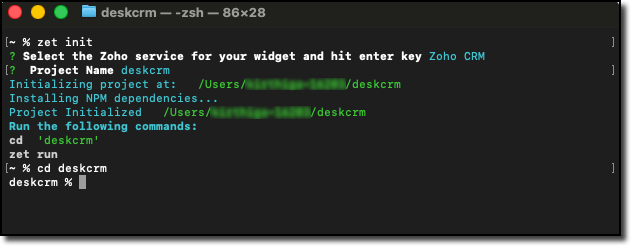
4. Create a local project folder for widget using Zoho CLI as mentioned in Creating your First Widget help guide.
Step-by-Step Implementation
In the widget project directory, code the following logic in the widget.html file.
Step - 1: Get the Current CRM Contact ID
On page load, you can capture the entity ID with the help of PageLoad event listener.
Also create a reusable ZRC instance configured with the Zoho Desk base URL and OAuth connection name.
// Initialize the embedded app ZOHO.embeddedApp.on("PageLoad", async function(data) { console.log("PageLoad data:", data); // Step 1: Get the entity (module) and entity ID (Contact record ID) if (data && data.Entity && data.EntityId) { entityModule = data.Entity; entityId = data.EntityId; console.log("Entity:", entityModule); console.log("Entity ID (CRM Contact ID):", entityId); // Create reusable ZRC instance for Zoho Desk API deskZrc = zrc.createInstance({ baseUrl: 'https://desk.zoho.com/api/v1', connection: 'desk_oauth_connection' }); await loadTickets(); } else { showError("No contact context found"); } }); ZOHO.embeddedApp.init(); |
Step - 2: Fetch Desk Contacts and Match the CRM Contact ID
Make a GET Contacts API call to the Zoho Desk API using the ZRC instance. Loop through the returned contacts and find the one whose zohoCRMContact.id matches the current CRM Contact ID.
// Step 2: Make GET contacts API call to Desk using ZRC const contactsResponse = await deskZrc.get('/contacts', { params: { limit: 100 } }); console.log("Desk Contacts Response:", contactsResponse); if (contactsResponse && contactsResponse.data) { // Parse the response data const contactsData = typeof contactsResponse.data === 'string' ? JSON.parse(contactsResponse.data) : contactsResponse.data; // Find the object where zohoCRMContact.id matches Contact record ID if (contactsData && contactsData.data && Array.isArray(contactsData.data)) { const matchingContact = contactsData.data.find(function(contact) { return contact.zohoCRMContact && contact.zohoCRMContact.id && contact.zohoCRMContact.id === entityId; }); if (matchingContact) { // Pick the id (Desk contact record ID) const deskContactId = matchingContact.id; console.log("Desk Contact ID:", deskContactId); // Proceed to fetch tickets await fetchTickets(deskContactId); } else { showEmptyState("No Desk contact found linked to this CRM contact"); } } } |
Step - 3: Fetch Open Tickets and Filter by Desk Contact ID
Make a GET Tickets API call to Zoho Desk with the following parameters:
- Specify status with Open value to retrieve only open tickets.
- Specify include with value set to contacts fetch each ticket details with its associated contact details.
Filter the API response with the matched Desk Contact ID and render the results.
async function fetchTickets(deskContactId) { try { // Step 3: Make GET Tickets API call using ZRC const ticketsResponse = await deskZrc.get('/tickets', { params: { include: 'contacts', status: 'Open', limit: 100 } }); console.log("Tickets Response:", ticketsResponse); if (ticketsResponse && ticketsResponse.data) { const ticketsData = typeof ticketsResponse.data === 'string' ? JSON.parse(ticketsResponse.data) : ticketsResponse.data; // Filter tickets where contact matches deskContactId if (ticketsData && ticketsData.data && ticketsData.data.length > 0) { const matchingTickets = ticketsData.data.filter(function(ticket) { return ticket.contact && ticket.contact.id === deskContactId; }); if (matchingTickets.length > 0) { renderTickets(matchingTickets); } else { showEmptyState("No open tickets found for this contact"); } } else { showEmptyState("No open tickets found"); } } } catch (error) { console.error("Error fetching tickets:", error); showError("Failed to fetch tickets: " + (error.message || error.toString())); } } |
Step - 4: Validate and Pack the Widget
Follow the steps given in the Widget help page to validate and package the widget. A complete working code sample is provided as attachment at the end of this post.
Creating a Related List Widget
1. Go to Zoho CRM > Setup > Developer Hub > Widgets and click Create New Widget.
2. Fill in the required details such as:
- Name: Zoho WorkDrive
- Type: Related List
- Hosting: Zoho
- File Upload: Upload the ZIP created in the dist folder within the widget project directory after packaging in the Step 4.
- Index page: /widget.html

3. Go to Customization > Modules and Fields > Contacts > Standard > Detail View. Then, create and associate the related list widget.
Refer to the Customize Related Lists help page for more information on creating a related list.

Try it Out!
Let us look at the output from the Contacts detail page in Zoho CRM.


Key Points to Remember
- Two-way sync is mandatory to link Desk contacts with CRM contacts.
- Connection setup in Zoho CRM for Desk is mandatory with Desk.tickets.READ and Desk.contacts.READ scopes. Ensure to replace the connection name in line 21.
- If the account has a large number of contacts or tickets, implement pagination using from and limit parameters to ensure all records are evaluated.
- Ensure to replace the Desk URL to ticket in line 181 with your portal name and company name.
We hope this Kaizen helps your sales team to see active issues instantly. Next week, we will look at how to establish a ticket escalation mechanism from Zoho CRM.
Have questions or suggestions? Drop them in the comments or write to us at support@zohocrm.com.
On to Better Building!
-----------------------------------------------------------------------------------------------------------
Related Reading
1. Widgets - An Overview, CLI Installation, Working with Widgets, ZRC Methods, Mobile Compatibility of Widgets and Kaizens
2. Connections - An Overview
3. CRM Customizations - Related Lists
4. Desk APIs - GET Tickets API and GET Contacts API
5. Desk Customizations - Integrate Zoho Desk with Zoho CRM
5. Desk Customizations - Integrate Zoho Desk with Zoho CRM
-----------------------------------------------------------------------------------------------------------

Previous Kaizen: Smart Discount-Based Quote Approvals Using CRM Functions and Approval Process | Kaizen Collection: Directory
Topic Participants
Kiruthiga G
Sticky Posts
Kaizen #198: Using Client Script for Custom Validation in Blueprint
Nearing 200th Kaizen Post – 1 More to the Big Two-Oh-Oh! Do you have any questions, suggestions, or topics you would like us to cover in future posts? Your insights and suggestions help us shape future content and make this series better for everyone.Kaizen #226: Using ZRC in Client Script
Hello everyone! Welcome to another week of Kaizen. In today's post, lets see what is ZRC (Zoho Request Client) and how we can use ZRC methods in Client Script to get inputs from a Salesperson and update the Lead status with a single button click. In thisKaizen #222 - Client Script Support for Notes Related List
Hello everyone! Welcome to another week of Kaizen. The final Kaizen post of the year 2025 is here! With the new Client Script support for the Notes Related List, you can validate, enrich, and manage notes across modules. In this post, we’ll explore howKaizen #217 - Actions APIs : Tasks
Welcome to another week of Kaizen! In last week's post we discussed Email Notifications APIs which act as the link between your Workflow automations and you. We have discussed how Zylker Cloud Services uses Email Notifications API in their custom dashboard.Kaizen #216 - Actions APIs : Email Notifications
Welcome to another week of Kaizen! For the last three weeks, we have been discussing Zylker's workflows. We successfully updated a dormant workflow, built a new one from the ground up and more. But our work is not finished—these automated processes are
Recent Topics
How do I insert a cross-reference link to a different section within one Knowledge Base article using Zoho Desk?
I would like to insert a link within a Knowledge Base article to a different section of that same article. The section I want to link to is formatted with the Heading 3 style and is displayed within my TOC. However, I do not see any way to add a linkProblem Adding Facebook Account
Hi, I'm new here, I'm having trouble setting up my Facebook account as a social channel. I think the issue is down to how my Facebook is set up, which is pretty confusing. I have a personal Facebook account (let’s called it A) which is my main FacebookZoho Desk Teams App is not loading
Hi Zoho Desk support. Need an assistance on the Zoho Desk Teams app. Once I click View Ticket, it isn't showing anything. Kindly refer to attached: ZohoDesk Teams App_View Ticket Error.jpg For our Dashboard, we are still experiencing the same issue. KindlyMapping a new Ticket in Zoho Desk to an Account or Deal in Zoho CRM manually
Is there any way for me to map an existing ticket in Zoho desk to an account or Deal within Zoho CRM? Sometimes people use different email to put in a ticket than the one that we have in the CRM, but it's still the same person. We would like to be ableWhich WhatsApp API works seamlessly with Zoho CRM?
I’m exploring WhatsApp API solutions that integrate seamlessly with Zoho CRM for customer communication, lead nurturing, and automation. I would love to hear insights from those who have successfully implemented WhatsApp within Zoho CRM. My Requirements:Allow people to sign a zoho form by using esign or scanned signature
Allow people to sign a zoho form by using esign or scanned signatureButton to Reapply Filters on Sheet(s)
I wrote a macro that I attached to a button to reapply the filters on all my sheets and it says it works, but it doesn't actually do anything. What is wrong with it? Is there another way? Or even make it work for one sheet? Sub UniversalFilterRefresh()Integrate Multiple ZohoBooks organization with zoho projects
We have successfully connected our Zoho Books with Zoho Projects for synronizing timesheet data. Our Business specialty is, that the staff of the Main company (A) is working on several projects, but the Clients are sometimes contracted and paying to aZoho OAuth Connector Deprecation and Its Impact on Zoho Desk
Hello everyone, Zoho believes in continuously refining its integrations to uphold the highest standards of security, reliability, and compliance. As part of this ongoing improvement, the Zoho OAuth default connector will be deprecated for all Zoho servicesHow do I add todays date to merge field
I don't see any selection of todays date when creating a letter. Surely the date option of printing is standard? JohnTracking Emails sent through Outlook
All of our sales team have their Outlook 365 accounts setup with IMAP integration. We're trying to track their email activity that occurs outside the CRM. I can see the email exchanges between the sales people and the clients in the contact module. ButWhats that
Price?The same Contact associated to multiple Companies - Deals
Hi, I would like to know if there is an option to associate the same contact with multiple companies (two or more) deals, using the same contact details for all. This is because we have contacts who are linked to different companies or branches of thePortals-Adjust Column Sizes
I am trying to adjust the column widths in Portals tabs. Columns that don't need to be wide are wide and longer ones are very short. I thought adding more to the digits box in Edit would widen them, but it doesn't. Anyone know how to adjust these?Add link/button to open approved record from approval list and detail views?
Hi, How do I allow users to click on an approval record and open that submission? For example, userA submits a quotation then userB approves/rejects. They both can see the quotation on "completed task" list & detail views, but there's no way for themrecord submitted from creator and invoice is creating in books , but the workflow of books is not tiggering on create of record in books
record submitted from creator and invoice is creating in books , but the workflow of books is not tiggering on create of record in books headermap = Map(); headermap.put("X-ZOHO-Execute-CustomFunction","true"); response_inv = invokeurl [ url :"https://www.zohoapis.com/books/v3/invoices/fromsalesorder?salesorder_id="Prevent editing of a record after getting approved/rejectedr
Hi, I'd like to block any user from editing a record after it was approved or rejected, how can I do that?Formula Field/Campo de Fórmula
Hello everyone, I have a purchase requisition form in which each department submits a request, and the request is automatically routed to the person responsible for that department. In this form, I have several fields with the following link names: Quantidade1,Formatting Problem | Export to Zoho Sheet View
When I export data to Zoho Sheet View, ID columns are automatically formatted as scientific notation. Reformatting them to text changes the actual ID values. For example, 6557000335603071 becomes 6557000335603070. I have attached screenshots showing thisFeature Request - The Ability to Link A Customer with a Vendor
Hi Finance Suite Team, Many businesses buy and sell products from the same companies or individuals. For example, a car sales business may buy a car from a member of the public, and that member of the public may also buy a new car from us. This makesLong table name (sync from Zoho Creator)
Dears, How can I remove the suffix in parentheses? These tables are synced from Zoho Creator and are treated as system tables, so their names cannot be changed. This issue makes the aggregation formulas look awful.[Free Webinar] Learning Table Series - Streamlining incident management process with Zoho Creator
Hello everyone, We’re excited to invite you to another edition of the Learning Table Series webinar. As you may already know, we've moved to a purpose-based approach in the Learning Table Series this year. Each session now focuses on how a Zoho CreatorUnattended - Silent
How can I hide the tray icon / pop up window during unattended remote access for silent unattended remote access?Text snippet
There is a nice feature in Zoho Desk called Text Snippet. It allows you to insert a bit of text anywhere in a reply that you are typing. That would be nice to have that option in Zoho CRM as well when we compose an email. Moderation Update: We agree thatMarketing Tip #18: Make your online store mobile-friendly to improve traffic
Most online shoppers browse on their phones first. If your store is hard to read, slow to load, or tricky to navigate on mobile, they’ll bounce fast. A mobile-friendly store doesn’t just look nice; it improves engagement, reduces drop-offs, and helps[Need help] Form closed. Please contact your form administrator for further assistance.
https://forms.zohopublic.com/cceinfoifly1/form/CCE2025CCEFocusGroupRegistrationForm2025Fall/formperma/s_8XcLETTbFxZ_TAS4r_W6W5UBl8o5oxEnIX35IBKg4 I checked we didn't exceed the usage limit and form availability is enabled, Please help us enable this formZoho People. Updating TabularData
I am trying to update tabular data in the record. I always have the same response. I have checked many times. Section ID is correct. May be something wrong with request structure itself. Can someone help me. Body content type: form urlencoded query paramsAutomatically CC an address using Zoho CRM Email Templates
Hi all - have searched but can't see a definitive answer. We have built multiple email templates in CRM. Every time we send this we want it to CC a particular address (the same address for every email sent) so that it populates the reply back into ourUnable to Send Different Email Templates for Different Documents in Zoho Sign
Hello Zoho Community, I am facing a limitation with Zoho Sign regarding email notifications sent to customers when a document is sent for signing. Currently, whenever I send any template/document for signing, the email notification that goes to the customerReminder needs 0 minute choice
I most use 0 minute reminders. Every other calender service has this choice. If I create an event in my Android calendar with 0 minute reminder it will change to 5 minute. Please ad 0 as a reminder choice, this should be a 5 minute fix. Thanks.Customer ticket creation via Microsoft Teams
Hi all, I'm looking to see if someone could point me in the right direction. I'd love to make it so my customers/ end users can make tickets, see responses and respond within microsoft teams. As Admin and an Agent i've installed the zoho assist app withinIs there a way to update all the start and end dates of tasks of a project after a calendar change?
Hi! Here's my situation. I've built a complete project planning. All its tasks have start dates and due dates. After completing the planning, I've realized that the project calendar was not the right one. So I changed the project calendar. I now haveHow to update task start date when project start date changes?
Hi there, When the start date of a project changes, it's important to update the start dates of the tasks associated with that project to reflect the new timeline. Is there a way to shift the start date of all project tasks when the start date of a projectIssue with Picklist Dropdown Not Opening on Mobile
Hello I am experiencing an issue with picklist values on mobile. While the arrow is visible, the dropdown to scroll through the available values often does not open. This issue occurs sporadically, it has worked occasionally, but it is very rare and quiteusing the client script based on the look up filed i wnat to fetch the record details like service number , service rate
based on selected service look up field iwant to fetch the service serial number in the serice form how i achive using client script also how i get the current date in the date field in the on load of the formZoho Books/Square integration, using 2 Square 'locations' with new Books 'locations'?
Hello! I saw some old threads about this but wasn't sure if there were any updates. Is there a way to integrate the Square locations feature with the Books locations feature? As in, transactions from separate Books locations go to separate Square locationsZoho Commerce - How To Change Blog Published Date and Author
Hi Commerce Team, I'm discussing a project with a client who wants to move from Woo Commerce / Wordpress to Zoho Commerce. They have around 620 blog posts which will need to be migrated. I am now aware of the blog import feature and I have run some tests.Does zoho inventory need Enterprise or Premium subsrciption to make Widgets.
We have Zoho One Enterprise and yet we can't create widgets on inventory.ZMA shows as already connected to Zoho CRM, but integration not working
When I try to connect ZMA with Zoho CRM, it shows as already connected, but the integration doesn’t seem to be working. I’ve attached the screen recording for reference.Automatic Email Alerts for Errors in Zoho Creator Logs
Hello, We would like to request a feature enhancement in Zoho Creator regarding error notifications. Currently, Zoho Creator allows users to view logs and errors for each application by navigating to Zoho Creator > Operations > Logs. However, there isNext Page