The Social Playbook - February edition: Why moment marketing works (and how brands use it)
Imagine the final season of your favorite series is about to drop. Your entire feed is talking about it. Trailers everywhere. Fan theories. Hype at 100%.
Now your go-to burger place launches a limited-edition meal box themed around that series—custom packaging, a collectible character inside, and a menu inspired by the show.
Be honest… you’re not just hungry anymore. You want it. You need it. That feeling? That’s not random. That’s "moment marketing."
What's happening here?
Moment marketing is when you start creating content around what’s actually happening in the world. It’s about tapping into real-time moments like a new series drop, a big match, or even a pop culture wave, and using that excitement to connect with your audience in a way that feels natural, fun, and timely. When a brand launches a limited-edition product, a themed post, or even just a clever content during a big moment, it’s not just marketing. It’s joining the conversation.
In the February edition of The Social Playbook, we break down what moment marketing is, how brands use real-time moments to create buzz, iconic examples that worked, and how you can apply it to your own content.
Why moment marketing works
When you connect your content or product to something people already care about, you stop feeling like an ad and start feeling like part of their world.
Here’s how using moments elevates your marketing:
- It builds brand recall and trust
When your audience sees your brand talking about something that’s happening right now, it feels relatable. Over time, this builds both brand recall and trust.
- It increases reach and shares
If your post taps into a moment in a clever way, your audience is more likely to send it to friends, post it on stories, or talk about it. That’s how your reach grows.
- It drives fast sales with FOMO (Limited-edition products)
When brands launch something exclusive around a hyped-up event (a series finale, a tournament, a festival) like limited-edition products, fans don’t want to miss out on something tied to what they love. It’s no longer just a product. It’s part of their passion. And that’s how brands build emotional connections.
Now let's take a look at an example;
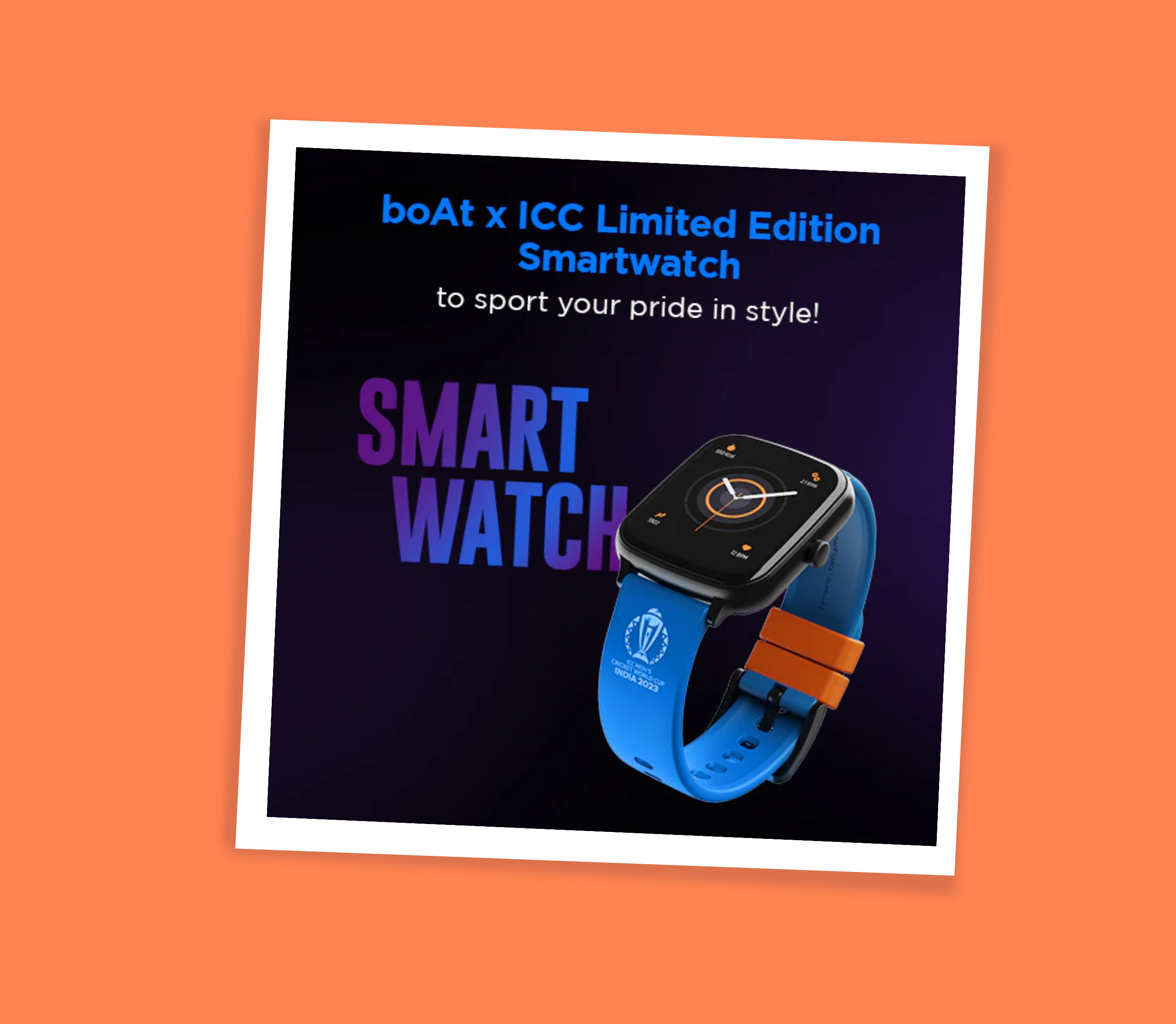
During the Cricket World Cup, boAt launched a World Cup–themed edition watch.
It worked because:
- It showed up during a moment cricket fans truly cared about -> built recall and trust
- Fans shared it because it felt cool and personal -> boosted reach
- It was a limited-edition product at the right time -> created FOMO and quick sales
That’s moment marketing done right: right time, right idea, right emotion.
How brands use moment marketing (with real examples)
Brands adapt to moments based on what fits their brand voice, audience, and product. Some go big with campaigns, some keep it simple with packaging or social posts, but the goal stays the same: stay relevant and memorable.
Let’s look at a few popular ways brands have done this really well.
- Limited-edition products and themed packaging
When a big show, movie, or cultural moment drops, some brands create products and packaging inspired by it. When Bridgerton released a new season, several brands jumped in creatively. Brands like Kimirica, Dove, Nykaa, and others launched Bridgerton-inspired packaging and limited-edition products. The designs, colors, and themes matched the vibe of the series This makes fans feel like they were owning a piece of the moment. The launch of Nykaa’s Bridgerton collection resulted in a significant and record-setting boost in sales.

Similarly, when Stranger Things dropped a new season, brands like KFC, Burger King, Kinder Joy, and Miniso introduced themed meal boxes, collectibles, and special products. These weren’t just products, they were experiences fans wanted to be part of.

- Timely and relatable social media content
Some brands use the moments just by showing up at the right time with the right content. Whether it's creating posts, visuals, or captions linked to trending shows, events, or pop culture moments, brands insert themselves into conversations audiences are already having. This makes the content feel less like advertising and more like participation.

The most iconic moment marketing move in history
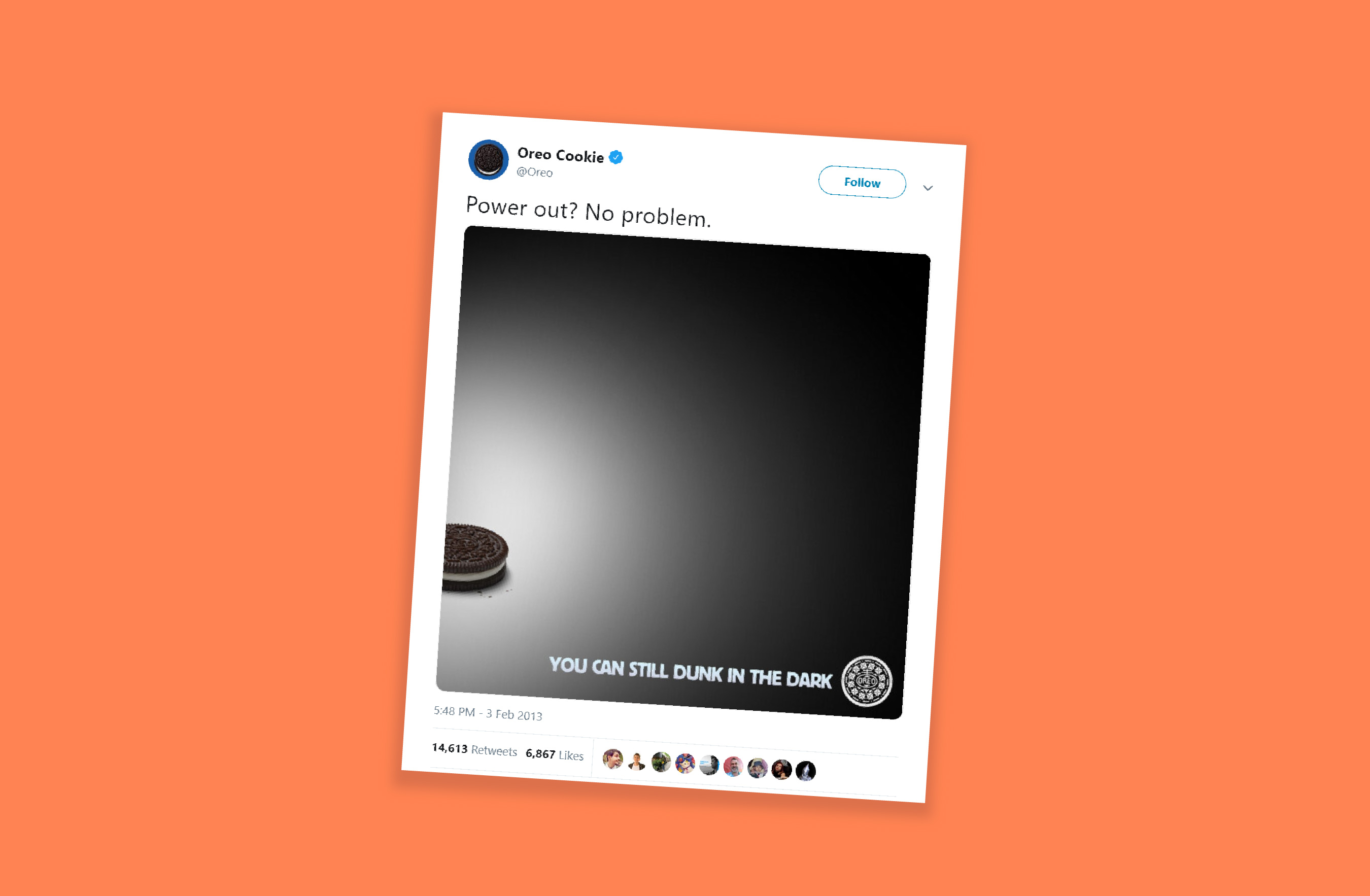
If there’s one example that perfectly defines moment marketing, it’s Oreo’s “Dunk in the Dark” moment during the 2013 Super Bowl.
During the Super Bowl, the stadium suddenly went dark due to a power outage. The game paused. The audience waited. And within minutes, Oreo’s social team posted a simple Tweet: “You can still dunk in the dark.” That’s it. No long copy. Just perfect timing and creativity.
The Tweet went viral, won multiple marketing awards, and is still talked about today as the most iconic moment marketing example ever.
- The Impact: The post received nearly 15,000 retweets and over 20,000 likes on Facebook within the first night.
- Social Growth: Oreo's Twitter following increased by 8,000, and Instagram followers grew from 2,000 to over 36,000 (reaching over 85,000 later that month).
- Media Value: The campaign generated approximately USD 525 million in earned media impressions.
How to use moment marketing the right way
Moment marketing works best when three things come together:
Perfect timing -> smart idea -> creative execution
- Get the timing right
- Keep an eye on what’s trending using tools like Google Trends, X, and social media analytics
- Watch for events, shows, matches, and cultural moments
- React fast, because the earlier you join the moment, the more attention you get
- Build a smart idea
- Your idea should connect naturally to the trend
- It should match your brand’s tone and personality
- Don’t force-fit yourself into a moment that doesn’t fit
- Add creative execution
- Use crisp copy
- Keep visuals clean and simple
- Add a witty or relatable twist
- Make people smile and think
For example, during the Women’s Premier League, Amul used the cricket buzz at the right time and created a fun post in their usual style. Even though they sell dairy products, the content felt natural and not forced. It worked because the timing was right, the idea made sense, and the creativity matched their brand.

Common mistakes in moment marketing
- Jumping on every trend without checking if it fits your brand
- Posting too late and missing the moment
- Using sensitive, political, or emotional topics for humor
- Being unclear or confusing in your message
- Trying to fit into trends that don’t suit your brand style
In moment marketing, you’re not chasing attention—you’re meeting your audience where their attention already is. When brands show up at the right moment, people notice and remember.
Stay tuned for the March edition of The Social Playbook.
Topic Participants
Stephania Beverly
Sticky Posts
The Social Playbook - February edition: Why moment marketing works (and how brands use it)
Imagine the final season of your favorite series is about to drop. Your entire feed is talking about it. Trailers everywhere. Fan theories. Hype at 100%. Now your go-to burger place launches a limited-edition meal box themed around that series—customThe Social Playbook - January edition: Getting started with content creation
Social media isn’t just about posting some random content. It’s about why certain content works, how brands stand out, and what makes people pause mid-scroll. The Social Playbook is a monthly community series where we break all of that down. Through real
Recent Topics
Assessment Answered - Automation (Related List)
Hello everyone, We have linked a candidate assessment to our job posting. When someone applies, they are required to answer all the assessment questions. However, some candidates submit their applications without completing the questions. In such cases,Paid Support Plans with Automated Billing
We (like many others, I'm sure) are designing or have paid support plans. Our design involves a given number of support hours in each plan. Here are my questions: 1) Are there any plans to add time-based plans in the Zoho Desk Support Plans feature? TheCan't change form's original name in URL
Hi all, I have been duplicating + editing forms for jobs regarding the same department to maintain formatting + styling. The issue I've not run into is because I've duplicated it from an existing form, the URL doesn't seem to want to update with the newCalendar report with order options and more quick view templates
I think many of us regularly work with calendar-style reports. It would be great to be able to customize the quick view with new templates and have options to sort the entries for each day of the calendar by different criteria. I think this is an interestingShared Views
Hello, is there a way to prevent an agent from changing a shared table view? I have no issues with agents being able to create and customize their own view, but when I create a view and share it to my team -- the expectation is that they are viewing itUsing Zoho answer bot across departments (help center articles from another department)
Hi Zoho Community, I’ve run into a major issue and hope someone here has experience with this setup. We currently have a Help Center in the department A where all of our knowledge base articles are maintained. However, we would like to use a Zoho AnswerZoho Desk Partners with Microsoft's M365 Copilot for seamless customer service experiences
Hello Zoho Desk users, We are happy to announce that Zoho Desk has partnered with Microsoft's M365 to empower customer service teams with enhanced capabilities and seamless experiences for agents. Microsoft announced their partnership during their keynoteThe Social Wall: January 2026
Hello everyone, We’re back with the first edition of The Social Wall of 2026. There’s a lot planned for the year ahead, and we’re starting with a few useful features and improvements released in January to help you get started. Create a GBP in SocialPipeline: Copying rulesets from one data source to another
When creating and editing data pipelines, it would be really helpful to be able to copy the ruleset from one data source and 'paste' it to another. This would save time and reduce manual mistakes.Doubt about maximum email reach
Good morning, greetings. This is Bramdon García from EDULABS S.A.S ESP, located in Colombia. I'm writing to inquire about the possibility of sending an email to 35,000 people simultaneously. Our company has a Zoho account, but we'd like to know if there'sZoho calendar not working in browser
Hello, I am new to Zoho. I have two accounts for two separate businesses. In one of them, calendar loads in a browser no problem. However, if I use this account (sairfeetmusic.co.uk) calendar does not load. I also cannot add it to my Thunderbird LighteningAuthentication Failure when adding POP3 accounts
Hi everyone, I am a new user currently migrating from Gmail to Zoho Mail. I decided to make the switch following Google's decision to discontinue POP3 fetching. I previously used Gmail as my primary mail hub, and Zoho seems like the perfect alternativeTrident Application Folder
Hi, How to choose installation folder for Trident, by default it gets installed in C drive. How to change drive?Email disappeared to specific contact
Good afternoon, this morning I emailed somebody. This email isn’t showing up in my sent folder. They sent me a response which I clicked on and it disappeared immediately. Why could this be?Create an Eye-Catching Announcement Widget for Your Help Center
Hello Everyone! In this week’s edition, let’s explore how to keep your customers updated with exciting news in the Help Center. See how ZylkerMobile wowed their customers by bringing updates right to their portal. ZylkerMobile, the renowned brand forEnable Free External Collaboration on Notecards in Zoho Notebook
Hi Zoho Notebook Team, I would like to suggest a feature enhancement regarding external collaboration in Zoho Notebook. Currently, we can share notes with external users, and they are able to view the content without any issue. However, when these externalUpdating records through Zoho Sheets View doesn't update timeline or trigger workflow rules
I have noticed that when i update a series of record with the zoho sheets view (see here http://d.pr/i/ahnR) it doesn't update timeline history or trigger workflow rules. I am using it in the Deals module. Looking forward for some more info. DenisHow do I change the account bank charges are charged to?
I want bank charges charged to my Credit Card Fees account. Is there a way to do this?Mail Search should allow grouping by conversation like Gmail.
Having switched from gmail I have found the search function hard to use. Mostly because mail is not grouped by conversation in search. If I search for a word when looking for a conversation had with someone then sometimes 10 emails will come up from theAbility to CC on a mass email
Ability to CC someone on a mass email.Updation of Old Browsers Versions for Zoho CRM
We have upgraded the default browser version for CRM to facilitate features like widgets and scripts that are often implemented aside from advanced functionalities for various business requirements. The latest version is aimed to provide better performanceProject-Based Inventory Consumption and Proforma Invoice in Zoho ERP
While working with customers across different industries, we have identified a few functional questions and gaps that commonly arise—especially for project-based and service-oriented businesses. Many organizations, such as those in shipping, construction,Zoho Desk domain Mapping not Working Showing CNAME Error
I have created the subdomain and created the Cname as well as its instracted on the Zoho website but when i try add the domain on help desk its showing error msg : Make sure you've mapped the CNAME entry and linked it to desk.cs.zohohost.com.au on yourFounders using Zoho — are you leveraging Zoho Campaigns + Zoho Social for thought leadership… or just sending emails?
I’ve noticed something interesting in the Zoho ecosystem. Many founders use Zoho Campaigns and Zoho Social for basic marketing—newsletters, scheduled posts, and announcements. But very few are using these tools strategically to: • Position themselvesI have the item field and Quantity field in the sub form , on the submit of the form if the quantity is grater than inventory means show alert on submit validation only for item type goods ,
I have the item field and Quantity field in the sub form , on the submit of the form if the quantity is grater than inventory means show alert on submit validation . Stock Check Validation only for item type goods , not for item type service . For theIMAP stopped working after enabling 2 factor authentication
IMAP stopped working after enabling 2 factor authentication. Is there any solution for this?Rename Service Report
Some of our customers are requesting the name of the service report PDF to be in a specific format, for example, instead of REP-001.PDF some are requesting to include their name like customername.pdf. is that possible?Outgoing emails rejected due to SpamCop RBL listing (IP 136.143.188.12)
Hi All, I am writing to report a deliverability issue affecting outgoing emails from my Zoho Mail account. Recently, several messages sent from my domain (example.com) to external recipients have been rejected with the following error message (redactedShare Record Ownership in Zoho Recruit
We’re introducing User Fields in Zoho Recruit designed to make collaboration easier when multiple team members need to work on the same record. With User Fields, you can extend record ownership beyond a single user and enable smoother teamwork acrossRecherche d'un développeur
Bonjour, j'ai un projet de SAAS sur une base de zoho créator et zoho CRM et je recherche un développeur qualifié français pour créer l'application créator (fonctionnel et graphique) et les workflow et blueprint de CRMDisplay actual mileage on an invoice
My users are creating expenses in Zoho expense. For example, they expense 10 miles and get paid 7 dollars (10 miles * IRS rate of .70). If I look at the expenses in Zoho Books, it does show them at 10 miles at .70 cent When I add these expense to an invoiceCustomer Parent Account or Sub-Customer Account
Some of clients as they have 50 to 300 branches, they required separate account statement with outlet name and number; which means we have to open new account for each branch individually. However, the main issue is that, when they make a payment, theyCloning a Pick List
I have an existing Pick List in my Contacts that I want to drop into my Leads. Is there a way to copy or clone the field with it's accompanying Pick List? Thanks for your time.How do I link my invoice to an estimate?
There has been instances where I have created estimates, however, invoices for the same estimate were created independently. The status of these estimates hasn't converted to 'invoiced'.I wish to upload 40000 Resumes in Zoho Recruit Database. Can I do this in batch of 1000 Resumes ?
I would like to upload thousand or few hundred of resumes in Zoho Recruit in one go. Please let me know how can I do this Or migrate my 40000 resumes from previous ATS to Zoho Recruit.Zoho Writer for Proposals
Hi, one of the things we've struggled with since moving to Zoho ecosystem is our proposal software Qwilr does not integrate well. It surprises me Zoho doesn't have proposal software but given all the capabilities of Zoho Writer, I'm wonder if anyone isCustom Fonts in Zoho CRM Template Builder
Hi, I am currently creating a new template for our quotes using the Zoho CRM template builder. However, I noticed that there is no option to add custom fonts to the template builder. It would greatly enhance the flexibility and branding capabilities ifFoutmelding bij uitvoering/opslaan functie 'Left expression is of type TEXT and right expression is of type NUMBER'
Hoi! Ik heb een workflow (zie bijlage) die wordt getriggerd zodra de verwachte weekomzet van een bedrijf wordt aangepast naar een bedrag hoger dan 0. Op dat moment moet een functie (zie bijlage) gaan berekenen wat het benodigde kredietlimiet moet zijn.Hoe kun je Nederlandse loonstroken boek in Zoho Books?
Beste Community, Heeft er iemand een idee hoe je standaard loonstroken kunt inboeken in Zoho Books? Ik ben benieuwd hoe jullie dit doen en wat de mogelijkheden zijn.Unable to Filter Retail Sales Orders & Need Paid/Unpaid Filter – Zoho Books
Hi Zoho Team, Recently you introduced Retail – Standard and Retail – Premium templates for Sales Orders. However, in the Sales Order module we still cannot filter or segregate Retail Sales Orders separately from normal B2B sales orders. Because of this,Next Page