Advanced Analytics for Semrush
Advanced Analytics for Semrush enables you to analyze search-driven marketing in depth. This allows you to measure your online marketing performance by tracking the keyword performance metrics over any preferred time line. This empowers the marketers with deeper insights into keyword analysis. This also provides a detailed competitor analysis over domain authority and backlink volume.
Advanced Analytics for Semrush includes a
50+ prebuilt reports and dashboards
over your Semrush data. The Semrush Analytics workspace is
Ask Zia
trained and can answer your questions with appropriate reports within minutes.
General
1. What is Zoho Analytics?
Zoho Analytics is a business intelligence and analytics solution that helps you derive insights from your business data, through its powerful reporting and analytical capabilities. You can create dynamic and interactive reports and dashboards in minutes, with no IT help.
It offers the following important capabilities:
- Complete Online Business Intelligence and analytics service, accessible anytime, anywhere!
- Easy-to-adopt a spreadsheet-like interface with powerful drag-and-drop based reporting features for quick report creation.
- Visual analysis capability for in-depth analysis and to slice & dice your data.
-
Supports a wide range of reporting capabilities like
Dashboards
,
Charts
,
Pivot Views
,
Summary Views
, and simple
Tabular Views
.
-
Supports the
creation of KPI widget
s in dashboards to analyze performance.
-
Supports data
import from a variety of file formats
like Excel, JSON, HTML, and more. Also supports data import from
cloud storage
and
Web URLs
. Supports periodic scheduling of importing data.
-
Integrated with a suite of Zoho products such as
Zoho CRM
,
Zoho Desk
,
Zoho Projects
,
Zoho BugTracker,
Zoho Books
, and more.
-
Integrated with popular business applications like
Facebook Pages
,
Facebook Competitive Analytics
,
Twitter
,
Twitter Competitive Analytics
, and more.
- You can also integrate your own applications with Zoho Analytics using the Zoho Analytics API .
-
Integrated with Zapier
to power up importing from over 500+ apps.
- Blend and merge data from across different sources to create meaningful business reports.
- With an advanced formula engine, you can derive key business metrics from your data.
- Supports SQL -driven (Structured Query Language) querying for powerful report creation.
-
Real-time collaboration by
sharing data
and reports with your colleagues and friends, in either read or read-write modes.
-
Export and Print
reports in a variety of formats.
Notify reports via email
.
-
Publish reports for wider consumption.
Embed reports
within your websites, web applications and blogs.
- Highly secure as all users login only over HTTPS (SSL connection).
- All your data and reports are hosted in highly secure data centers. (Refer to Security and Privacy )
-
Supports
Logo Rebranding
.
2. Why Semrush Advanced Analytics?
It's a full-featured business intelligence (BI) and reporting tool that can slice and dice Semrush data, to create any report or dashboard you require.
-
Create your own reports and dashboard
s based on not only your Zoho SalesIQ data but also data from other data sources.
-
Blend Data
- Build cross-functional visualizations to extract end-to-end insights by combining data from a wide range of business applications.
-
Ask Zia
- Workspace is trained for Ask Zia, our intelligent assistant, which can answer your question immediately.
-
Share reports and dashboards
with your colleagues.
-
Set up Alerts
to get notifications on immediate changes in your key business metrics.
-
Schedule and email
your reports whenever you want.
-
Export your reports
as PDF, HTML, Excel, CSV and image files.
-
Embed your reports
on websites, blogs, etc.
3. Who can subscribe to the Zoho Analytics Semrush connector?
Users with paid accounts of Zoho Analytics or Zoho CRM Plus / Zoho One users can avail this connector. Users with the Administrator roles ( Account Administrator or Organization Administrators ) in Zoho Analytics can configure this connector.
In Semrush, users need Guru or Business plan to sync all supported modules. Users with Pro plan can sync only the non-historical modules such as Backlinks Competitors, Backlinks Overview, Backlinks Referring Domains, and Broad Match Keywords.
Pricing & Trial
1. How much does this connector cost?
Semrush Advanced Analytics is bundled free for all paid users of Zoho Analytics. The Zoho Analytics paid plans start at $25 per month . Click to learn more about Zoho Analytics pricing .
2. Do you provide trial evaluations for this connector?
Yes, we do provide a 15-day free trial for this connector. The trial for the Standard plan will be enabled from the date you set up the connector.
3. What do you mean by 'Users' in the (connector) pricing plan?
Anyone to whom you privately share your Workspace, tables (data), reports and dashboards, created in Zoho Analytics for collaboration is considered a 'User' in Zoho Analytics. A user is identified by their unique email address, with which their Zoho Analytics account was registered.
Suppose you subscribe to the Zoho Analytics Standard plan_you can privately share the data/reports in your account and collaborate with 4 other persons. Now your Zoho Analytics account is said to have 5 users (including yourself).
4. What do you mean by 'Rows'/'Records' and how is it calculated in the pricing plan?
In Zoho Analytics, a row or record is defined in the same context as in a database (or spreadsheet). In simple terms, a table consists of rows (records) and columns (fields). Each row in a table represents a set of related data and has the same structure.
For example, in a table for a Campaign, each row would represent a single record. The number of rows calculated for pricing is the sum of all rows/records stored across all your Workspace tables in your Zoho Analytics account.
Setup
1. How do I set up Semrush Advanced Analytics?
2. How long should I wait for my Semrush data to initially appear in Zoho Analytics?
Initial data import will take from a few minutes to a couple of hours depending on the volume of the data. You will receive an email notification once the import is complete. If you access the Workspace before the initial fetch, it will not display any data.
3. What modules and fields in Semrush will be synchronized in the Zoho Analytics Workspace?
You can synchronize the following data from Semrush into Zoho Analytics.
- Backlinks Competitors - Target, Domain Authority Score, Neighbour,Similarity, Common referring domains, Domains, and Backlinks
- Backlinks Overview - Target, Authority Score, Total, Domains, URLs, IPs, Class C IPs, Follows, No Follows, Sponsored, UGC, Texts,I mages, Forms, and Frames
- Backlinks Referring Domains - Target, Domain Authority Score, Domain, Backlinks, IP, Country, First Seen, Last Seen, First Seen Time, and Last Seen Time
- Broad Match Keywords - Phrase, Database, Keyword, CPC, Competition, Search Volume, Number of Results, and Trends
- Keyword Overview - Keyword, Database, Number of Results, CPC, Competition, Search Volume, Trends, and Month
- URL Organic Search Keywords - URL, Time, Keyword, Position, Previous Position, Change Position, CPC, Competition, Search Volume, Number of Results, Keyword Difficulty, Keyword Difficulty Level, Traffic (%), Traffic, Traffic Cost (%), Database, Trends, SERP Features by Position, SERP Features by Keyword, and Timestamp
- URL Paid Search Keywords - URL, Time, Number of Results, Keyword, CPC, Search Volume, Competition, Position, Traffic (%), Traffic Cost (%), Trends, Database, Traffic, and Timestamp
4. I got an email which said "Setup Process Failed'/'Synchronization Process Failed". What should I do?
The import/sync process of your Semrush can fail sometimes, due to a variety of reasons. Hence, you may receive such emails occasionally. The Zoho Analytics team will look into it immediately and get back to you, after taking the required corrective action.
Case 1: You'll receive the Setup Process Failed e mail when there's a failure during the initial fetch. In this case, we request that you:
- Open the Workspace in which you have set up the connector.
- Click the Data Sources button in the Explorer .
- On the Data Sources page that opens click the Retry Now link.
Case 2: : You'll receive the Synchronization Failed email if there's any failure during the data synchronization process between Semrush and Zoho Analytics, after the initial setup and importing of data. This might be a momentary failure due to internal issues. The import schedule will be suspended if there are five successive failures.
If the issue persists please write to support@zohoanalytics.com . We will look into it and help you resolve it
5. How frequently can I synchronize my data with Zoho Analytics?
If you're a Basic plan user of Zoho Analytics, you can synchronize your data once every day. If you're a user of the Standard plan or above, you can choose to synchronize your data at one of the intervals mentioned below.
- 3 Hours
- 6 Hours
- 12 Hours
- Everyday
6. Can I edit the Semrush connector Synchronization setting?
Yes, you can edit the Semrush connector synchronization setting if you're the administrator of the Semrush Analytics.
To do so,
- Open the corresponding Semrush Analytics Workspace in Zoho Analytics.
- Click Data Sources in the left panel. All the data sources of the workspace will be listed.
- Click Semrush . The Data Sources page for Semrush will open.
-
In the
Data Sources
page that opens, click the
Edit Setup
link.
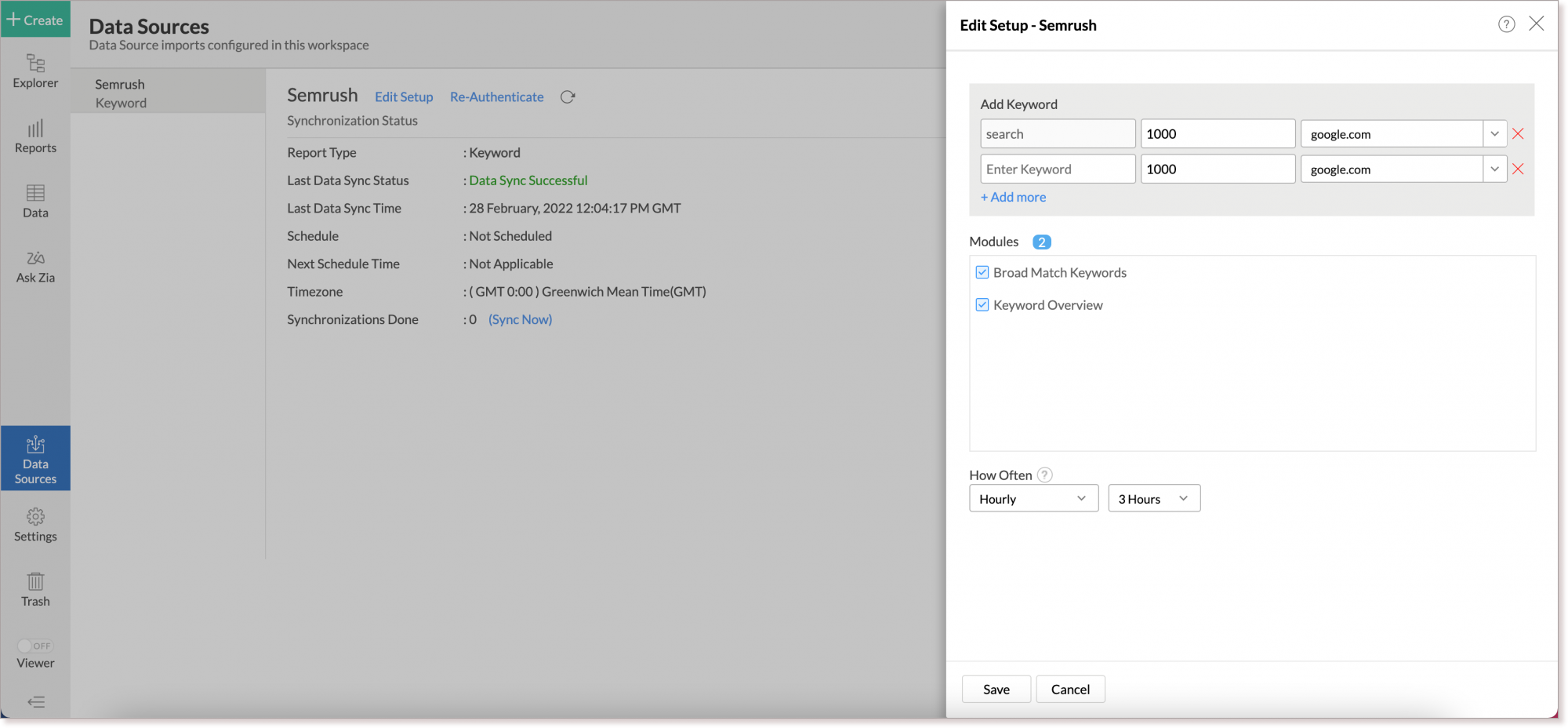
- The Edit Setup - Semrush dialog will open. Modify the settings as needed.
- Click Save . The synchronization setting will be modified and data will be synced in the next synchronization interval.
- You cannot edit an existing Keyword/URL/Backlink', however, you can remove it and add new.
- To add more Keyword/URL/Backlink, please configure a new setup or contact our support to get assistance.
7. Can I synchronize my Semrush data instantly?
Yes, you can synchronize your Semrush data instantly when needed.
To synchronize your data instantly:
- Open the Data Sources page.
-
Click
Sync Now
. Semrush data will then get instantly synchronized.
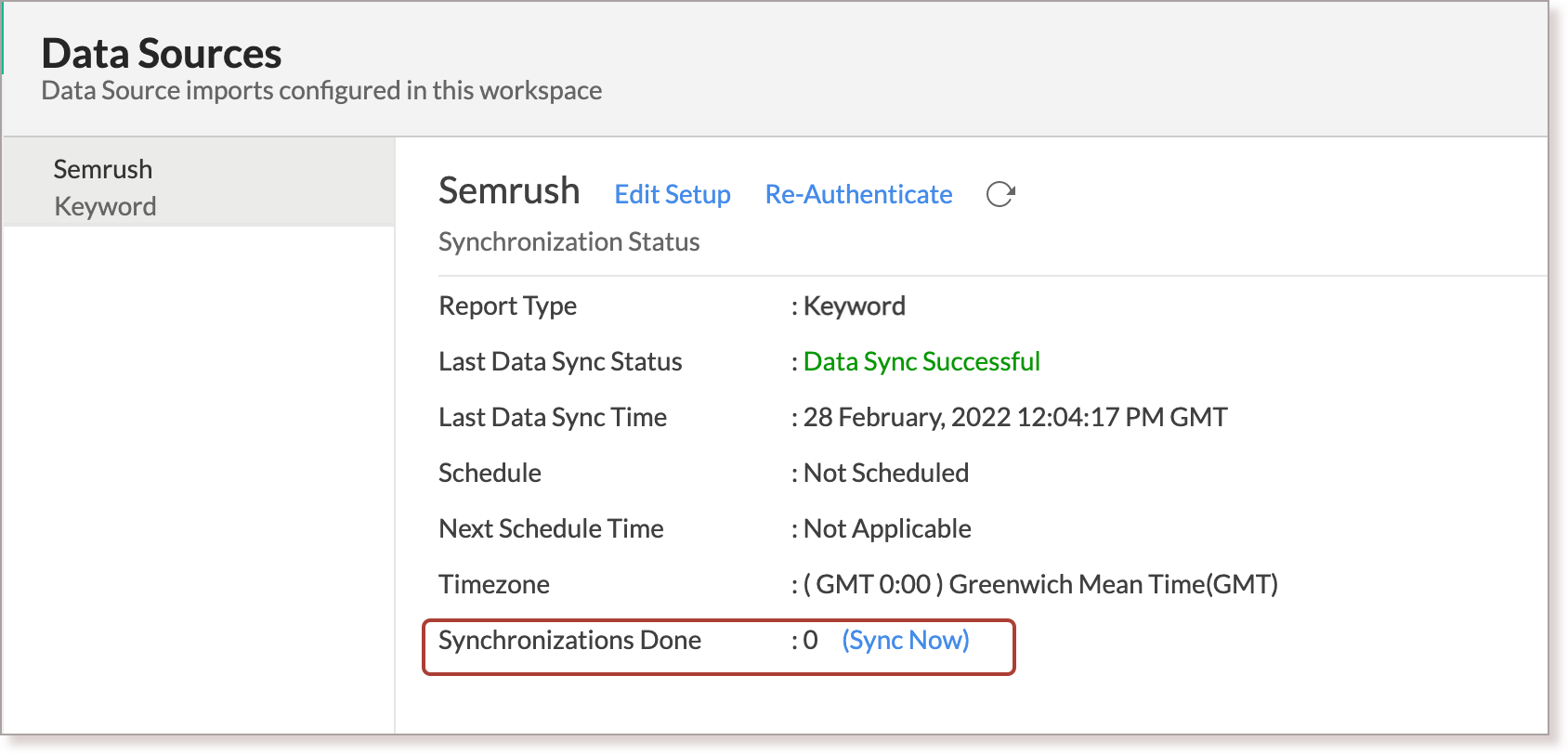
This option can be used up to five times between the scheduled intervals.
8. Can I set up Semrush Advanced Analytics in any other existing Workspace or in any other Advanced Analytics Workspace?
Yes, you can set up the Semrush Advanced Analytics in an existing Workspace or in any Advanced Analytics Workspace to analyze data together. You can do this by creating a new table by importing data.
9. Can I add/modify data in the Semrush Advanced Analytics data tables within Zoho Analytics?
No, you cannot add/modify data in the Semrush Advanced Analytics tables. Data from Semrush will automatically get synced into Zoho Analytics in the different tables. You cannot edit any of this data or add new data records from within Zoho Analytics.
However, you can add new tables and add/import data into that, to create reports
combining data
with Semrush data.
10 Can I add new columns to the Semrush data tables within Zoho Analytics?
No, you cannot add new columns. But, you can add Formula Column and Aggregate Formulas (i.e., calculated fields) to these tables to help you create powerful reports. Refer to
Adding Formulas
to learn more about this.
11. Can I add new data tables in this Workspace to create reports & dashboards?
Yes, you can add new data tables. Click New > New Table/Import Data to add a new table in the existing Semrush Advanced Analytics Workspace.
With this feature, you can import data from other sources or add them manually into your Workspace to analyze and create reports combining it with your Semrush data.
References:
-
Import Data from Files
-
Import data from Feeds
-
Import Data from Cloud Storages
-
Importing Data from Cloud Databases
-
Import Data from Local Databases
-
Import Data from popular Business Applications
- Import Data using the Zoho Analytics API
12. Can I transfer my Zoho Analytics connector to another admin account?
Yes, the Semrush connector in your account, can be transferred to another Administrator in the Organization.
An Account Administrator can transfer the connector by transferring the account to an Organization Administrator. An Organization Administrator can transfer the connector setup to another Administrator by unsubscribing from the Organization.
13. How do I re-authenticate my Semrush account in Zoho Analytics?
You can re-authenticate the setup by following the steps below.
- Open the Data Sources page.
-
Click the
Re-authenticate.
The
Re-Authenticate Semrush
dialog will open.
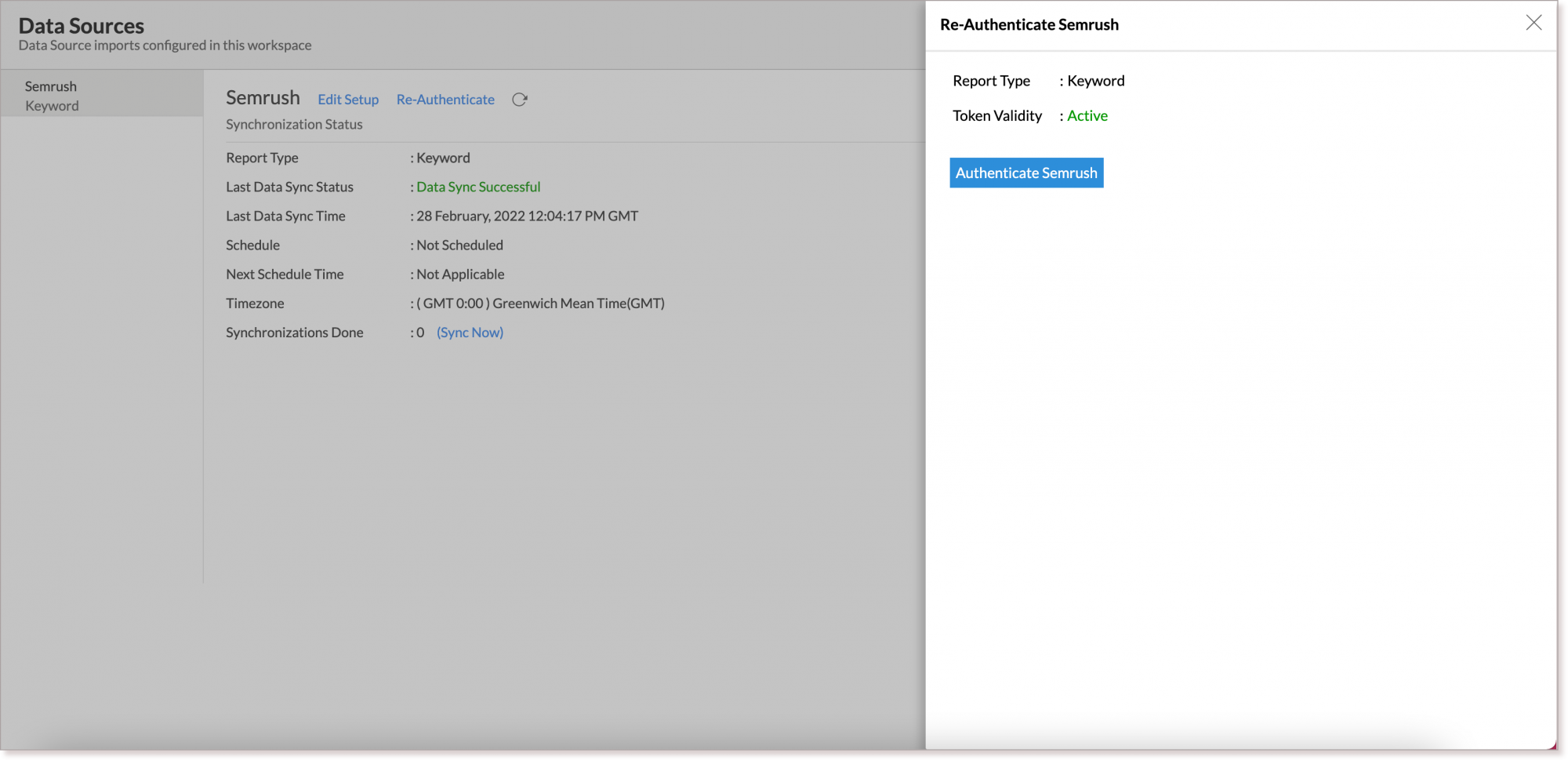
- Click the Re-authenticate Semrush button. You will be prompted to provide credentials.
- Enter your credentials and re-authenticate your account.
14. How can I remove the integration?
You can remove the connector from the Data Sources page.
- Open the Data Sources page .
- Hover the mouse over Semrush. A Settings icon will appear.
-
Click the
Settings
icon, then select
Remove Data Source
.
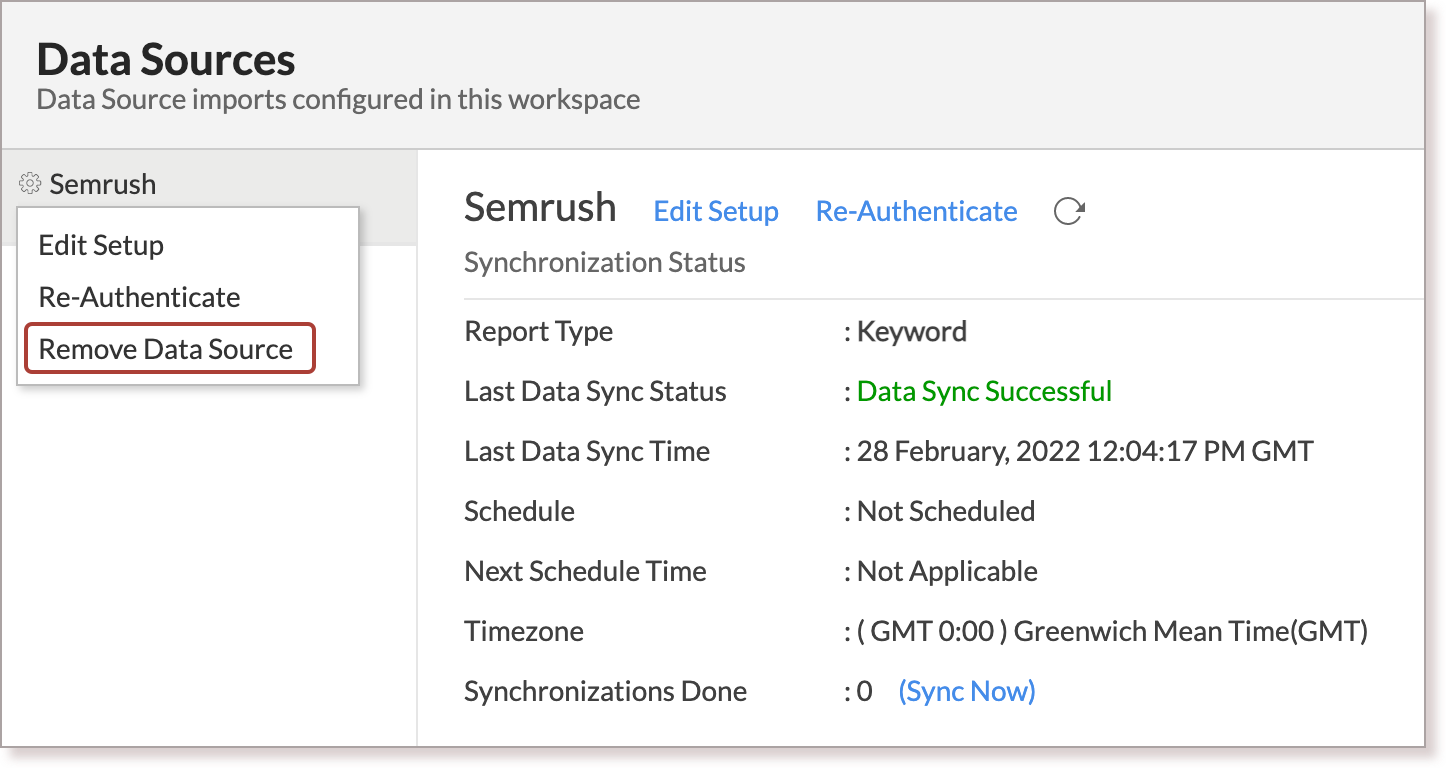
- The data synchronization from Semrush into this Workspace will be removed. However, you'll still be able to access this workspace with existing data.
Reporting Features
1. What modules and fields on Semrush can I create reports on?
Zoho Analytics will synchronize a set of modules and fields from Semrush, over which you can create reports. To get the detailed list of Fields and Modules, refer to this question .
2. How do I create my own reports with this connector?
3. Can I create reports using the columns from different modules?
Yes, you can create reports using columns from different tables. Each Semrush module is a table in Zoho Analytics. And all these tables are linked to each other by default. You can create reports by simply dragging and dropping the required columns into the reports designer.
4. What are the report types supported by Zoho Analytics?
Zoho Analytics supports a wide variety of reports.
-
Charts
- Pie
- Bubble
- Packed Bubble
- Bubble Pie
- Bar
- Stacked Bar
- Histogram
- Butterfly
- Line
- Smooth Line
- Scatter
- Combination
- Geo Map Chart
- Area
- Stacked Area
- Web
- Funnel
- Doughnut
- Word Cloud
- Table View
- Pivot tables (Matrix Views)
- Summary view
- Tabular view
-
KPI Widgets
- Single Numeric Widget
- Dial Chart Widget
- Bullet Chart Widget
- Dashboards (multiple reports arranged on the same page)
5. What are the default reports & dashboards created by Zoho Analytics, upon setting up this connector?
When you setup/configure the Semrush Connector, 50+ default reports and dashboards are automatically created. These hand-picked reports will be useful in analyzing your help data effectively.
6. What is Ask Zia? How can I create reports using Zia?
Zia is Zoho's Intelligent Assistant.
Ask Zia
understands your questions asked in plain English and gets you powerful insights as answers in the form of attractive and relevant visualizations.
You can simply Ask Zia questions and it will interpret these questions, fetches data from the relevant tables, and generates the most appropriate reports immediately.
7. What are Formulas in Zoho Analytics?
Formulas, as the name indicates, are calculations that help you derive key business metrics that can be used for reporting and analysis. Zoho Analytics provides a powerful formula engine to create any type of calculations required, to enable creating any required reports. Refer to
Adding Formulas
in Zoho Analytics to learn more.
8. What are the default formulas that get added by Zoho Analytics upon setting up this connector?
The default formulas added by Zoho Analytics are listed below. You can view these formulas by opening the corresponding table and selecting Add > Edit Formulas from the toolbar.
The following are the default formulas in the Backlinks Referring Domains table.
| Formula Name | Formula Type | Formula | Description |
| First Seen Time | Formula Column | from_unixtime ( "First Seen" ) | This gets the first seen date of the backlink. |
| Last Seen Time | Formula Column | from_unixtime ( "Last Seen" ) | This gets the last seen date of the backlink. |
The following are the default formulas in the URL Organic Search Keywords table.
| Formula Name | Formula Type | Formula | Description | |
| Time | Formula Column | from_unixtime ( "Timestamp" ) | This gets the time when a keyword is associated with a url | |
| Change Position | Formula Column | "Position"-"Previous Position" | This tracks the change in position the domain gets with a particular keyword. | |
| Keyword Difficulty Level | Formula Column | if ( "Keyword Difficulty" > 0 and "Keyword Difficulty" < 15 , ' Very Easy' , if( "Keyword Difficulty" > 14 and "Keyword Difficulty" < 30 ,' Easy ', if ( "Keyword Difficulty" > 29 and "Keyword Difficulty" < 50 , ' Possible ', if( "Keyword Difficulty" > 49 and "Keyword Difficulty" < 70 , ' Difficult ', if ( "Keyword Difficulty" > 70 and "Keyword Difficulty" < 85 ,' Hard ', if( "Keyword Difficulty" > 85 and "Keyword Difficulty" < 101 , 'Very Hard','Not Mentioned ')))))) | This categories the data based on the keyword difficulty level. | |
| CPC Rank | Aggregate Formula | rank(sum( "URL Organic Search Keywords"."CPC" )) | This gets the ranking based on cost per click. | |
| Traffic Rank | Aggregate Formula | rank(sum( "URL Organic Search Keywords"."Traffic" )) | This gets the ranking based on traffic. | |
| Number of Results Rank | Aggregate Formula | rank(sum( "URL Organic Search Keywords"."Number of Results" )) | This gets the ranking based on number of results. | |
| Search Volume Rank | Aggregate Formula | rank(sum( "URL Organic Search Keywords"."Search Volume" )) | This gets the ranking based on search volume. | |
| Competition Rank | Aggregate Formula | rank(sum( "URL Organic Search Keywords"."Competition" )) |
|
The following are the default formulas in the URL Paid Search Keywords table.
| Formula Name | Formula Type | Formula | Description | |
| Time | Formula Column | from_unixtime ( "Timestamp" ) | ||
| CPC Rank | Aggregate Formula | rank(sum( "URL Paid Search Keywords"."CPC" )) | This gets the ranking based on cost per click. | |
| Traffic Rank | Aggregate Formula | rank(sum( "URL Paid Search Keywords"."Traffic" )) | This gets the ranking based on traffic. | |
| Number of Results Rank | Aggregate Formula | rank(sum( "URL Paid Search Keywords"."Number of Results" )) | This gets the ranking based on number of results. | |
| Search Volume Rank | Aggregate Formula | rank(sum( "URL Paid Search Keywords"."Search Volume" )) | This gets the ranking based on search volume. | |
| Competition Rank | Aggregate Formula | rank(sum( "URL Paid Search Keywords "."Competition" )) |
|
9. How do I create my own custom formulas in Zoho Analytics?
To learn how to create your own formulas, refer to
Adding Formulas
on Zoho Analytics help page.
10. Can I combine data from other sources with the data from Semrush to create reports and dashboards?
Yes, you can combine data from other sources with your Semrush data for analysis.
To do this, you need to add/import a new data table into the Semrush Advanced Analytics Workspace as explained in the previous question , and then define a look-up to join it with the table from Semrush.
To define a lookup relationship between two tables, it is essential that the tables have at least one column which is common between them. Follow the below steps to look up a column from Semrush along with the data from any other source.
- Open the corresponding table, right-click the column header and select Change to Lookup Column.
- In the Change to Lookup Column dialog that opens, select the column to look up.
- Click OK .
Click here to
learn more.
11. Can I join data from multiple tables to create reports?
Yes, you can join data from multiple tables to create reports. Refer to
Joining Tables
in Zoho Analytics for detailed help on this.
12. What are Query Tables?
Zoho Analytics allows you to derive required data by writing standard SQL SELECT Queries. This feature is called Query Tables. With Query Tables, you can also combine data from different tables and create reports from them. View this video demo to learn about how to
create Query Tables
in Zoho Analytics.
Cross-Functional Analytics with Popular Business Applications
1. What are the popular business applications that I can integrate this connector with?
You can integrate and perform cross-functional analytics with most business applications that Zoho Analytics integrates with. Refer here to see the list of
Business Analytics
supported in Zoho Analytics.
2. How can I analyze the data from other business applications along with Semrush Advanced Analytics?
To import data from business apps:
- Open the Workspace in which you have set up the connector.
- Click the Import Data button.
- In the Create New Table tab that opens, select the application that you wish to import.
- Provide the necessary authentications.
- Select the necessary modules and fields. Select the schedule import option.
- Click Create . Data from the selected application will be imported as a different set of tables in the Semrush Advanced Analytics workspace.
3. Will a lookup relationship between the related modules from Semrush and other third-party applications be created automatically?
A lookup relationship will not be created automatically between the Semrush modules and the modules of the application that you're trying to import. You'll have to manually link the tables using a lookup relationship.
To manually create a lookup relationship refer to the
Join Tables
section.
Users, Sharing, & Collaboration
1. How do I share the reports in Zoho Analytics with my colleagues?
You can easily share the reports that you create with other users. Refer to the
Sharing and Collaboration
help page for more details on this.
Once you privately share a report with your colleagues they will be able to access the reports as you do.
Refer here
to learn how to access reports.
2. What are the user roles available in Zoho Analytics?
Zoho Analytics offers four user roles—Account Administrator, Organization Administrators, Workspace Administrators, and User. Learn about the Zoho Analytics
Organization Model
and
User Roles
.
3. Why can't other users edit the reports that I've shared with them?
This is the expected behavior. Only when the shared users are set as a Workspace Administrators, they will be able to edit the reports.
If a normal user wants to edit the report, he/she will have to save the report with a new name using the
Save As
option toolbar. The User can then edit this report. To learn more about user roles
click here
.
4. Can I share the same report, to multiple users with different criteria associated, so that they see different data?
Yes, you can. Refer to the topic
Apply filter criteria
.
5. Can I export a report/dashboard?
Yes, you can export the report/dashboard in various file formats such as CSV, EXCEL, PDF, HTML, and as an Image. Click to
Learn more.
6. Can I print the reports & dashboards created in Zoho Analytics?
In order to print the report/dashboard, you first need to export it. You can export the report in various file formats such as CSV, EXCEL, PDF, HTML, and Image. Click to
know more
.
7. Can I email reports & dashboards created in Zoho Analytics in a scheduled manner?
If you are the Administrator in Zoho Analytics or a 'Workspace Administrator', you can schedule reports and dashboards to be emailed automatically. Refer to the email schedule section in this
help documentation
.
8. Can I embed/create a permalink for reports & dashboards created in Zoho Analytics?
Yes, you can embed/create a permalink for reports and dashboards. You can also create a slideshow of views. Refer to the
Publishing Options
section to learn how to do this.
9. Can I create Slideshow in Zoho Analytics?
Yes, you can create Slideshows. You can also embed slideshow. Refer to the
Creating Slideshow
section to learn how to do this.
Solutions
1. Does Zoho Analytics offer Embedded Analytics or rebranding?
Yes, Zoho Analytics supports various rebranding options such as
Portal rebranding/white labeling
and
Logo Rebranding
.
Help & Support
1. How do I get technical support on Zoho Analytics?
We offer 24x5 technical support (Monday to Friday). In case you need our assistance, email us your questions to support@zohoanalytics.com .
You can also reach out to us on our toll-free numbers -
United States:
+1-888-900-9646
United Kingdom:
+44-20-35647890
Australia:
+61-2-80662898
India:
+91-44-6965 6060
2. Can I have someone from Zoho do a demo for me?
Yes, certainly. Register for a demo on this page!