Intelligent character recognition by Zia Vision
Subject your physical data into your digital processes

Intelligent character recognition or ICR is an optical recognition technology that can recognize, capture, and digitize data available in any physical form using Artificial Intelligence.
In Zoho CRM, ICR is built as part of Zia Vision—the AI-powered image detection and validation tool.
In this document, you’d know about:

Why do you need ICR in CRM?
From business cards to product tags, registration forms to invoices, or proof of ID to shipping labels, your operations rely on printed data from a variety of physical media. Yet it's important that your agents keep pace with your business and not spend their valuable time and effort manually converting printed text into usable data.
- Let's say you're a busy sales rep and have met with a few high-value prospects at a customer conference and exchanged business cards. When you return to the office, you have to create a record for each business card you obtained, filling in details like the person's name, phone number, website, address, and so on.
- Or imagine a post-production workflow where a warehouse manager has to record information like product names, SKU numbers, dates of manufacture, and so on from product labels attached to packaged products and enter it all into Zoho CRM.
In both scenarios, the actual process of lead nurturing and stock management starts only after the data is uploaded into the system, but the agents had to spend most of their time importing the data into the system.
Thus, to help simplify record creation, enhance business productivity, and ease form fatigue, Zia Vision is optimized with the ICR functionality.
Choose the ICR technique that suits your business: Types of ICR in Zoho CRM
From working with predictive standard orientations like ID proofs to dynamically differing ones like business cards, your business works with a range of physical data forms and to suit and still accommodate different business needs, ICR in Zoho CRM is equipped with two types of extraction methods:
- Template-driven
- Zero-shot field prompting
Template-driven extraction
Template-driven extraction is an extraction method where you train Zia with a few samples
- It requires you to upload sample images of the data in the same orientations (Same template with different data values, for Zia to understand)
- Manually localize values from the uploaded image and associate to the CRM fields from the chosen layout/ module.
By doing so, Zia will know where in the image to fetch the values from and which CRM field to associate them with in selected layout.
For example:
One-click insurance
Insurance businesses often involve time-consuming processes. To streamline them, Coverly—a tech-savvy insurance provider—came up with one-click insurance requests, whereby customers submit a government-authorized IDs to create instant policies. Using ICR, insurance agents working on these requests can use these images to create new records in just a few simple steps.
Completing vendor background checks
Zylker is an online education platform that enables domain experts to register and conduct courses on their platforms. To enhance their user experience, the platform onboards experts via webforms and requires only a few basic details, like their names and email addresses. With just these bits of information, Zylker can't authorize experts; however, by also requiring them to submit pictures of their IDs, Zylker can extract their data and enrich their records with the information they need.
Here's a look at how you can create a record from an image:
Training Zia for template-driven extraction
Like any discriminative AI model, Zia Vision requires preliminary training with image formats and orientations via sample images.
To train Zia
- Go to Setup > Zia > Vision > Intelligent Character Recognition.
- In the ICR page, click Create New Rule to create a training set for a module.
- In the Create New Rule page, do the following:
- Provide a rule name.
- Choose the desired module and the layout.
- From the type of extraction options, choose Template-driven. This will require you to train Zia with sample images before you extract data real time.
- In the Field to store the input image field, choose the desired field name to which you’d like to store your image you use for the extraction.
- Click Next. This will take you to the training interface named as Upload Image(s).
- In the Upload Image page, click Upload Image(s).
- In the following Upload Image for Extraction screen, add your image either by dragging and dropping it from your file manager or locating it by browsing.
- To browse for the file, click the Browse button and select the file from your device. Then click Extract.
- You'll arrive at Zia's training studio. Zia will recognize the characters in your image and mark all the valid characters as the region of interest using the bounding box.
- Zia recognizes every word in the image, including field names and field values.
- If what Zia recognizes is accurate, you can click on the box and associate it with the field name from the layout.
- If not, you can also drag the margins to cover the characters and associate them as a field's value.
- After you've associated the localized characters with fields, click Train.
- Click Save to save the rule.
Once you have trained Zia for the template-driven extraction, you can start creating and enriching records in that layout and module.
Accuracy for template-driven extraction type
Accuracy in text-to-digital transformation is based on training and consistent model usage. In addition to the training set you upload, Zia trains itself from the images you upload to create records.
To ensure acceptance and accuracy, please ensure you've met the following prerequisites:
- You've created ICR rules under Zia Vision.
- The uploaded image should have the same layout as the sample.
- The image should have a card-based orientation.
Here are the guidelines for image tagging and data extraction:
If your image complies with the pre-requisites and ICR guidelines mentioned above, Zia can give you a perfect match.
Zero-shot field prompting
Zero-shot field prompting is an advanced method of data extraction that requires no training whatsoever. You tell Zia which fields to look out for in the input image (field prompting) and Zia, by the virtue of its intelligence, will be able to identify and extract those data without requiring any human intervention.
How does it work?
You saw how in template-driven extraction method, you have to localize values from the images and train Zia to associate them to the CRM fields. In the field prompting method of extraction, Zia deploys its VLM-based model, to do that.
Here’s a quick snapshot on VLM:
Vision-Language Model (VLM)
A Vision-Language Model (VLM) is a multi-modal generative AI system that accepts images and text as inputs and produces text outputs such as descriptions, labels, or extracted fields.
Architecture Overview:
Architecture Overview:
A typical VLM integrates two core components:
- Vision Encoder - A neural network that converts an image into high-dimensional visual embeddings.
- Large Language Model (LLM) - A text-generation model that processes text tokens and produces outputs based on multi-modal context.
These components are connected using projection layer, so the LLM can interpret visual features as part of its input sequence.
The vision encoder converts the image into patch embeddings, while the LLM converts the prompt into text embeddings. These visual and textual embeddings are projected into a compatible space allowing the LLM to integrate visual context with the prompt. The LLM then performs standard next-token generation to produce outputs, guided by explicit instructions provided by the user.
In the case of Zero shot field prompting, you are choosing fields whose values you want to extract and associate to the CRM record.
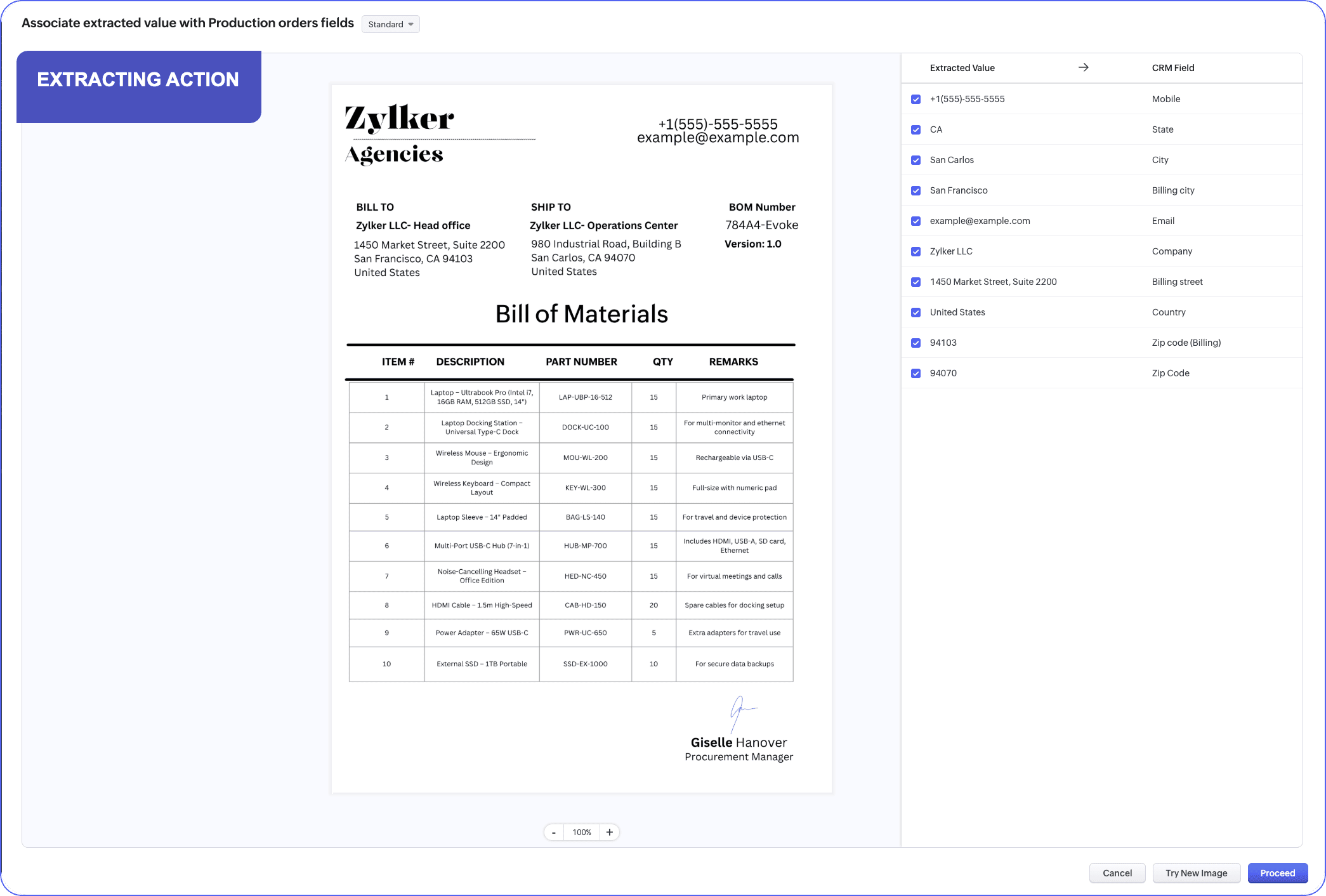
So, whenever there is an image uploaded in the given module, based on the fields chosen, Zia can instantly identify the relevant values from the input image, extract them as digital data, and renders outputs by associating the right values against those CRM fields.
As a user, all you have to do is to validate its accuracy and decide to retain the associations or not. If there are inconsistencies in the data (Say, you have O positive in your CRM picklist, and your customer wrote O+, Zia could identify them as a result, but still lets you fix them right after extraction.
This is called the Zero-shot field prompting: You choose the fields and you extract without any prior training as to where in the standard template can one find the values.
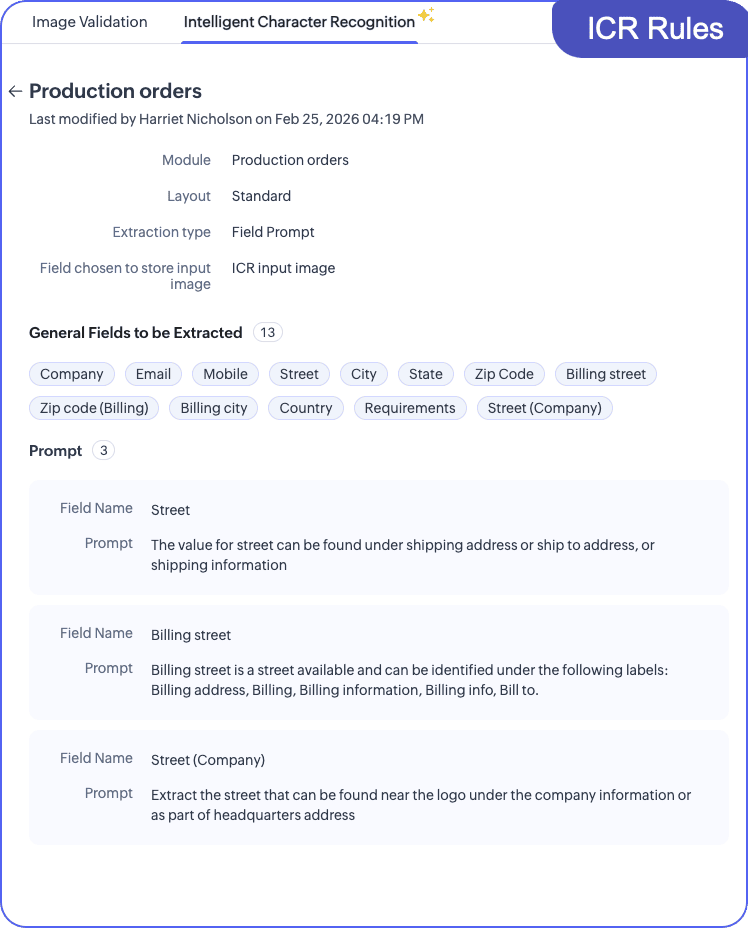
However, Field prompting, by itself derives accurate extraction, there may come scenarios when a business might need to extract images with similar values (example, billing address and shipping address) in which case you can choose to give advanced extraction prompts for Zia.
Advanced extraction prompts for Zia
Imagine you want to use an invoice to create production orders in your organization. An invoice is a document that contains a shipping address and billing address and choosing the field in the rule alone might sometimes be vague and can fetch wrong value extractions. So, in those cases, where multiple values or interpretations are possible for a field, you choose to add more details about the field as a prompt.
This prompt can be given natural human language and Zia can understand the specifics before commencing extraction.
Capabilities of ICR using VLM:
Extraction using the field prompting method can work with the following:
- Formats: JPG, JPEG, and PNG
- Orientations: Predictive geometric shapes and other custom shapes as in die-cut cards.
- Script types: Handwritten, legible printed texts, and dot printed texts.
- Field types: General fields ( Single -line and multi-line) and subform (tabulated) fields.
Configuring ICR rules for field prompts
To enable ICR capture for a module, you need to have the ICR rules in place.
To configure ICR rules for field prompting:
- Go to Setup > Zia > Vision > Intelligent Character Recognition.
- In the ICR page, click Create New Rule to create a training set for a module.
- In the Create New Rule page, do the following:
- Provide a rule name.
- Choose the desired module and layout.
- Choose the type of extraction as Field prompting.
- Select all the fields that you need to extract values for from the input image.
- Choose a field into which the input image shall be stored for future reference. Remember, this is optional.
- Click Proceed. Your ICR rule for that module and layout is ready. Now, your agents can start scanning images to digitize data.
The ICR rule for that module/layout is created.
If you wish to give more specific instruction about the chosen set of fields, so that the extraction is as accurate per your business standards, then do the following:
- Select the Advanced extraction prompts for Zia checkbox, a prompting space will be ensued beneath the chosen fields.
- In the Field name, select a field you want to specify instructions for, listed in the dropdown.
- In the Prompt field, type in your preferences.
- Click on Add Field button, to choose and provide instructions for as many fields you want to.
Say you want to extract the country field from your record. During configuration, you’d have chosen the field country in your rule. By choosing the advanced extraction prompt for Zia, you can instruct Zia to
- Expand the country names, when acronyms were used in the import file.
Example: United States of America, even if the import file carries USA. - Retain a specific structure.
Example: Some people refer to the USA as USA, U.S.A., US, America, or North America. The prompt can be designed to render United States of America, even if either of the above formats are used as the country.
Click here to learn how to create records using ICR.
Extracting fields in a table and storing in a Subform of a record
If a record is a form, then subforms are sub-section(s) of a record form, that stores data as tables. Much like a record, a subform also has fields, field types, and functions which you can use to store data in a systematic way. Learn more about Subforms in Zoho CRM
In addition to extracting general field values, Zia ICR can also extract data from files in tabulated forms. Imagine an invoice: It has texts like Ship to/ Bill to addresses, Mobile numbers, tables, and more. Similarly, a school application form can have handwritten values stored as lines or as tables. All these data, irrespective of their representation, are important for a business, which if extracted in one shot, a lot of time and efforts are saved. This is where, subform extraction plays a vital role.
To choose fields for subform extraction,
- Head to your ICR configuration.
- Under the Subform fields to be extracted section, click Add Subform.
- A new section will appear, wherein you can select the desired subform from the layout, choose fields, and add extraction instruction for each fields within a subform.
- Likewise, you can add more subforms if available in the layout.
Business scenarios
Reaching out to tradeshow prospects
One of the main benefits of attending tradeshows is attracting new leads, and one quick way to get acquainted is to exchange business cards. Using ICR, reps can quickly create lead records and start qualifying and nurturing them without spending time entering details into records manually.
Digitizing patient registrations
Patient registrations are still collected as hand-written forms in many hospitals. Although, they might have robust process automation, manually transferring this lengthy form-type data into your system and then to your process, is going to strain the state of flow. Using ICR, the front-desk executive can capture, upload, and create the patient record in an instant.
Turning student application forms into CRM records
Much like patient registrations, university applications are long, dense, and come filled in various types of data formats: Handwritten fields, tabulated values. Using ICR, these varied types of values in one form can be extracted, all at once.
Working with ICR
Creating records with images
- Navigate to the required module (for example, Leads).
- Click on the dropdown available next to Create Lead.
- Click Create from Image.
- From the layout dropdown choose the layout in which you want to create the record.
- Upload a maximum of three images from which you want to extract text.
- Click Yes, Proceed. Zia will start extracting the data, and once extraction is complete, it will associate the extracted values from the image with the CRM fields.
- Review the extracted values and confirm that:
- Text such as name, address, ID number, or product details is correctly recognized.
- Critical information (e.g., unit price or rate) is extracted accurately.
- In the General fields section, verify that each extracted value (for example, "Ethan Walker") is mapped to the correct CRM field (for example, "First Name"). If there are more than one extracted value for a CRM field, choose one from the dropdown.
- In the Subform section, review the mappings for line items or repeating values, and confirm the number of extracted rows (for example, 4 rows extracted). Ensure each subform column (e.g., "Product/Description," "Qty," "Rate," "Amount") is mapped correctly to CRM subform columns (e.g., Single Line 1, Single Line 2, etc.), and enable or disable mappings using the checkboxes.
- Use the Add button on the left panel if you want to include more images. Use the delete icon that appears on hover, to delete an image.
- Confirm that all mandatory CRM fields (as defined in your module layout) are either mapped to at least one extracted value or manually filled if extraction didn't find a value.
- After reviewing and adjusting the mappings:
- Click Proceed to create the record using the mapped values. If you want to abort the operation
- Click Cancel to discard the current extraction and mapping session.
- You'll be taken to the record form view, where the validation is applied. You can review, add, and modify the values as needed.

Note:
- In the General fields section, you can change the CRM field by selecting another target field from the dropdown if the extraction type is template-driven.
- Mandatory fields are not listed for value selection in this flow. Instead, after proceeding, you will be directed to the record's form view, where standard field validation applies, and the record cannot be created until mandatory fields are filled. If any mandatory field is missing or invalid, you may be prompted to correct it before proceeding.
- If you notice fields like "Unit Price" or values under "Rate" not being extracted correctly, they can be improved using prompts in the ICR rule configuration. Existing prompts defined in the rule are reused and pre-populated on this screen.
Update existing records
In addition to creating records from images, you can also enrich your existing records using images uploaded in your records.
To enrich existing records
- Edit the record you want to enrich, upload more images to the image storage field and save it.
- Click on the image you'd like to refer to for enrichment.
- Click on the Enrich from Image button in the top-right corner of the preview.
- Zia will have isolated characters in the image. Validate the enriched and existing data and click Proceed.
- After associating, you will be navigated to the Edit record page, with the enriched fields highlighted for quick reference.
- Click Save to record the new changes.
In conclusion, ICR in Zoho CRM helps you achieve the following:
- Save time and effort.
- Improve agility and productivity.
- Take care of the operational logistics so that agents can focus on processes.
- Alleviate fatigue caused by constant gaze shifting between data sources and screens.
When to use what: A guide to choose between the extraction type
Although ICR offers two types of extraction, using the right one for the right activity, will bring efficiency to the process.
Use template-driven extraction:
- If your data source always comes in a standard and constant format.Once trained on their standard structure, Zia will be able to churn the rest of the incoming records with higher accuracy.
- If you need to extract images as well as characters from the source image.
Use extraction using field prompting:
- If the format and orientation of your source image keeps differing for each uploads.
- If your source image has a range of script formats including hand-written notes.
- If you have many impromptu extraction needs.
Limits and limitations: A summary
Limits:
- Allowed import image formats: JPEG, JPG, PNG
Limitations of template-driven extraction method:
- As part of its ICR training extraction methods, Zia can recognize human faces, but not products, objects, or animals.
- Template-driven extraction works only with images in a card-type orientation.
- Values extracted from images can only be associated with fields in the specified layout.
- It's not currently possible to train tables in the sample file to associate with a record's subform.
Limitations of Zero shot field prompting:
- The current Zero shot field prompting is not equipped to capture images.
- If you are enriching an existing record with an import file, the subform values in the import file will only add to the existing line items and will not replace the existing table values.
Points to remember
- You must create ICR rules to start creating records.
- At any point, you can edit, update, or delete the rule.
- For accurate association, in the case of template-driven extraction method, we recommend that you encompass the entire area containing your target characters without cutting corners.
- You can zoom the image in and out for legibility in association.
- Clear instruction, with examples with help Zia identify and associate right values accurately.
- If the import image has a field in a table that you want to extract, it should be selected in the Subform configuration. If, by chance, there is a field inside a table in the import file and you have that very field as part of general fields, ICR will not extract. Only Table to Subform extraction is possible.