Configuring Fields: Datapoints
When creating custom datapoints or datapoint templates, users must configure several fields that control how data is processed, and stored. This document provides a detailed explanation of each field and guidance on how to configure them based on the selected datapoint type.
Datapoint Type
Choose between Realtime Datapoint or Scheduled KPI Datapoint based on your requirements.
Realtime Datapoint: values are processed and stored as data is received.
Scheduled KPI Datapoint: values processed and stored at defined intervals.
Fields common to Realtime Datapoints and Scheduled KPI Datapoints
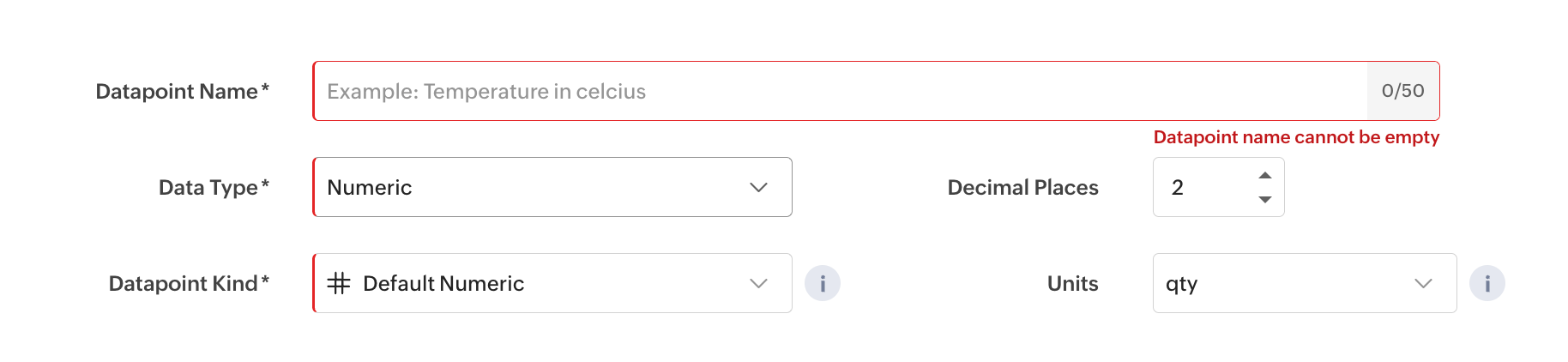
The following fields are common to both Realtime Datapoints and Scheduled KPI Datapoints. These fields define the basic properties of a datapoint, such as its name, data type, and unit of measurement, and must be configured regardless of the selected datapoint type.
Field Name | Field Description | Examples |
Datapoint Name | A unique, user-defined label used to identify the datapoint across the system. | Room Temperature, Engine RPM. |
Data Type | Defines the type of data the datapoint stores. | Numeric indicates that the datapoint holds numerical values. |
Decimal Places | Specifies how many decimal places are shown when displaying numeric values. Displayed values are rounded for readability, while the system stores the full precision of the received data. | If set to 3, a value is displayed as 23.457 but stored internally as 23.45678. |
Datapoint Kind | Classifies the datapoint and provides context for the type of data it represents. | Level, Battery Percentage, Cost, Count. |
Units | Indicates the unit of measurement associated with the datapoint, based on the selected datapoint kind. | Celsius for temperature-related datapoints. |
Datapoint Status | Controls whether the datapoint is active. | On: The datapoint processes incoming messages and stores the resulting data. Off: The datapoint is inactive and does not process or store any data. |
Fields Specific to Realtime Datapoints
The following fields and options are specific to Realtime Datapoints and control how incoming device data is parsed and processed in real time.
Field / Option | Field Description | Examples |
Parsing Key | Specifies the key used to extract the datapoint value from the incoming device data payload. | temp_c |
Ignore negative values storage for the configured parsing key | When enabled, the system ignores and does not store values that are less than zero for the configured parsing key. | When enabled, if the parsing key value is -5, the datapoint is not updated. If the value is 25, it is stored normally. |
Computation | Enables the use of an expression to calculate/manipulate the received value before storing it into the datapoint. Note: Only computed values are stored for this datapoint. To retain the raw values, create a separate datapoint. | A temperature value received in Celsius can be converted to Fahrenheit using a computation expression, and the resulting Fahrenheit value is stored in the datapoint. |
Ignore negative values storage from the expression | When enabled, negative values are still used during expression evaluation, but the final computed result is not stored if it is negative. | When enabled, If the expression uses an input value of -5 and evaluates to -12, the result is discarded. If the expression evaluates to 18, the value is stored. |
Expression Handling Mode | Controls how the system evaluates expressions when one or more input values are missing. Strict Evaluation: The expression is skipped if any required value or operand is missing and no value is stored. Flexible Evaluation: The expression is evaluated even if some values or operands are missing. Missing values are treated as 0. If the evaluation results in an invalid value, the result is not stored. If the evaluation produces a valid numeric value, it is stored. | Strict Evaluation Example: In the expression, energy + standby_power. If standby_power is missing, the expression is not evaluated and no value is stored for the datapoint. Flexible Evaluation Example: 1. Consider the expression, energy / runtime. If runtime value is missing, it is treated as 0. The expression results in infinity or an invalid value. In this case, the computed value is not stored. 2. Consider the expression, energy + standby_power. If standby_power is missing, it is treated as 0. The expression is still evaluated, and the resulting value is stored if it is a valid number. |
Expression Builder | Enables defining expressions or formulas to calculate values of derived datapoints. |
Fields Specific to Scheduled KPI Datapoint
Scheduled KPI Datapoints are used to compute and store derived values at defined time intervals based on existing datapoints or expressions. The following fields and options are specific to Scheduled KPI Datapoints and control how aggregated data is parsed and stored.
Field / Option | Field Description | Examples |
Execute Interval | Defines when the KPI datapoint is executed and its value calculated. Periodic: Executes the KPI datapoint at fixed intervals, where the interval is defined in hours or days. Set Active Period: The KPI datapoint is executed only during the defined active period and follows the configured execution interval. Days of the Week: Specifies the days on which the KPI datapoint needs to be. Time Range: Defines the time window during which the KPI datapoint is allowed to execute on the selected days. | Periodic Example: If the execution interval is set to 1 Hour and the start date and time is 01-Aug-2024, 09:00 AM, the KPI datapoint is first calculated at 9:00 AM on August 1st and then repeats every hour thereafter. Set Active Period Example: If the execution interval is set to 1 Hour and the active period is configured from 9:00 AM to 6:00 PM on Monday, Wednesday, and Friday, the KPI datapoint is calculated at 9:00 AM, 10:00 AM, 11:00 AM, and so on, until 6:00 PM, only on the selected days. |
Execute Interval | Schedule: Executes the KPI datapoint at specific days and times. Start Date of KPI: Specifies the date from which the KPI datapoint begins execution based on the configured schedule. Days of the Week: Specifies the days on which the KPI datapoint needs to be. Custom Time: Allows you to specify exact times at which the KPI datapoint should be executed on the selected days. End of Business Day: Executes the KPI datapoint once per selected day at the configured business closing time. Note: The business closing time is taken from the Business Hours configured in the application. If no business hours are defined, the KPI datapoint is executed at 12:00 AM at the end of the day. | Schedule Example: If the Start Date of KPI is set to 01-Aug-2024, Days of the Week are set to Monday, Wednesday, and Friday, and Custom Time is set to 10:00 AM and 4:00 PM, the KPI datapoint is executed at 10:00 AM and 4:00 PM on the selected days, starting from August 1, 2024. |
Ignore negative values storage from the expression | When enabled, negative values are still used during expression evaluation, but the final computed result is not stored if it is negative. | Example: If the expression uses an input value of -5 and evaluates to -12, the result is discarded. If the expression evaluates to 18, the value is stored. |
Expression Handling Mode | Controls how the system evaluates expressions when one or more input values are missing. Strict Evaluation: The expression is skipped if any required value or operand is missing and no value is stored. Flexible Evaluation: The expression is evaluated even if some values or operands are missing. Missing values are treated as 0. If the evaluation results in an invalid value, the result is not stored. If the evaluation produces a valid numeric value, it is stored. | Strict Evaluation Example: In the expression, energy + standby_power. If standby_power is missing, the expression is not evaluated and no value is stored for the datapoint. Flexible Evaluation Example: 1. Consider the expression, energy / runtime. If runtime value is missing, it is treated as 0. The expression results in infinity or an invalid value. In this case, the computed value is not stored. 2. Consider the expression, energy + standby_power. If standby_power is missing, it is treated as 0. The expression is still evaluated, and the resulting value is stored if it is a valid number. |
Expression Builder | Enables defining expressions or formulas to calculate values of derived datapoints. |
See Also