Checking Duplicate Records in Zoho CRM
When you have hundreds or thousands of records in your CRM, as your business grows, it becomes very difficult to check for duplicates. Zoho CRM helps you prevent duplicates before they're created using what we call "unique fields".
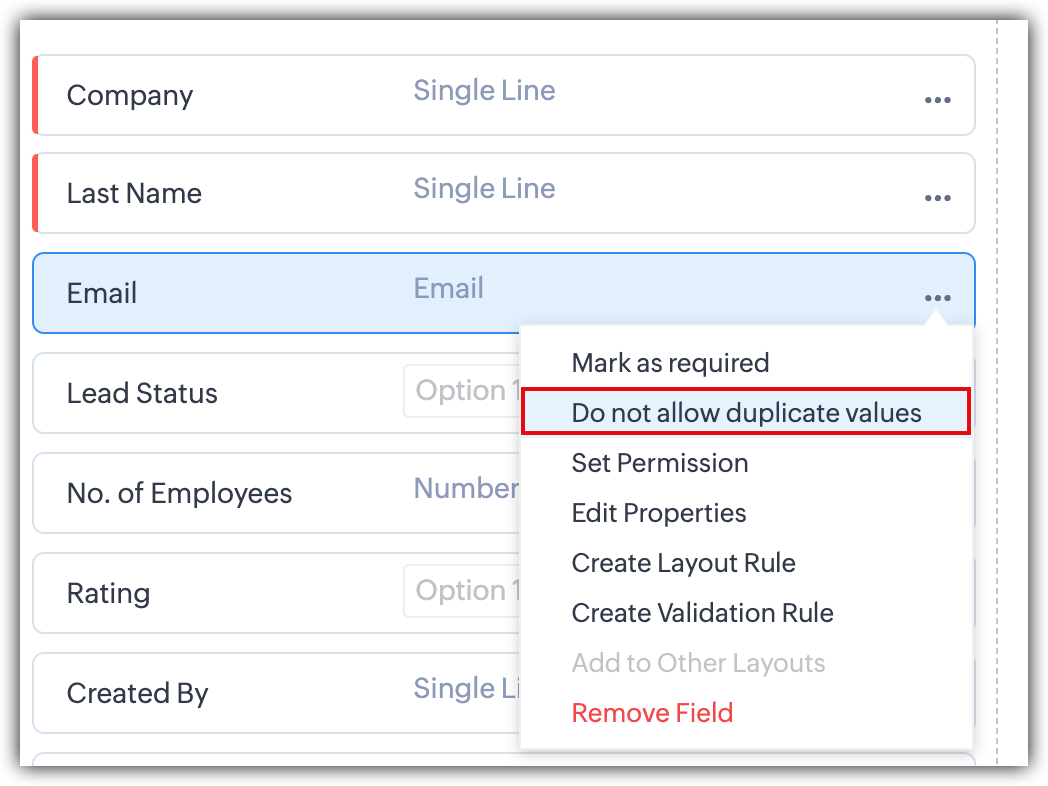
When you mark a field as unique, CRM will search existing records for duplicates based on that field's value. For example, assume that you have marked Email address as a unique field in the Leads module. When you try to create a lead with the same Email address as an existing lead, CRM will show a duplication alert. Clearly, two people cannot have the same email ID. Other examples include Social Security Numbers, Passport Numbers, Product codes, and the like. In Zoho CRM, you can mark a field from any module as "Unique". Once marked as "Unique", these fields play a vital role in managing duplicate records in Zoho CRM in various instances, including manual creation of records as well as records created via import, APIs, lead/sales order/quote conversion.
An administrator or a user with the Modules Customization profile permission can mark a field as unique. Once a field is marked as unique in a module, you will be able to arrest the creation of duplicate records in that module via manual creation, imports, integrations, web forms, and so on.
Even if you mark a field as unique, over time, if you find duplicate records in your account, you can use CRM's de-duplication tools to clean them up.
Mark a field as unique
Users with the Modules Customization permission in their profile can enable this feature. You must enable it separately for the Leads and Contacts modules. Once enabled, all users can use it, and they will be notified when adding a lead or contact whose email address already exists in CRM.
Click on this link to learn how to mark a field as unique and related notes: Mark a field as unique
Lead-to-Contact Duplicate Check
Let’s consider a scenario: you followed up with a lead named James and successfully converted him into a Contact, which is now recorded in the Contacts module. However, another sales representative on your team unknowingly adds the same lead, James, again. As a result, James is entered as a lead for a second time, creating a duplicate entry.
When you enable the Duplicate Check Preference, the CRM system will prevent the creation of duplicate leads. This feature ensures that all leads, whether converted into contacts or directly added to the contacts module, are checked for duplicates. Once enabled, any attempt to create a duplicate lead in the Leads module will trigger a check against existing leads and contacts. If a match is found, the CRM blocks the creation of the duplicate record.
There are two methods to enable the Duplication check for Leads:
- Using the Change Preference link:
When you've marked a field as Unique, click the three dots to find the Change Preference link. - Navigating through Setup:
1. Go to Setup > Customization > Modules and Fields > Leads
2. Click on More options > Duplicate Check Preference
Once you've opened the Duplicate Check Preference window using either of the methods described above,
To check for duplicates only within converted leads, check the box, select "Converted Leads" from the dropdown, and click Save.
To check for duplicates within the Contacts module, check the box, select "Contacts" from the dropdown, specify the unique field for comparison, and click Save. You can change or edit this setting later.
Usage
There are several ways to add a record in Zoho CRM, including filling out the lead or contact form, cloning a record, using web forms, importing records, utilizing the APIs, and more. Below are the various scenarios when the email duplication check is performed.
- Create and Edit records - You will get a notification message, and you will not be able to save the record if the email address already exists in another record.
- Related Lists - The email address duplication check will also be done when you create contacts in Related Lists.
- Lookup pop-up box - While creating leads/contacts from the lookup field's pop-up box, the email address duplication check will be performed.
- Web form - Only records pulled from web-to-lead/contact forms will have the email duplication check. If a duplicate is found, it will be automatically sent for approval, even if the Lead/Contact Approval option is disabled. Only after the records are reviewed and approved will they be added to the module. See Also: Approve Records
- Clone - When you clone a record, remove the unique fields' values on the Clone <record> page. Update them manually and save the record, for example, a contact's email address.
- Import - During import if the file record's value matches with existing CRM record's unique field value, the file record will be skipped. You can choose to skip or update the existing records for duplicate entries. When you choose to update existing records, either the unique field (email, phone) or the Lead/Contact ID can be chosen to identify and update existing records.
- Mobile App - While adding a record using the Zoho CRM Mobile App, a duplicate check will be performed, and you will not be able to create duplicate Leads or Contacts.
- - The following are the scenarios when the email address duplication check is enabled:
- insertRecord API Method - Using this API method, if you add a record with an email address that already exists in the CRM account, you will receive a notification message: <message>Record(s) already exists</message>. The record will not be added.
- updateRecord API Method - Using this API method, if you update the Email field in a record, the email address duplication check will be performed. If a similar email address already exists in the CRM account, then the record will not be updated. While updating multiple records, it will be skipped.
- convertLead API Method - When you convert a lead using this API method, the email address duplication check will be performed. If a similar email address already exists in the CRM account, then the record will not be converted.
- insertRecord API Method - Using this API method, if you add a record with an email address that already exists in the CRM account, you will receive a notification message: <message>Record(s) already exists</message>. The record will not be added.

- If the system-defined Email field is hidden, this feature will not be available.
Limitations
Email address duplication check will not be performed in the following scenarios:
- Updating or adding records using Zoho Sheet View.
- During Data Migration.
- Restoring records from the Recycle Bin.
- Synchronizing contacts using Zoho CRM Plug-in for Microsoft Outlook, Google Contacts Sync features.