Button
Buttons on landing pages help visitors take important actions such as signing up or making a purchase. These buttons guide users seamlessly through the landing page and help boost overall conversions. Well-crafted, effective buttons can also make your landing page goals clear and encourage users to take action.
Inserting a button
- Click on the Insert button on the top bar of your landing page builder to view the menu.
- In the menu, click on the Elements tab and choose the Button that you want to have inserted in your landing page.
- You can either choose the Button or the Button with icon to be inserted on your landing page. They will appear on your landing page as shown below
-
Button
-
Button with icon
Accessing button properties
Customizing landing page buttons enhances user engagement and conversion rates by making them more clear and visually appealing. Tailoring properties like size, color, and links ensures that the buttons are effective in making the users take action.
Button general properties
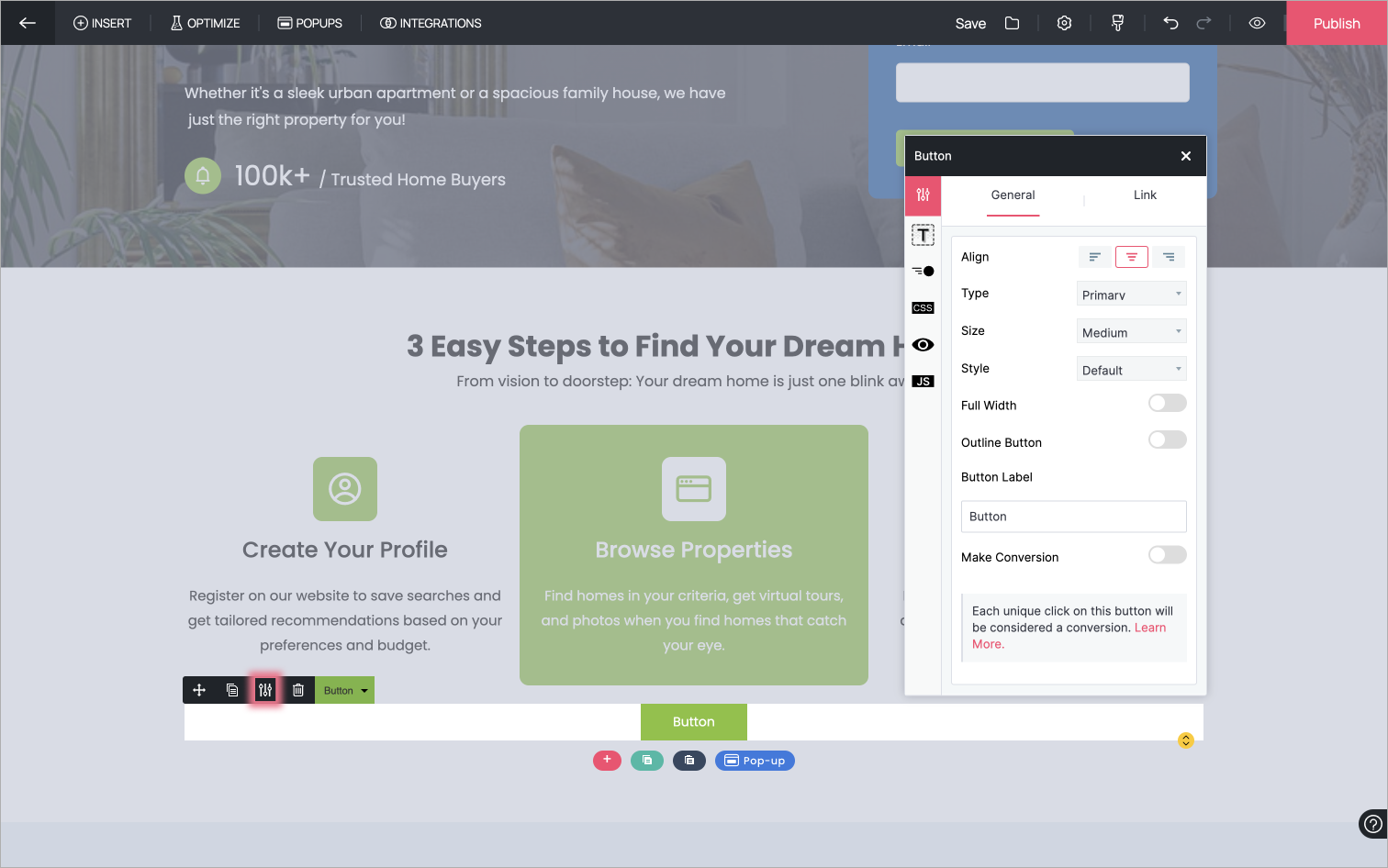
You can access the button properties by clicking on the properties icon next to the element name in case it is not visible already. In the General Properties tab, you can change the alignment, button type, size, style, and choose whether button should be full width or an outline button. Additionally you can enable the Make Conversion feature to ensure each unique click on this button is marked as a conversion.
Button link Properties
- In the Link Properties tab, you can add a link to your button. Visitors who click on this button will be redirected to the provided link.
- You can add a link to any landing page in your portal. Choose from the list of landing pages displayed to select the desired destination. You can also add an anchor and tool tip to help make the link more relevant. Visitors will now be redirected to the landing page when they click on the button in your landing page.
- You can add a link to any webpage. Users will be redirected to your webpage when they click on the button in your landing page.
- Using the anchor option, you can redirect users to any section in your landing page where you have added an anchor. The anchors created in your landing page will be displayed in the drop-down list next to Select Anchor.
Linking a Button to a Section on Your Landing Page
To direct visitors to a specific section of your landing page, you can use an anchor. For example, if you want to take visitors to a form at the bottom of the page, you can add an anchor to the heading above the form or any nearby text element.
Steps to Add an Anchor
- Select the text where you want to add the anchor.
- In the floating toolbar, click the Anchor option.
- Enter a name for the anchor and click Save.
Linking the Button to the Anchor
- Select the button element.
- Choose Anchor as the link type.
- Select the anchor you created from the list.
Now, when visitors click the button, they’ll be taken directly to the anchored section!
- To link an email address to your button, you can type in an email address here. You can also add extra details such as Cc, Bcc, Subject, and the message in the fields below. When users click on the button on your landing page, a new email composition window will open with all the details already filled in.
- If you want to link a phone number to your button, you can choose any phone number you like. When users click on the button on your landing page, their phone will open the dialer with the phone number already entered, ready to call.
- If you want to link a downloadable file to your button, you can upload the file of your choice here. When users click on the button on your landing page, the file will be downloaded automatically.
Whether it's prompting sign-ups, purchases, or downloads, tailored buttons ensure clarity and ease of use. Thus, creating and customizing landing page buttons is essential for maximizing user engagement and achieving desired business outcomes.