Generative AI services and Answer Bot feature currently supports multiple languages. For a detailed breakdown of the supported languages and associated features, refer to the
Zia master sheet in the overview article. We are actively working on expanding language support even further.
Customers expect swift, accurate, and personalized service. To meet these demands, companies are increasingly turning to Generative AI to enhance their customer service capabilities. Zia's analytical and AI capabilities can analyze a ticket and understand the context. Its generative abilities generate a response, summarize the ticket and thread conversation, perform intent and tone analysis, and extend assistance with drafting personalized empathetic responses. Overall, Zia is able to give service industries an opportunity to delight customers with faster delivery, accurate, and empathetic responses, making it a win-win situation for both.
Zoho Desk offers two GenAI services to perform the above mentioned activities. Businesses can enable either of the services depending on their business requirement.
- Zia (powered by open source language model Qwen)
- ChatGPT integration via an API key
- Azure OpenAI
Zia Powered by Open Source Language Models
Zia's generative AI abilities are powered by open source language model
Qwen.
The decision to host Open Source Language Model Zia in our own environment stems from the following observations:
- Privacy and security - Hosting in our own environment gives us an edge in maintaining data privacy and securing customers' data. Unlike OpenAI/ChatGPT, where the data goes out of Zoho's servers to generate responses, Zia ensures that all data stays within the Zoho ecosystem for Generative AI capabilities. This approach guarantees that customer data remains securely contained within Zoho's infrastructure, leveraging the Knowledge Base (KB) to analyze and generate suitable responses without compromising privacy or security.
- Secure data storage - Zia Powered by Open Source Language Models does not store customer data in its servers. However, it processes the data temporarily to generate responses, ensuring that the data remains secure and is not retained beyond the response generation process. Zia never trains on customer data; it trains exclusively on the knowledge base articles to analyze and understand the context. Using its analytical abilities, it understands the ticket's context and summarizes a response that best suits the query.
- Compliance adherence - Zia, like all Zoho services, strictly adheres to GDPR guidelines. Zia Powered by Open Source Language Models is hosted on Zoho's servers within the data center corresponding to the customer's region, ensuring that data never leaves the Zoho ecosystem. Additionally, the model is not trained on customer data, further safeguarding privacy and compliance.
Compliance with GDPR
Zoho Desk is compliant with GDPR guidelines. Desk, as a data processor, does not record or process your information without consent. However, as an administrator, you can moderate your preferences and choose to stop processing data, raise data delete requests, and restrict data access through API from our GDPR settings.
Learn more about how Zoho Desk handles GDPR compliance.ChatGPT as a generative AI service
Zia uses ChatGPT's OpenAI models to analyze the ticket content, understand the context, and generate response. The response can be generated from the KB as well as the open domain depending on the configuration. We recommend reading
OpenAIs terms and conditions to understand their working and data processing before setting up the integration.
Azure OpenAI as a generative AI service
Businesses can use Azure-hosted OpenAI models for Zoho Desk's generative AI capabilities. Organizations that manage their AI infrastructure on Microsoft Azure can integrate their Azure OpenAI deployment to generate ticket summaries, insights, writing assistance, and reply assistance in tickets.
Before configuring Azure OpenAI in Zoho Desk, following prerequisites must be set in the Azure account.
Prerequisites
To configure Azure OpenAI as a generative AI service, you must have:
- An active Azure subscription with access to Azure OpenAI Service
- An Azure OpenAI resource
- A deployed supported language model in your Azure OpenAI resource
- An API key generated for the Azure OpenAI resource
- The Azure OpenAI resource URL (endpoint)
- The deployment name of the deployed model
Supported models
The available models displayed during configuration depend on the models that are already deployed in your Azure OpenAI resource.
Note:
- Azure OpenAI resources, model deployments, and API keys must be created and managed in Azure OpenAI account, only then can they be used in Zoho Desk.
- The deployment name entered in Zoho Desk must match the deployment created in Azure OpenAI.
- Azure OpenAI usage is billed through Microsoft Azure OpenAI subscription according to their pricing plan.
- Zia actions in workflows are not supported with Azure OpenAI.
Enabling generative AI services
Admins who have the permission to access Zia can enable it for the entire organization by selecting the preferred service.
Generative AI can only be enabled at the organization level. The generative AI section is divided into three categories:
- Services - Zia, ChatGPT or Azure OpenAI
- Feature preference - Insight, Summary, Writing Assistance, Reply Assistance
- General preference - Model selection
Services
The admin can select either Zia or ChatGPT. They can switch services whenever they want, but only one service can be used at a time.
The table below highlights the key differences between the services
Feature | Zia | ChatGPT |
API key | Not needed. | Requires an API key from OpenAI. |
Response generation | Replies to tickets are generated based on the information available in the knowledge base. | Replies to ticket can be generated from both the knowledge base and/or open-domain depending on the configuration. |
Data privacy and security | All data processing and generation occur entirely on Zoho's servers within the designated data center. Trains exclusively on Knowledge Base articles and does not use ticket-related data, such as customer information or ticket content, to train the AI model. | Data is transmitted from Zoho's servers to ChatGPT for generating responses. ChatGPT functions as an integration and does not use the data for training. The data processing takes place in OpenAI's designated data centers. |
Pricing | No charges | Usage-based pricing through API tokens.
|
Zia
Zia is powered by Open Language Models that are fine tuned and run on Zoho's environment help businesses to deliver great support while maintaining privacy and security. Qwen (30B parameters) is the default LLM when choosing Zia generative AI service.
Note
- Qwen is supported only in US, IN, AU, EU, JP, and CA data centers.
ChatGPT
ChatGPT - GPT-4o is the default model, admins can choose from GPT-3.5 Turbo (0125), GPT-4o, GPT-4 Turbo, GPT-4o Mini, GPT-4.1 Mini, GPT-4.1, GPT-5.1, GPT-4o Mini, GPT-5.4 Mini, and GPT-5.4 based on their requirements, and view the respective pricing.
Azure OpenAI
Users who are already using Azure OpenAI as their LLM in their organization can connect the same Azure resource to power Zia’s generative AI features using their deployed model. GRPT-5.1, GPT-5.4 mini, and GPT-5.4 can be used as based on their requirements available options.
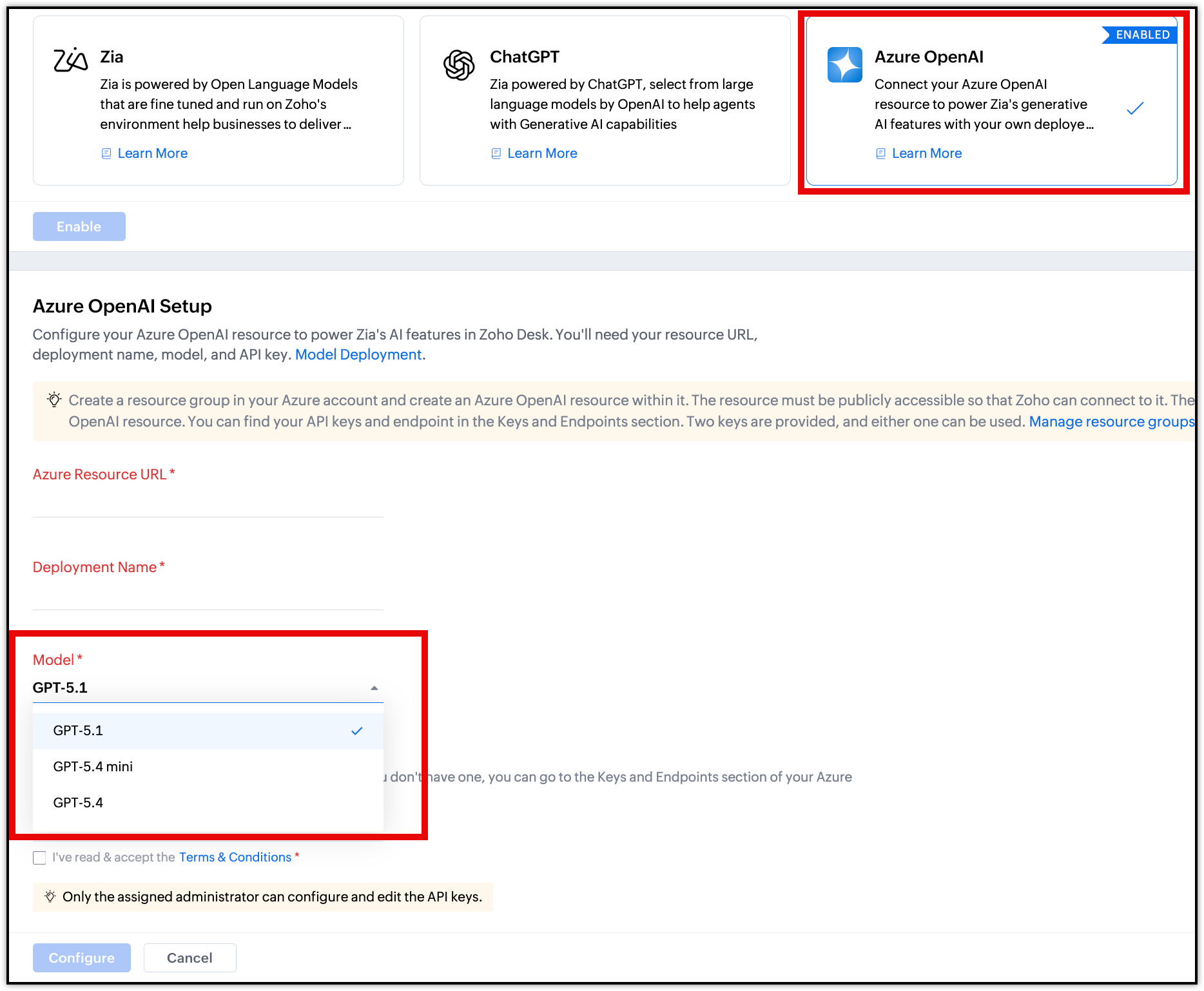
To enable a Generative AI service
- Navigate to Setup > Zia > Generative AI.
- Click Services.
- Select Zia and click Enable.
- Qwen will be opted by default model.
- Select ChatGPT and click Enable.
- Choose the ChatGPT model
- GPT-3.5 Turbo (0125)
- GPT-4o
- GPT-4 Turbo
- GPT-4o Mini
- GPT-4.1 Mini
- GPT-4.1
- GPT-5.1
- GPT-4o Mini
- GPT-5.4 Mini
- GPT-5.4
- Select Azure OpenAI and click Enable.
- Enter the following details:
- Resource URL: The endpoint URL of your Azure OpenAI resource.
- Deployment Name: The name of the model deployment created in Azure OpenAI.
- Model: Select one of the supported models available in your Azure OpenAI deployment.
- API Key: The API key generated for your Azure OpenAI resource.
- Read and accept the pricing notice.
- Click Configure to complete the integration.
Feature preferences
Generative AI services are configured at the organization level, while feature preferences can be managed independently for each department. The administrators can enable only the AI capabilities that are relevant to a department's workflows without affecting other departments.
For example, the Support department can use all generative AI features, while the Billing department can choose only ticket summaries and writing assistance.
The following features can be configured separately for each department:
- Insights ( (Sentiment, Tone, & Key Topics)
- Summary
- Writing Assistance
- Reply Assistance
While feature preferences can vary between departments, the AI model and service will remain common across the organization. For example, if Zia is selected as a GenAI service, then other services cannot be selected in other departments.
Note:
- Only one generative AI service can be active for the organization at a time. If the service is switched at any point, it will change across departments automatically.
- Feature preferences are configured independently for each department.
- Changes made to one department do not affect the feature configuration of other departments.
Generation preference
Generation preferences allow administrators to control how AI-generated content is produced for supported features. Instead of relying on the default behavior, admins can choose when summaries and insights should be generated for agents within each department.
Generation preferences are available for:
- Insights
- Summary
The user can select the generate preference from one of the following options:
- Generate on click: Content is generated only when an agent clicks the option. This gives support reps complete control over when AI-generated summaries or insights are created.
- Auto generate: Content is automatically generated each time an agent opens a ticket. Agents do not need to manually trigger the generation, ensuring that summaries and insights are readily available for every ticket.
- Dynamic: This is the default behavior. The user's actions determine how the AI feature works. Once an agent generates a summary or insights for a ticket, the same behavior is applied as they navigate to other tickets.
To configure feature preferences for a department
- Navigate to Setup > Zia > Generative AI.
- Click Feature Preferences.
- Select the required Department from the drop-down list.
- Enable or disable the required AI features.
- When enabling Insights or Summary.
- Click Configure.
- Select the preferred generation mode:
- Generate on click: Generates content on demand.
- Auto generate: Generates content automatically.
- Dynamic: Adapts based on previous usage.
DeepSeek as a generative AI service for China
Zia features in China data center are supported by DeepSeek integration as it is a widely used and legally compliant AI model in the country.
DeepSeek is optimized for Chinese language, offering more accurate and contextually relevant responses than ChatGPT for Chinese-language content. It also supports the
other languages that Zia currently supports, ensuring a consistent experience across features.
DeepSeek will operate on a Bring Your Own Key (BYOK) model, similar to ChatGPT. Users will require an account on the DeepSeek platform, add credits to their wallet, and generate an API key. This API key can then be integrated into Zoho Desk to activate Zia’s AI capabilities.
All existing Zia features in Zoho Desk will be supported for China DC, both native features such as Sentiment Analysis, Auto Tags, Anomaly, Field Predictions and Zia's AI capabilities such Zia Insights, Summary, Content Generation,Ticket to Article, Reply assistance etc. However, Answer Bot does not support Chinese language for now, but DeepSeek supports all other Zia supported languages.
Some Zia features like Insights, Summary, and Article Generation work independently of the Answer Bot and will normally function in all supported languages.
However, since Reply Assistance relies on the Answer Bot to fetch Knowledge Base articles, it will not provide article-based suggestions in Chinese. For example, if an agent in the China DC receives a ticket in Chinese, Zia can summarize and draft a response tone, but not suggest related KB articles. In English or other supported languages, Reply Assistance will continue to function as usual.
To enable DeepSeek service:
- Navigate to Setup > Zia > Generative AI
- In Generative AI page, enable DeepSeek.
Further read

 Permission Required

