View appointments (Calendar view)


1. In a nutshell
You can view the appointments on a calendar layout, which helps you visualize your schedule more effectively and manage time slots efficiently. Click on any appointment to view its summary, and from there, update both the appointment and payment statuses, ensuring a smooth and organized booking workflow.
2. Feature availability
- Super admins and admins can view all appointments
- Workspace admins and managers can view all appointments of their assigned workspaces
- Staff can only view their own appointments
3. View all appointments of any given day
You can select users to view all of their scheduled appointments for any specific day using the calendar view. This provides a quick snapshot of your daily bookings across selected users and workspaces.
Steps to view day appointments:
- Click the Calendar icon
at the top-right corner.
- Choose Day from the view options to select the date.
- Use the date picker at the top-center of the calendar to select the day you want to view.
- Click Manage Calendar at the top-right to select users whose appointments you want to view for any day.
- Click Apply to save changes.
- The appointments for the selected day and users will be displayed.
4. View appointments of the week
You can check all appointments scheduled for a week for selected users. This helps in efficiently planning and reviewing weekly schedules.
Steps to view weekly appointments:
- Click the Calendar icon at the top-right corner.
- Choose Week from the view options to switch to a weekly view.
- Use the date picker at the top-centre of the calendar to select the week you want to view.
- Click Manage Calendar and select users whose appointments you wish to view for the week.
- Click Apply to save changes.
- The calendar will now show appointments for those users across the selected week.
5. View appointments of the month
The month view provides a high-level overview of all appointments scheduled across the entire month of the selected users. This helps in identifying busy days, open slots, and planning ahead.
Steps to view monthly appointments:
Steps to view monthly appointments:
Click the Calendar icon at the top-right corner.
Choose Month from the view options to switch to a monthly view.
Use the date picker at the top-centre of the calendar to select the month you want to view.
Choose the user from the dropdown at the top right to view their monthly schedule.
The calendar displays a grid layout of the selected month showing appointments for the selected user.

6. Update appointment and payment status
To update appointment status
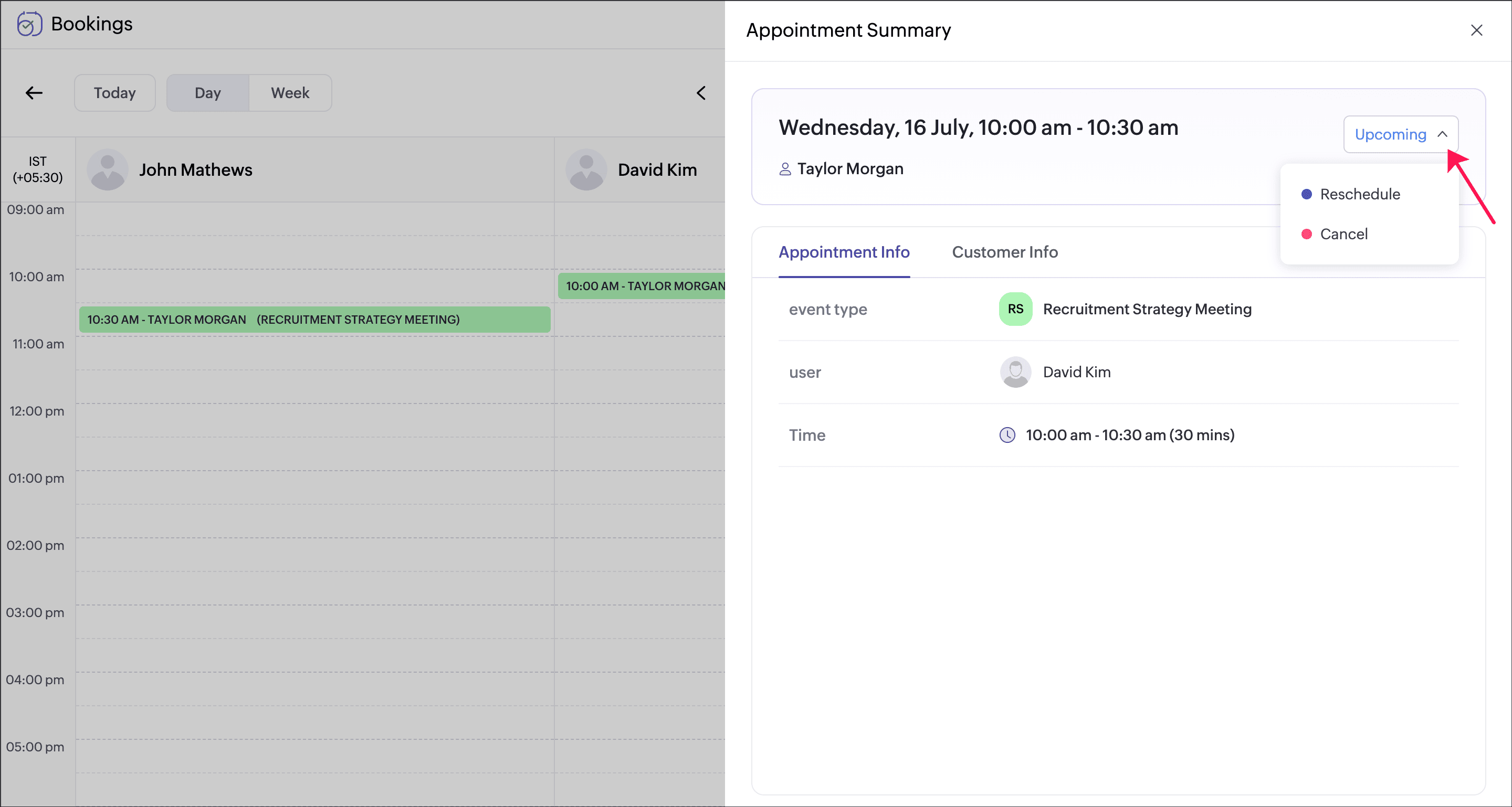
You can change the status of an appointment by clicking the required appointment, which shows its appointment summary. Next to the appointment details, you have the option to change the appointment status.
To update payment status
You can change the payment status of an appointment by clicking the required appointment to Pending, Due, Paid, Payment Failure, or In Progress which shows its appointment summary, then navigating to Customer Info > Payment tab.
7. Set calendar time interval
You can customize how time slots are displayed in the calendar using Calendar preferences. This setting splits the day into blocks in the calendar grid, helping you view and manage schedules at your preferred time interval.
Info: Calendar time interval applies to Day and Week views.
Steps to set calendar time interval
Steps to set calendar time interval
- Click Calendar Preferences icon
next to Manage Calendar on the right top.
- Choose the required time interval: 5, 10, 15, or 30 minutes. Click Save.
The calendar will now display time blocks for the day based on the selected time interval.
Example: If you choose 15 minutes, the calendar day is divided into 15-minute time slots (four blocks per hour), allowing more precise visualization of appointments.
8. Additional actions
- When you navigate away from the Calendar tab
and return, it will automatically display only the appointments for the current day of the logged-in user.
9. Related links
- Appointment and payment status